|
Subpage beetles:
Ground
beetles (Carabidae)
Leaf
beetles (Chrysomelidae)
Snout
beetles, weevils
Longhorn
beetles, similar to longhorn beetles
Rove
beetles (Staphylinidae)
Small
beetles
 Nederlands /
Dutch Nederlands /
Dutch
Ladybirds, ladybugs in the garden.
| Ladybirds (Coccinellidae). North American: ladybugs. Scientist increasingly prefer: lady(bird) beetles.
In the Netherlands there are sixty species. They are different in colour, size and
spot. Worldwide
5000 species. The Seven-spot ladybird is very common and therefore the best known.
From the joints of their legs, they release an orange-yellow liquid as a defense
with a
strong repellent smell (hemolymph
or insect bleed). It is
a little predator. Both the larva and the ladybird itself feed on
aphids and insects larvae. There are also species, which feed on
mildew and even scale insects.
In wintertime ladybirds hibernate, often in large groups
in sheltered places.
The eggs are laid on or under the leaves. The larval period lasts about
three weeks.
You the
ladybirds from
many other
beetles,
because
they have
the form of half
ball.
But there are also similar beetle species.
German: Marienkäfer
French: Coccinellidés, coccinelles, bêtes à bon Dieu
|
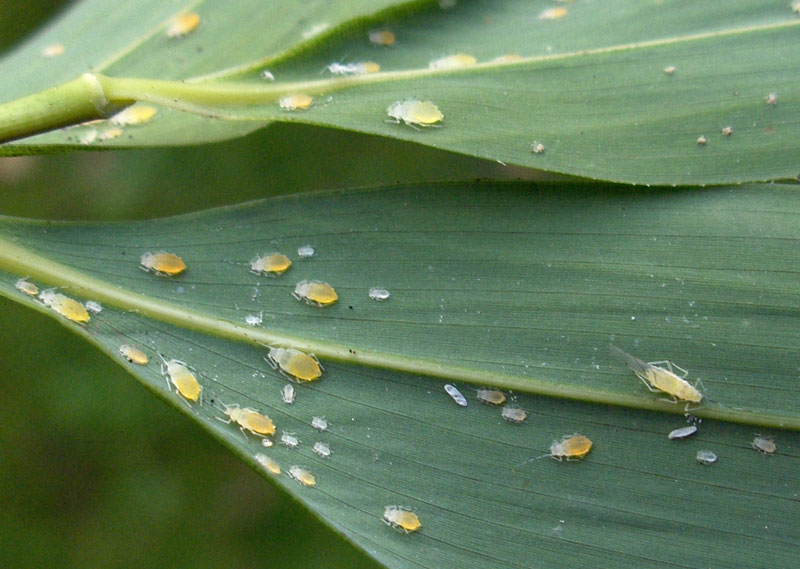
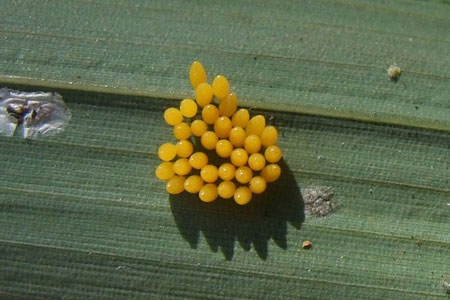 Ladybird eggs
Ladybird eggs are stuck in clusters
under leaves.
On this photo it is a bamboo leaf. I'm not sure what kind of
ladybird has layed this eggs. There were many Asian ladybirds. But a Seven-spot ladybird is also possible.
 It was a good spot, for there were many aphids on the bamboo
leaves.
It was a good spot, for there were many aphids on the bamboo
leaves.
|
Subfamily Chilocorinae.
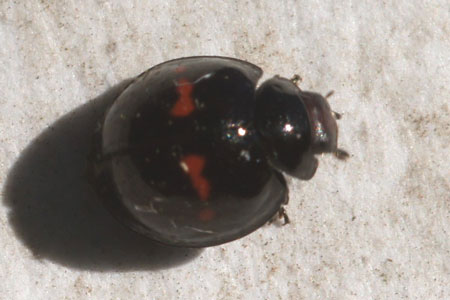 .. ..
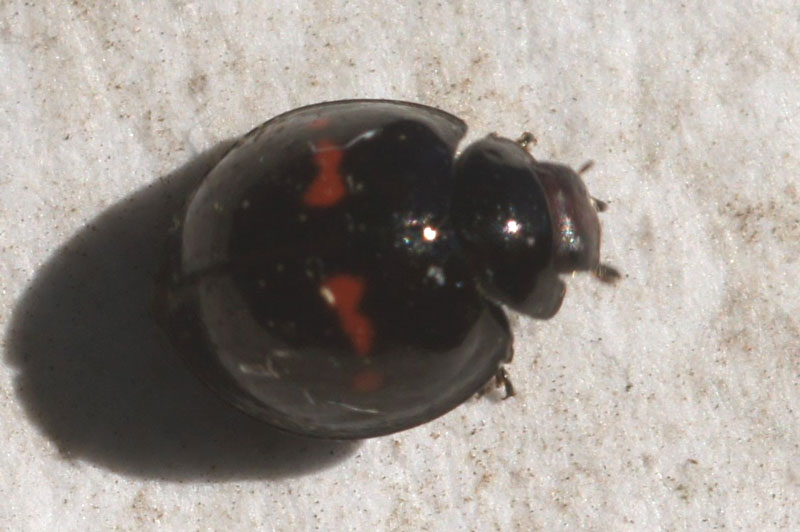
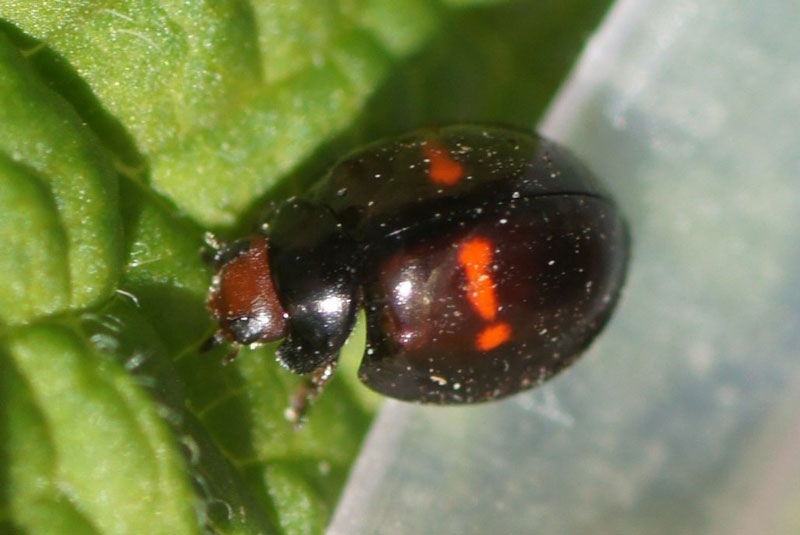
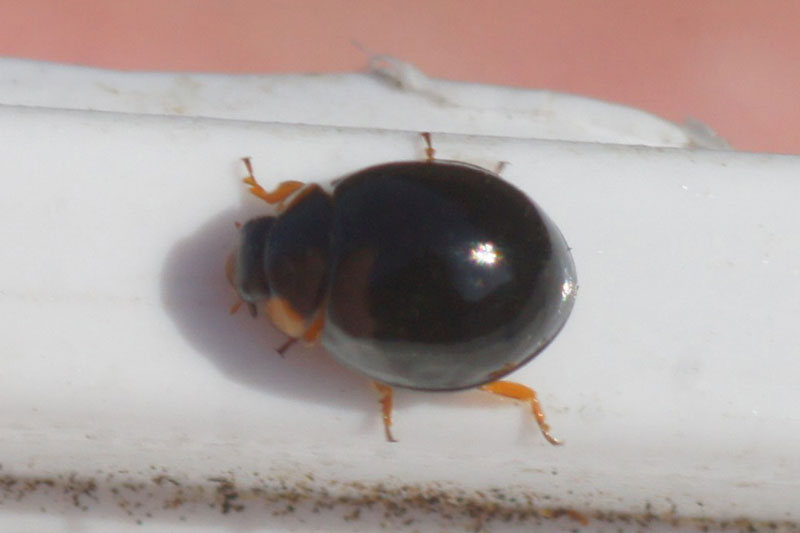
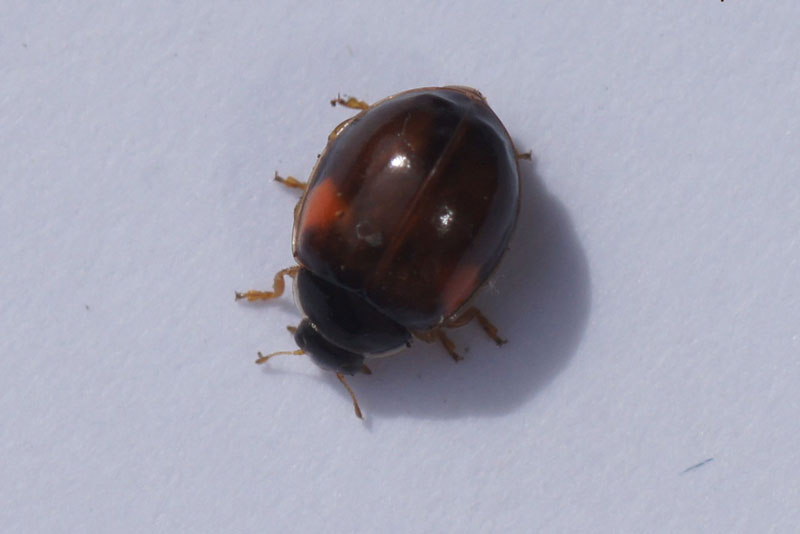
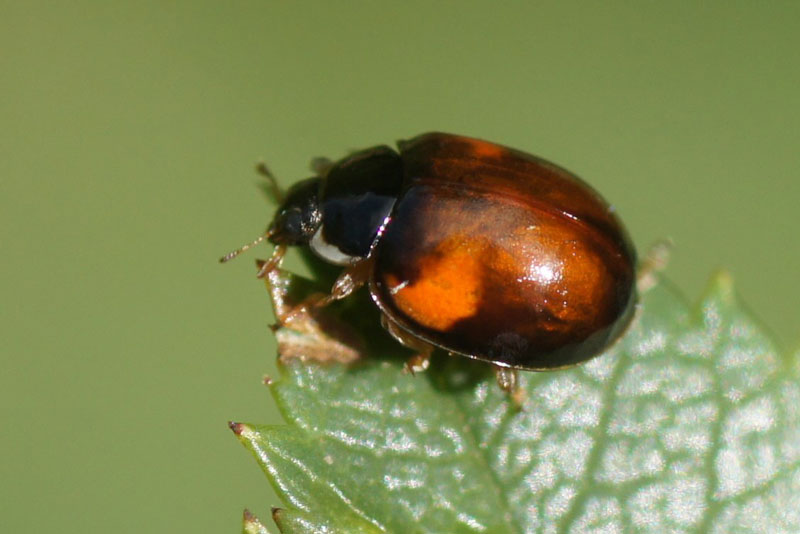
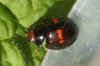 Heather ladybird (Chilocorus
bipustulatus). Subfamily Chilocorinae. Family Ladybirds, ladybugs (Coccinellidae).
Heather ladybird (Chilocorus
bipustulatus). Subfamily Chilocorinae. Family Ladybirds, ladybugs (Coccinellidae).
It looks like the Pine ladybird, but the elytra is more brownish black. The pronotum is black,
the head is reddish brown. At the center of the elytra is a short row of transverse red dots, which are usually fused together into an elongated red spot. The elytra has a broadened border.
Length: 2 - 4 mm. Flying time: Especially from March to April and from August to November.
They feed on scale insects. On sandy soils with heather and juniper.
Europe, North America, North Africa and West Asia.
Both heather ladybirds I found in the little greenhouse. They had become a
bit dusty. Photos 12-5-2015 and 7-5-2018.
Photos taken 10-4-2015 in the dunes: 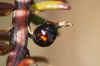 
|
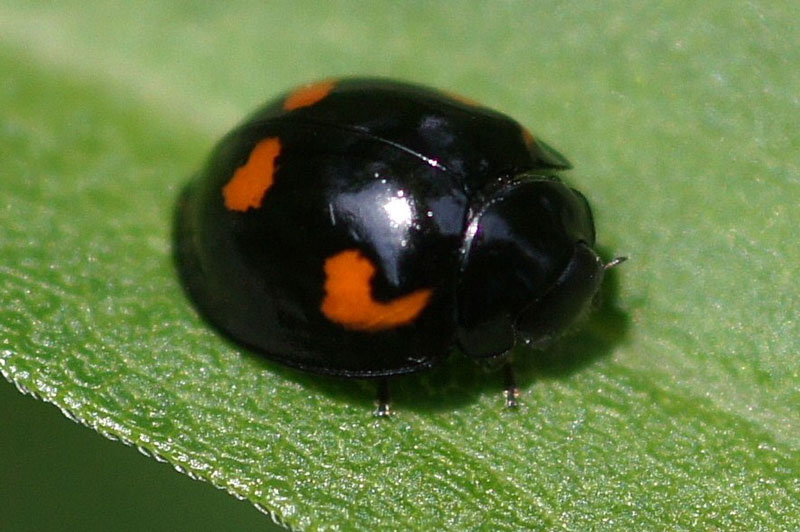
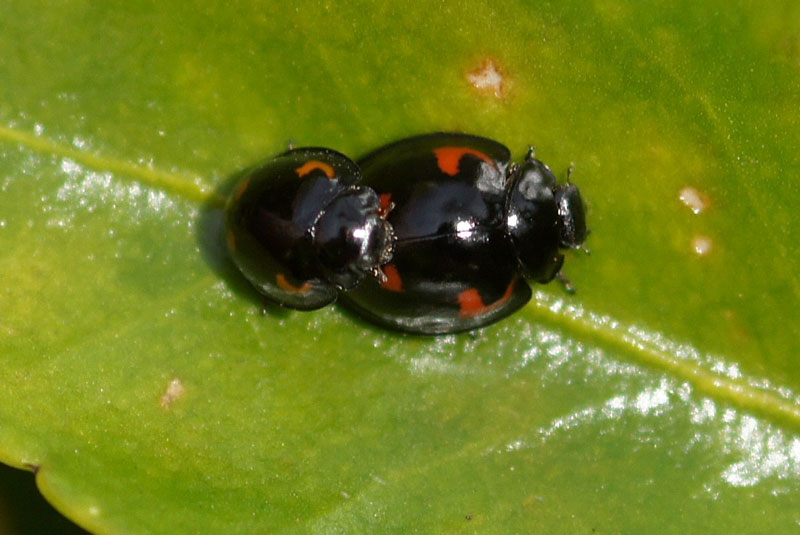
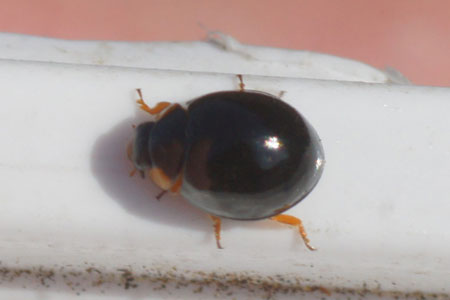 ..Exochomus nigromaculatus. Subfamily
Chilocorinae. Family Ladybirds, ladybugs (Coccinellidae). Not
in the garden, but in the dunes about 4 km from our house. ..Exochomus nigromaculatus. Subfamily
Chilocorinae. Family Ladybirds, ladybugs (Coccinellidae). Not
in the garden, but in the dunes about 4 km from our house.
The elytra is black. The pronotum is black with orange sides. Orange legs. Length: 3.2
- 4 mm. Especially from August to October.
They feed on scale insects. On heathlands.
Europe. Rare in the Netherlands. German: Schwarzer Schildlaus-Marienkäfer.
 Photos 24-9-2016.
 |
Subfamily Coccinellinae.
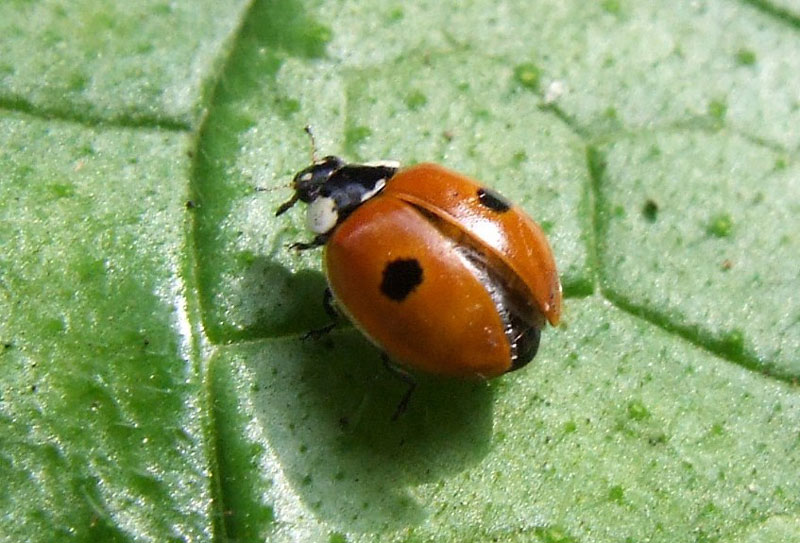
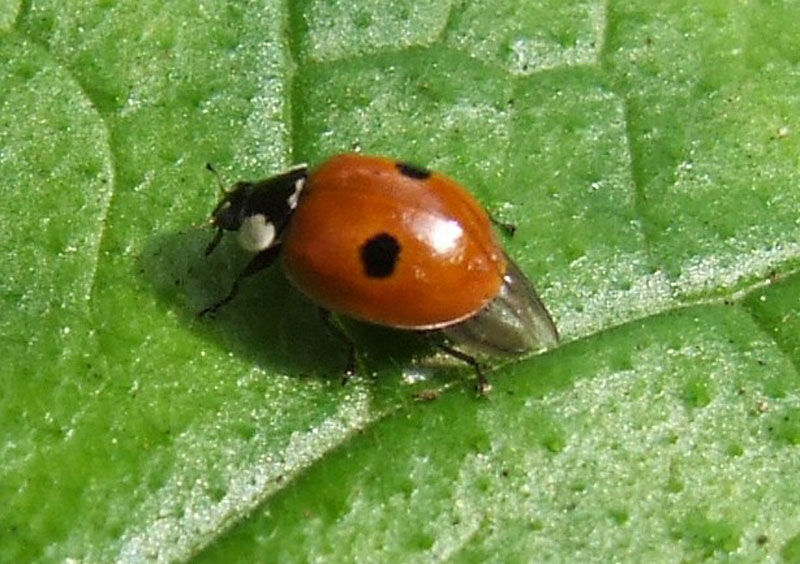
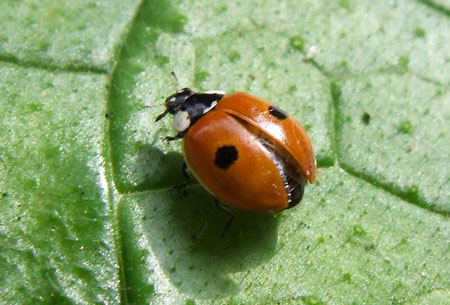 ..Two-spot ladybird, Two-spotted ladybug
(Adalia bipunctata) Genus Adalia. Subfamily Coccinellinae. Family Ladybirds,
ladybugs (Coccinellidae). ..Two-spot ladybird, Two-spotted ladybug
(Adalia bipunctata) Genus Adalia. Subfamily Coccinellinae. Family Ladybirds,
ladybugs (Coccinellidae).
A very common, easily recognizable ladybug. Only the dots are
sometimes so big, that the beetle is black with red spots. Then it is more
difficult to recognize it. The legs are black
Length: 3,5-5,5 mm. Adult and larva feed on aphids. Europe, Asia, North America. German: Zweipunkt Fichten-Marienkäfer
French: Coccinelle à 2 point.
 Photos
28-9-2008.
Photos
28-9-2008.
|
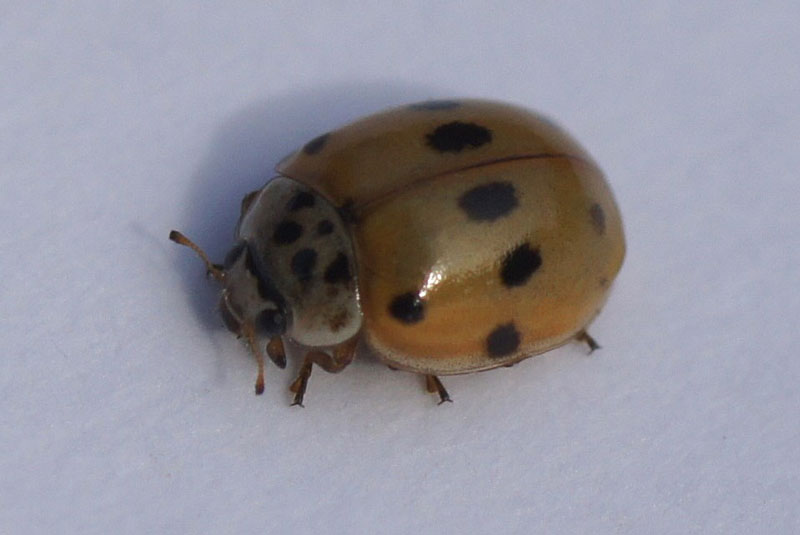
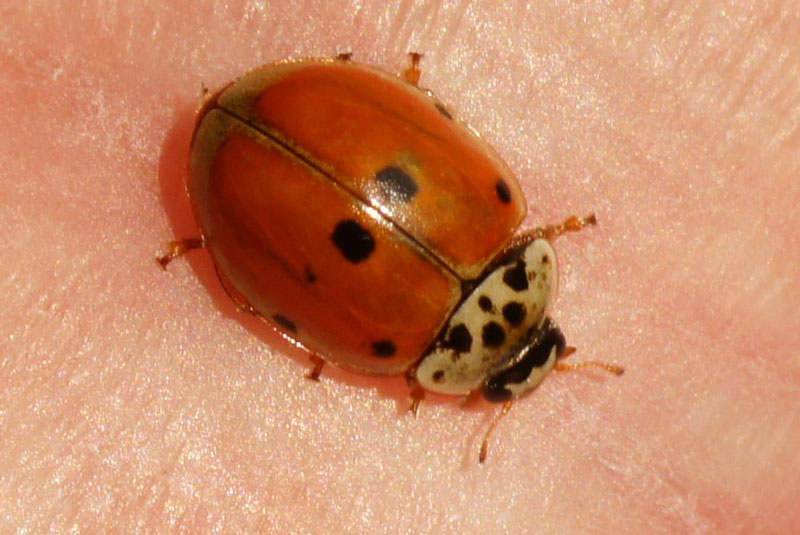
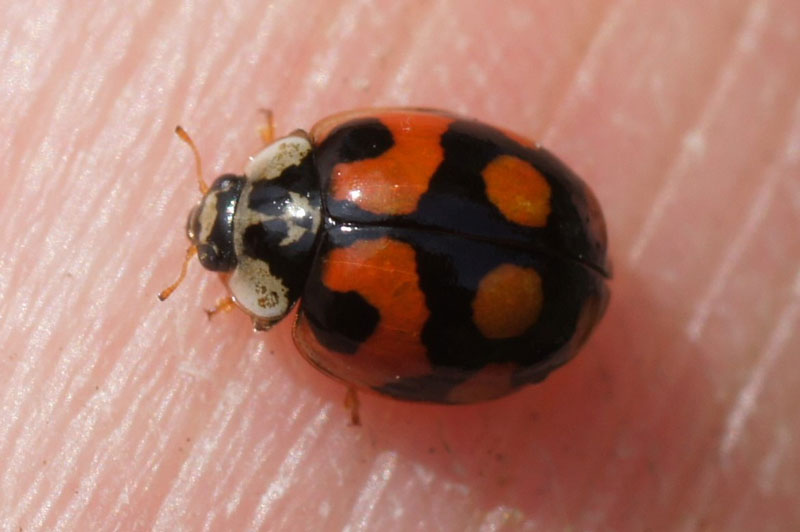
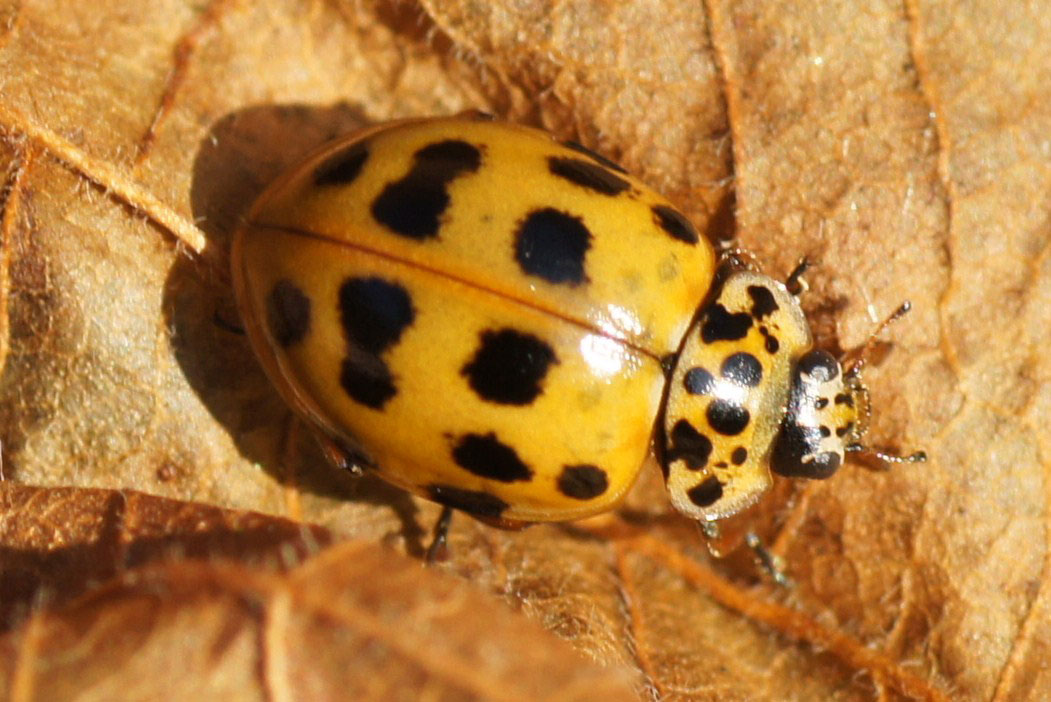
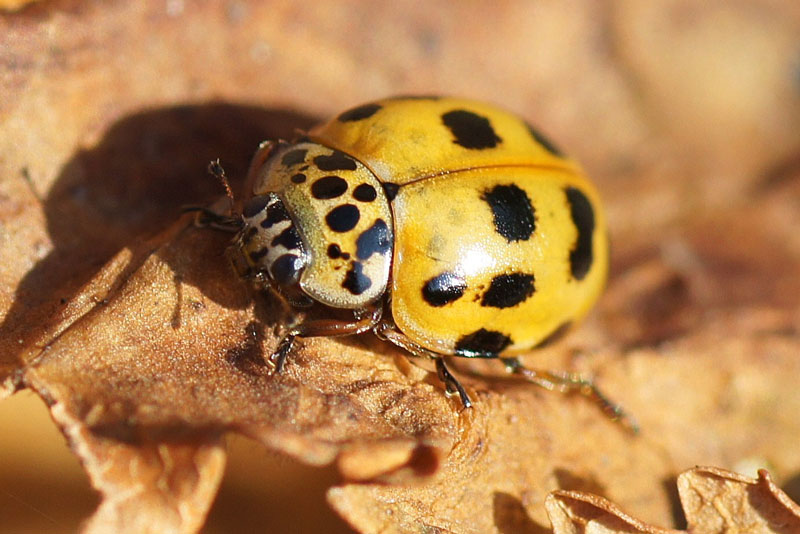
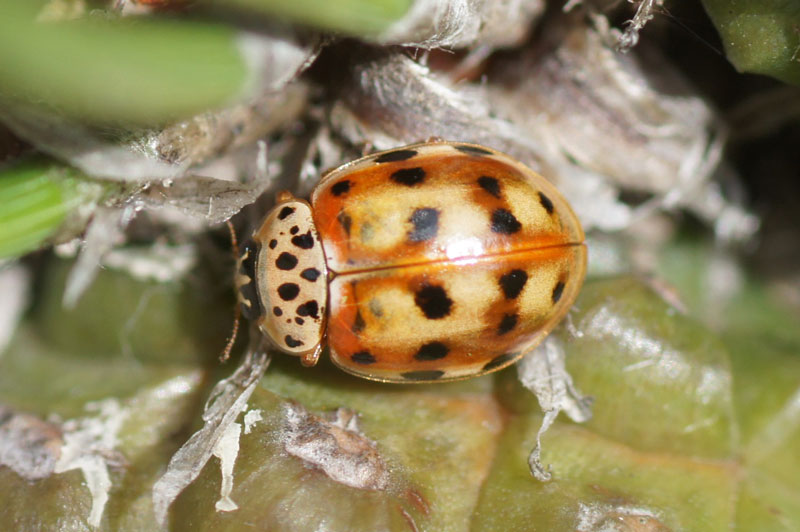
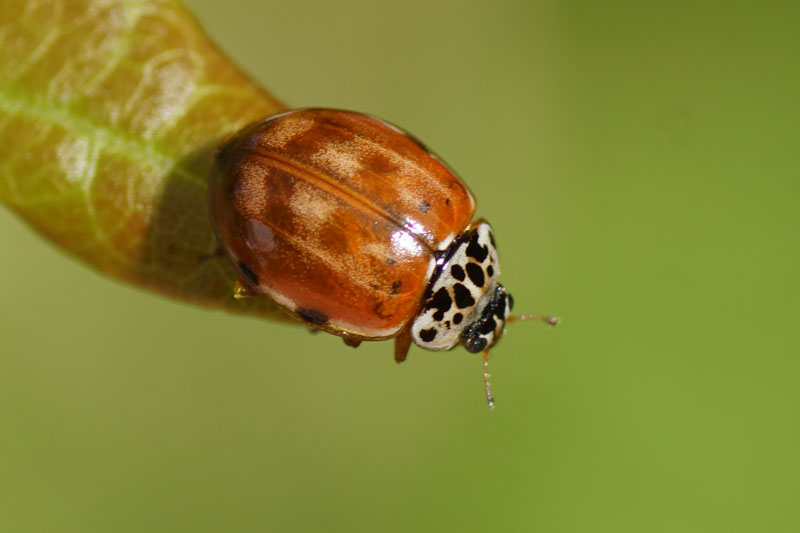
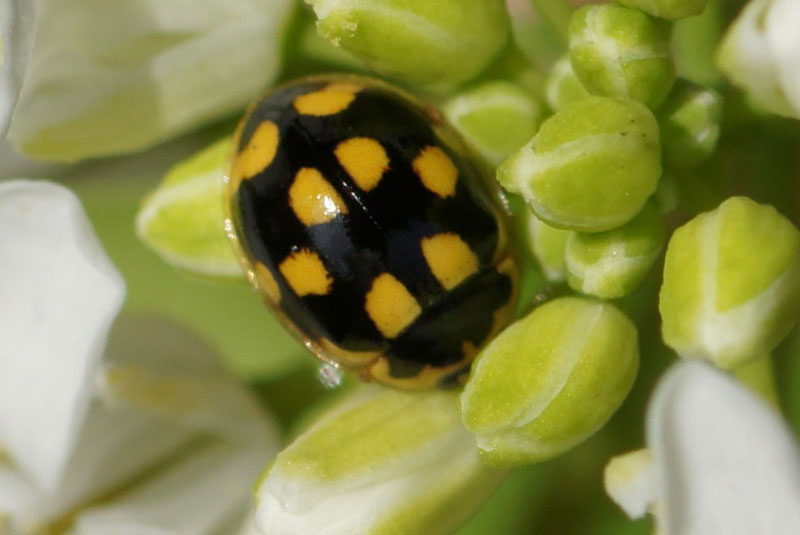
 Ten-spotted ladybird, ten-spotted lady beetle
(Adalia decempunctata). Subfamily Coccinellinae. Family Ladybirds,
ladybugs (Coccinellidae).
Ten-spotted ladybird, ten-spotted lady beetle
(Adalia decempunctata). Subfamily Coccinellinae. Family Ladybirds,
ladybugs (Coccinellidae).
This ladybird is to recognize by the spots pattern on the pronotum, a "track" on the femur and
the short transverse elytral ridge. But the Asian ladybug has the same transverse elytral ridge. It is even more
difficult to find the right species, because both species are variable in
pattern and colour. In real it is easy, because the ten-spotted ladybird
is much smaller. From a photograph it's often difficult to see the
differences. Both species have brown orange legs and antennae.
Length: 3,5-5 mm. Adult and larva feed on aphids.
April - October. Europe en Asia.
Photo 28-03-2012. German:
Zehnpunkt-Marienkäfer.
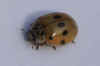
 Photos 21-9-2013, 12-4-2014.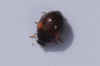
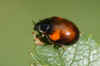
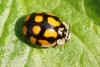
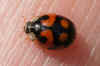
 An other pattern. Photos
15-8-2013, 13-4-2016, 7-5-2017, 16-6-2017.
An other pattern. Photos
15-8-2013, 13-4-2016, 7-5-2017, 16-6-2017.
|
 , ,
 .
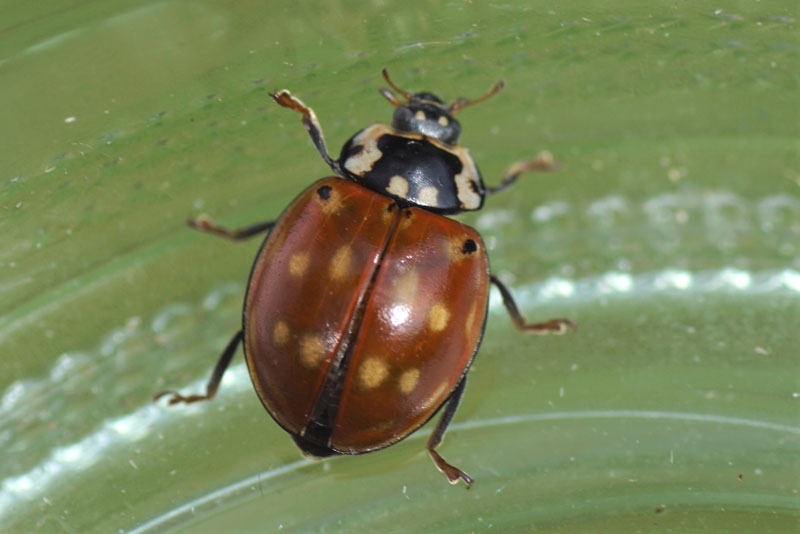
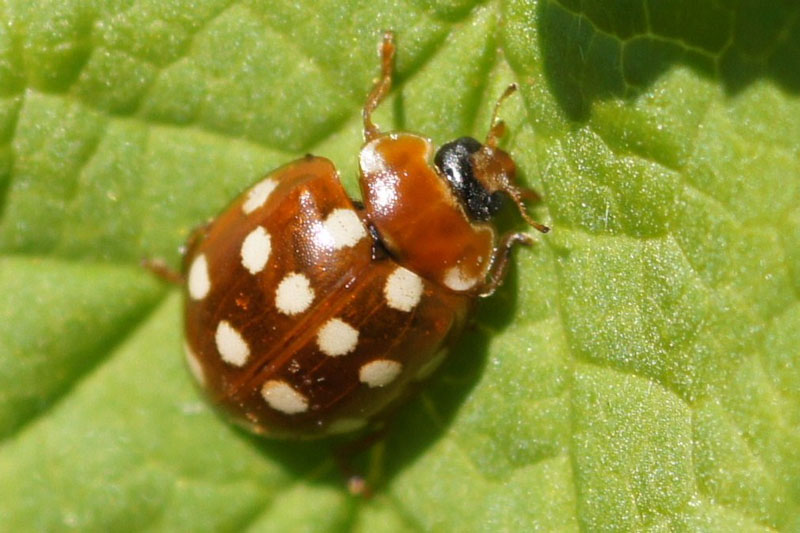
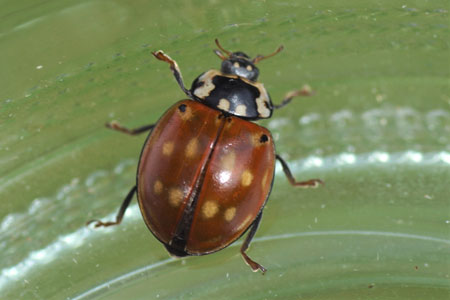
Eyed ladybug (Anatis
ocellata). Genus Anatis. Subfamily Coccinellinae. Family Ladybirds,
ladybugs (Coccinellidae). .
Eyed ladybug (Anatis
ocellata). Genus Anatis. Subfamily Coccinellinae. Family Ladybirds,
ladybugs (Coccinellidae).
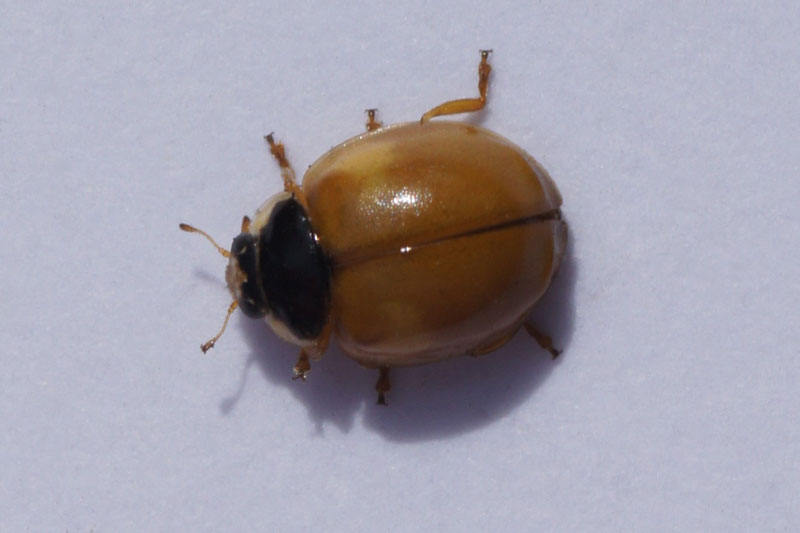
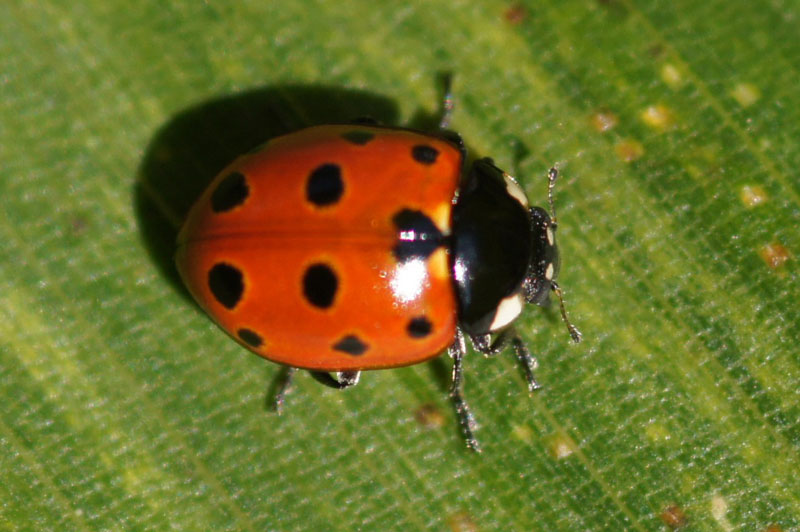
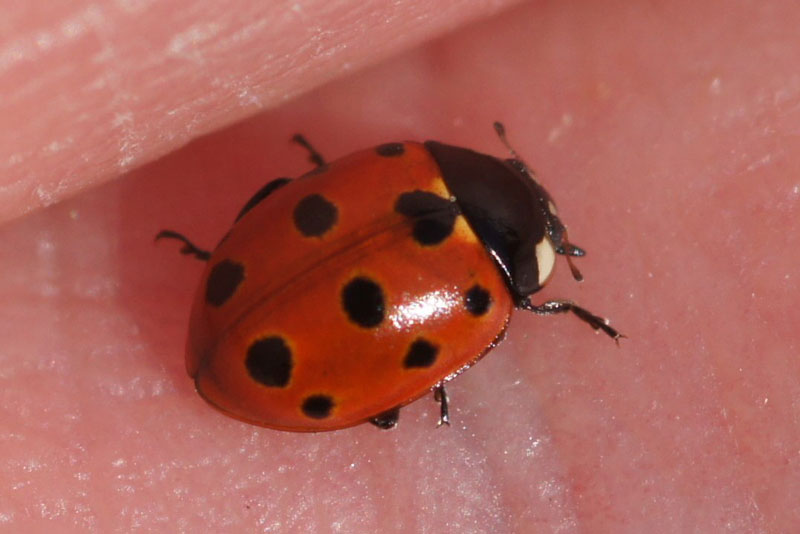
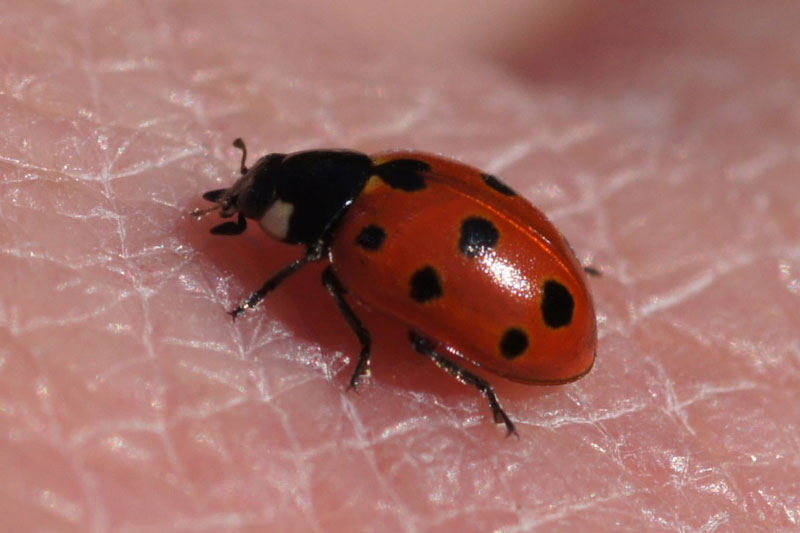
A large ladybird. Black dots with a yellow border. Sometimes yellow spots without black. Like the ladybird in the photo, which only has a black spot on the shoulders. Often near conifers.
Length: 6-9.5 mm. It feeds on aphids. Europe, Asia. Photos 24-6-2019. German:
Augenmarienkäfer, Augenfleck-Marienkäfer. French: Coccinelle à ocelles, anatis ocellé.
|
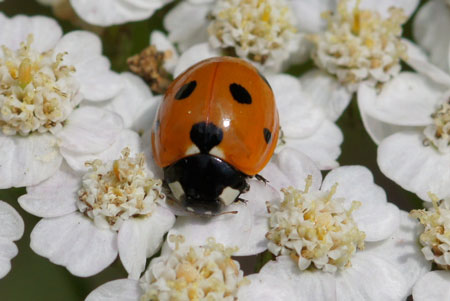 ..
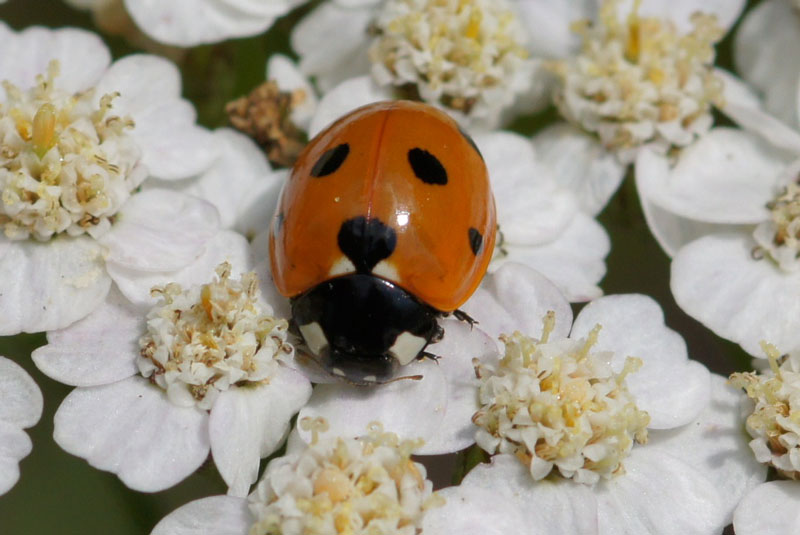
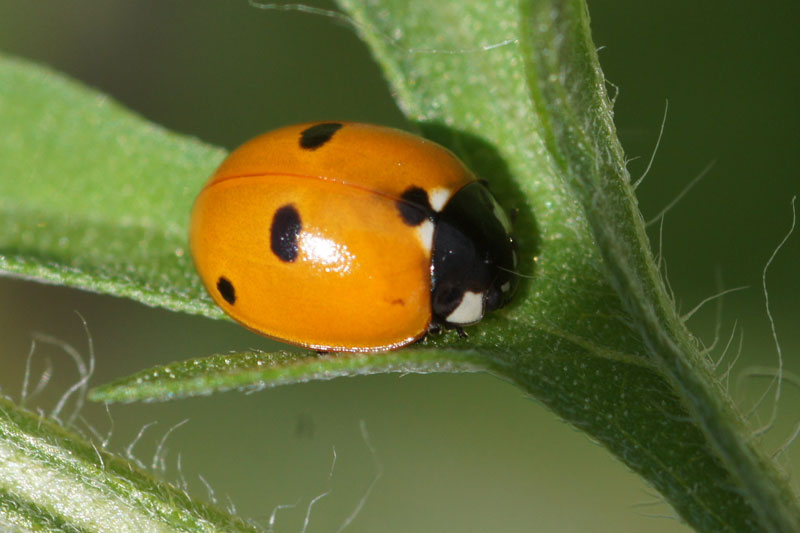
Seven-spot ladybird, Seven-spotted ladybug (Coccinella
septempunctata). Genus Coccinella. Subfamily Coccinellinae. Family Ladybirds, ladybugs
(Coccinellidae). ..
Seven-spot ladybird, Seven-spotted ladybug (Coccinella
septempunctata). Genus Coccinella. Subfamily Coccinellinae. Family Ladybirds, ladybugs
(Coccinellidae).
In the
Netherlands the most common ladybird. A red
beetle, punctuated with three black spots on each
elytron (is a modified, hardened forewing) , with one further spot being
spread over the two elytra, making a total of seven spots.
The
pronotum is
black with
a white
spot on the
side.
Adult and larva feed on aphids. Length 6-8 mm . Europe, Asia,
North-America. They are introduced to North America
to reduce aphid numbers. Photos 3-7-2011, 4-8-2010. German:
Siebenpunkt-Marienkäfer, Siebenpunkt.
French: Coccinelle à sept points.
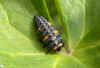
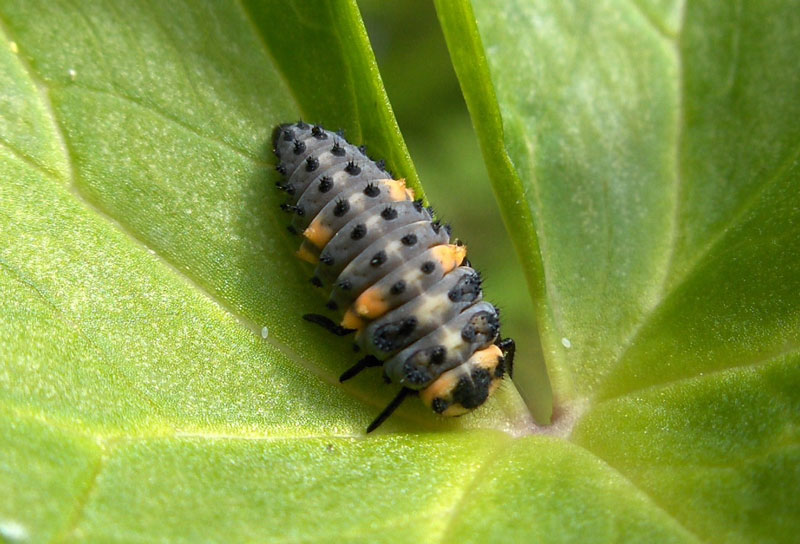
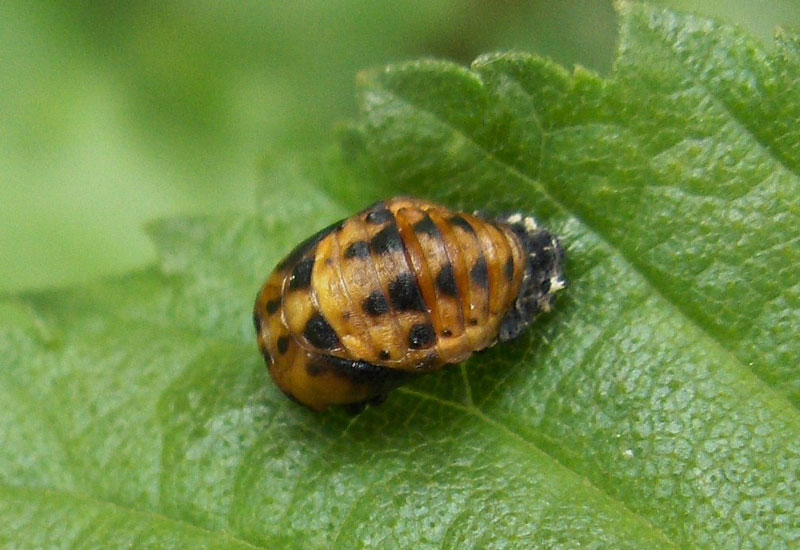
 larva, pupa seven-spot ladybird. Photo 12-5-2007 and 14-5-2007.
|
 .. ..
 . .
 . .
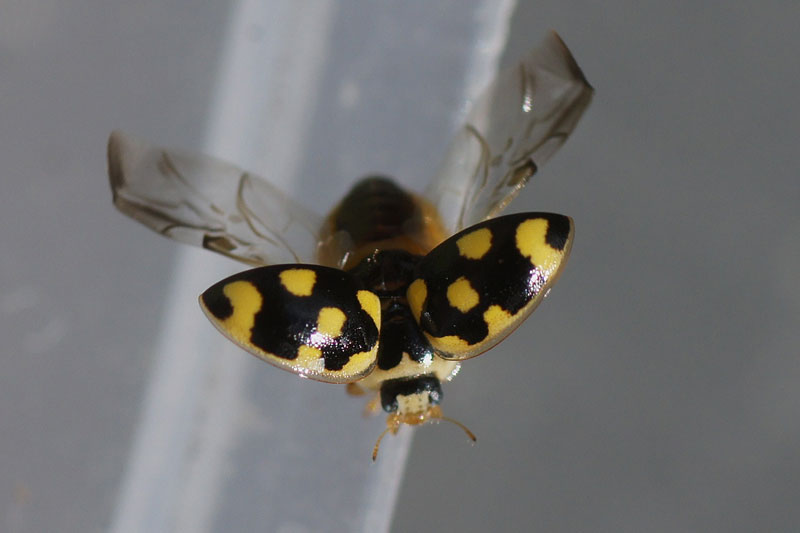
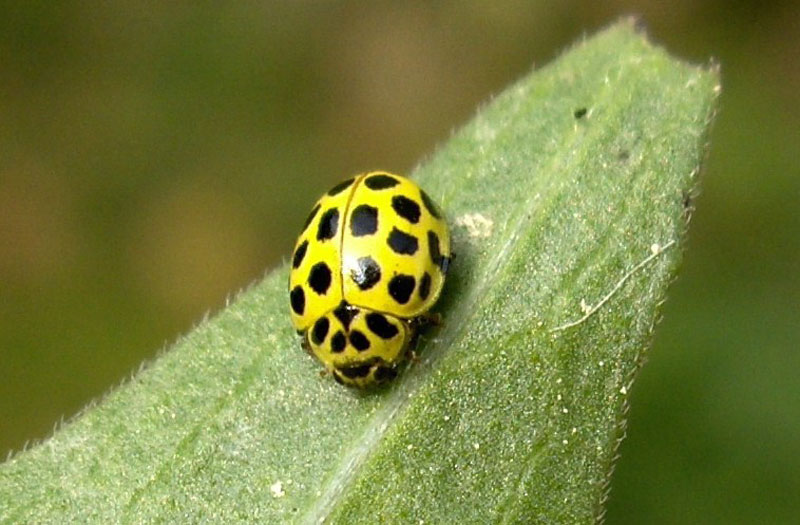
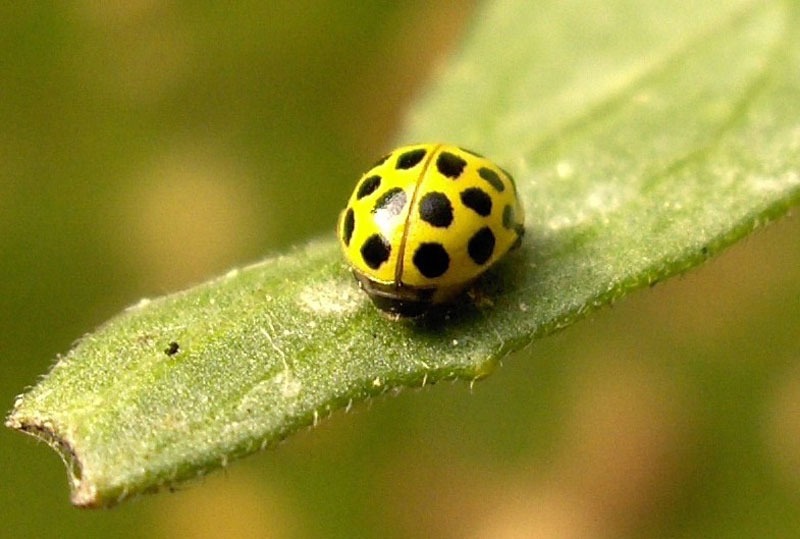
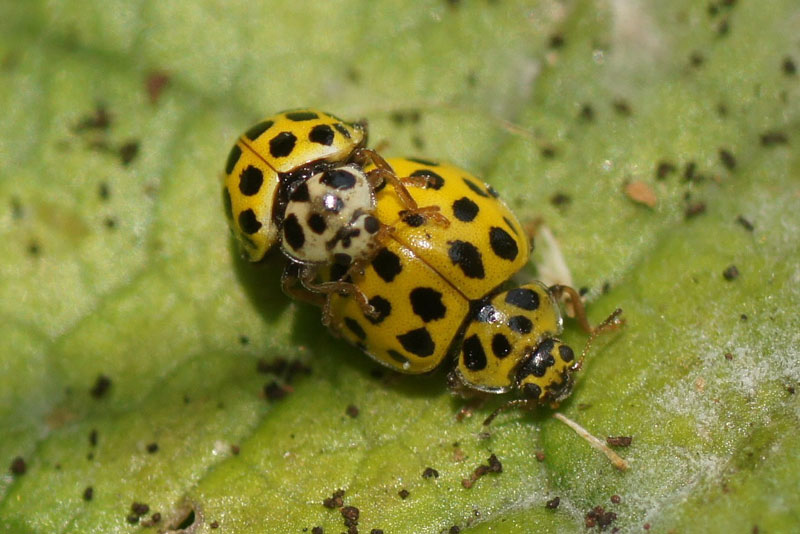
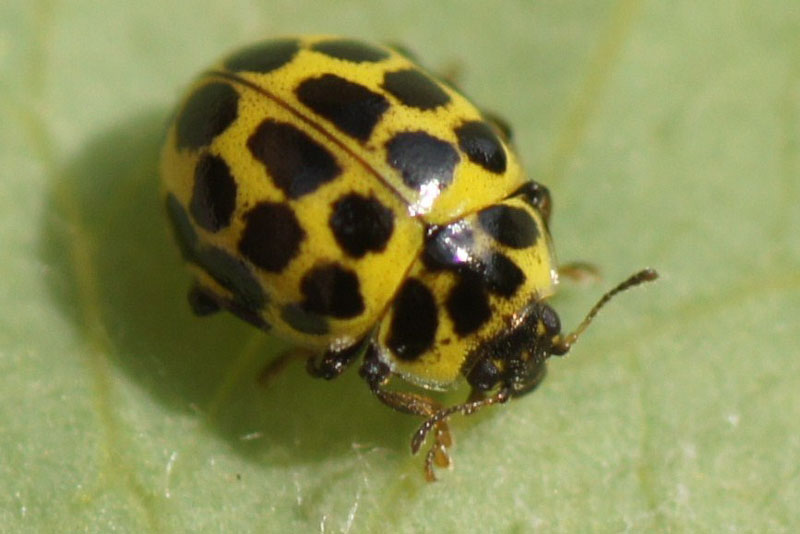
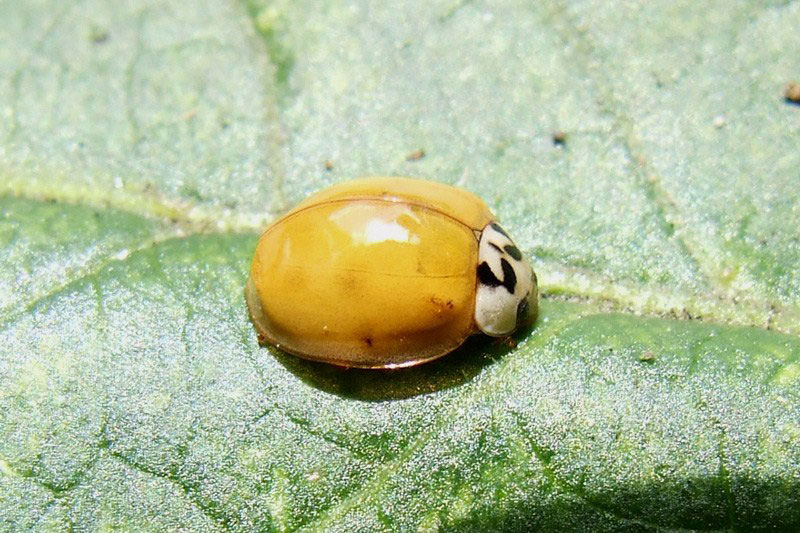
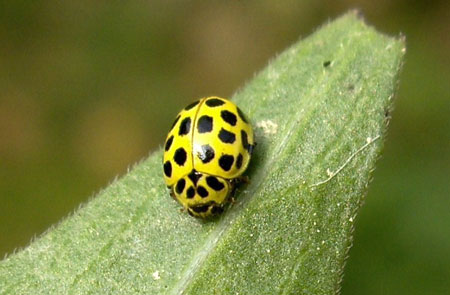
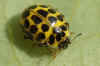 22 spot ladybird (Psyllobora
vigintiduopunctata). Genus Psyllobora. Subfamily Coccinellinae. Family Ladybirds, ladybugs (Coccinellidae).
22 spot ladybird (Psyllobora
vigintiduopunctata). Genus Psyllobora. Subfamily Coccinellinae. Family Ladybirds, ladybugs (Coccinellidae).
The colour is lemon yellow. The male's thorax seems to be whiter. Not variable. The 22 black dots are in the same place.
Length: 3-4,5 mm. April - September.
Adult and larva feed
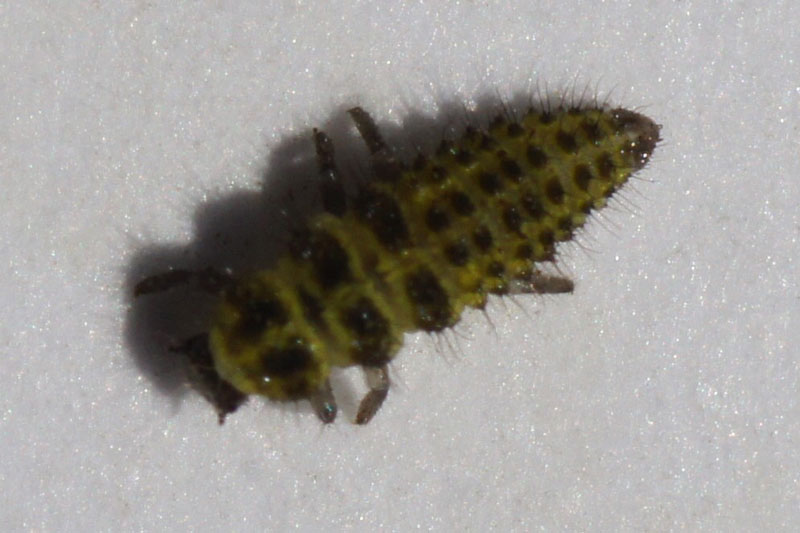
on mildew. The larva are bright yellow too. Europe , North-Africa and Asia.
Photos 15-10-2007, 14-7-2013. A
darker 22 spot laydybird, photo 31-10-2012. German: Gemeiner
Pilz-Marienkäfer. French: Coccinelle à 22.
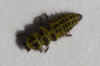 Larva 22 spot ladybird. Photo 3-7-2016. points
 |
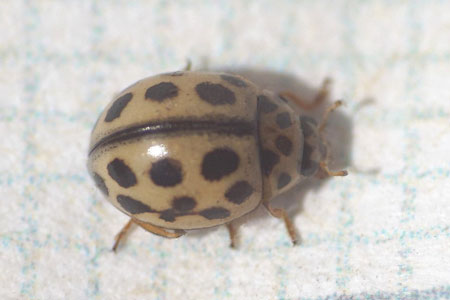 .. ..
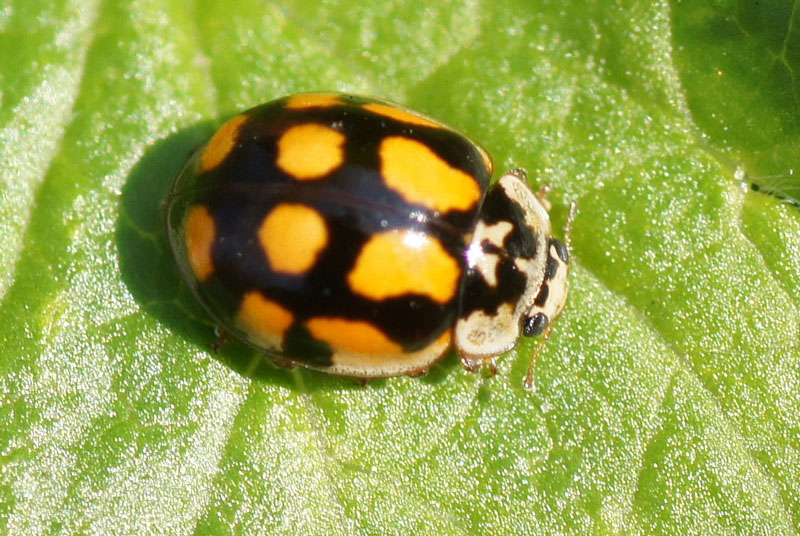
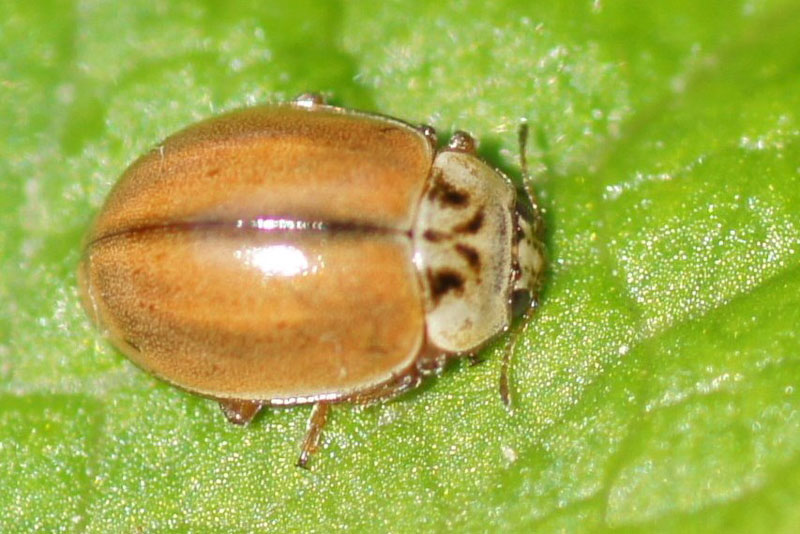
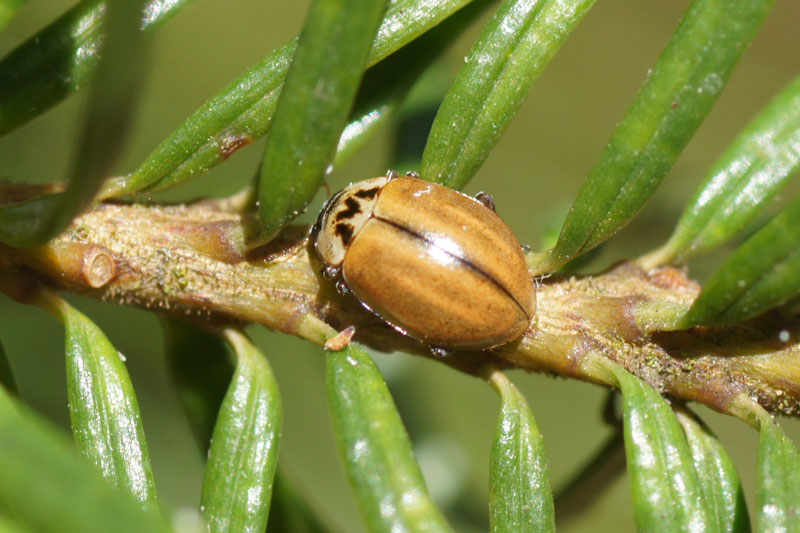
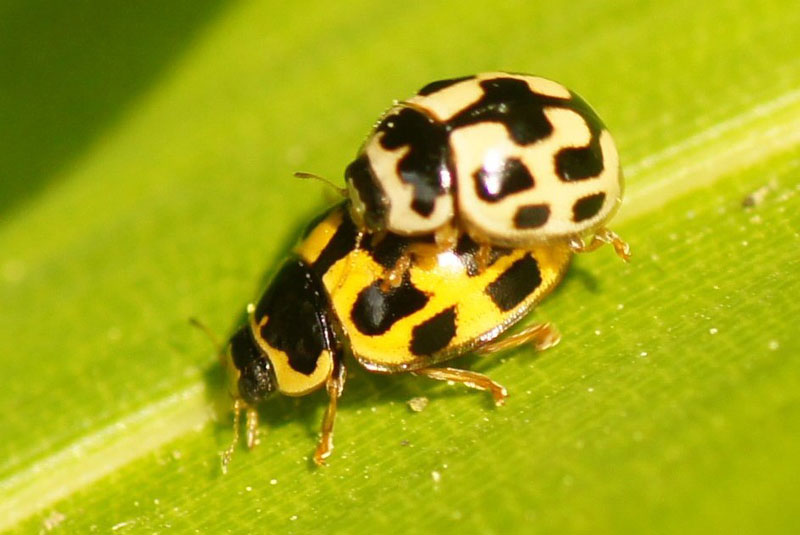
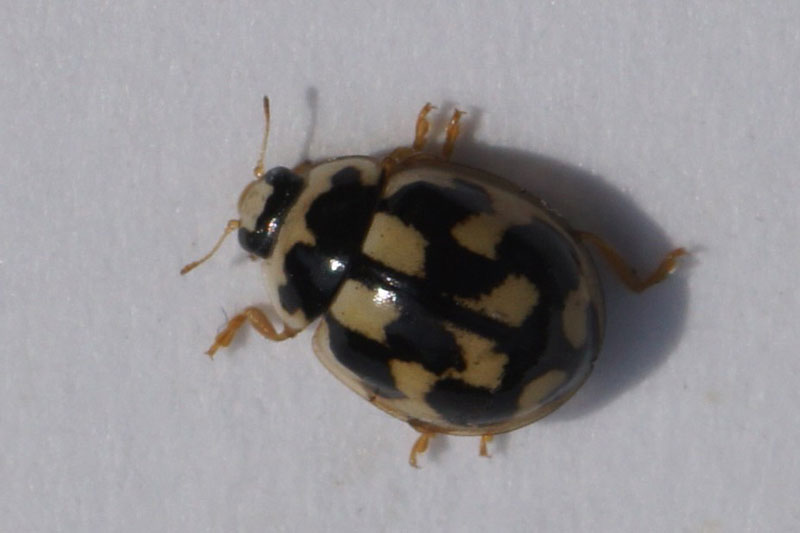
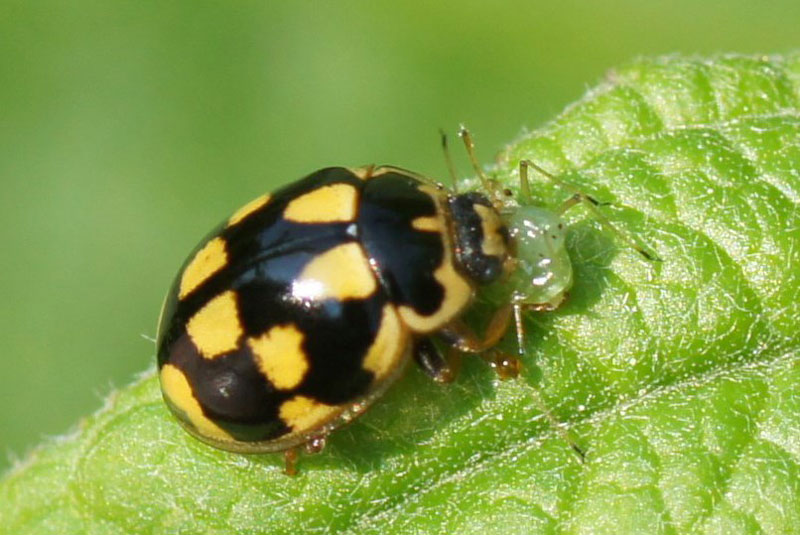
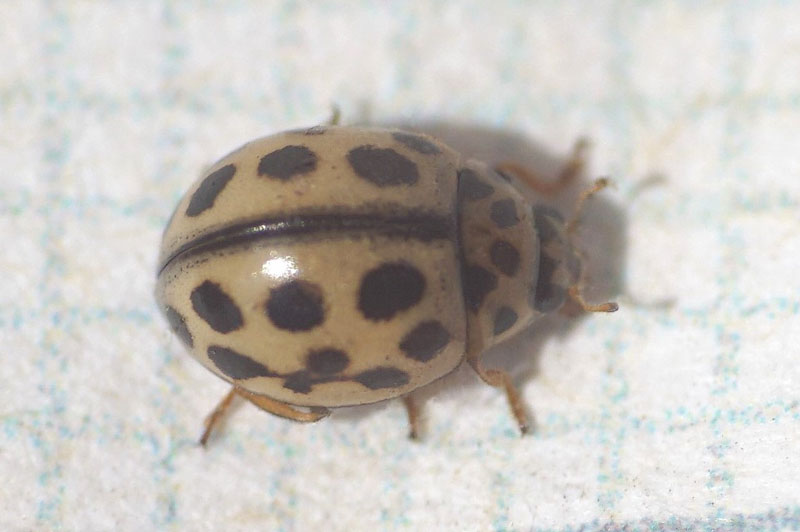
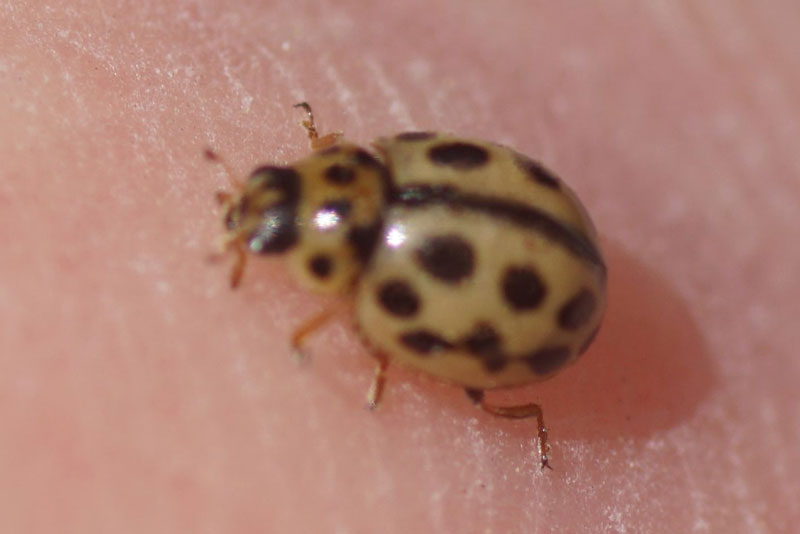
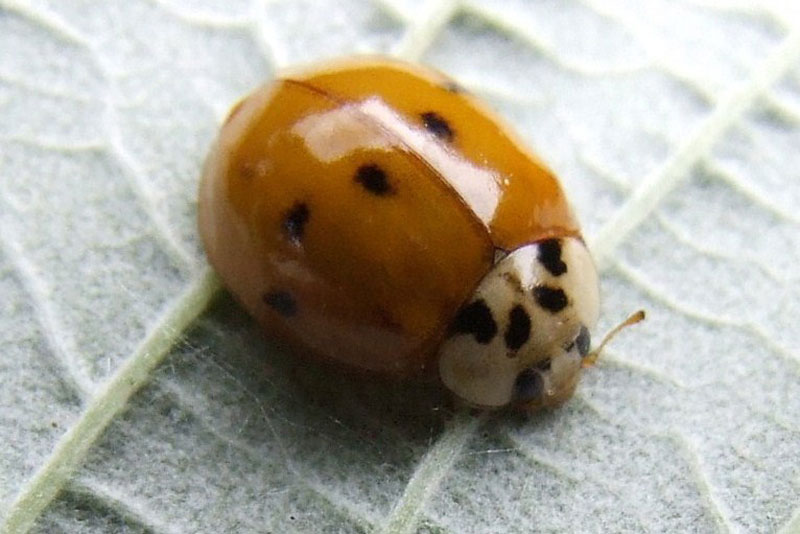
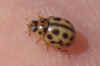 Sixteen-spot ladybird ( Tytthaspis sedecimpunctata). Genus Tytthaspis. Subfamily
Coccinellinae. Family Ladybirds,
ladybugs (Coccinellidae).
Sixteen-spot ladybird ( Tytthaspis sedecimpunctata). Genus Tytthaspis. Subfamily
Coccinellinae. Family Ladybirds,
ladybugs (Coccinellidae).
Yellow-beige. On the elytra
eight black dots of which the three on the side can be connected to a wavy line. The female has a vertical black band between the eyes. Length 2.5-3 mm. All year round. Especially in the spring (April / May) and in the summer the summer (August). Food: Mildew, pollen, nectar.
Europe, North Africa, Asia. Photos 29-4-2019. German:
Sechzehnpunkt-Marienkäfer.
|
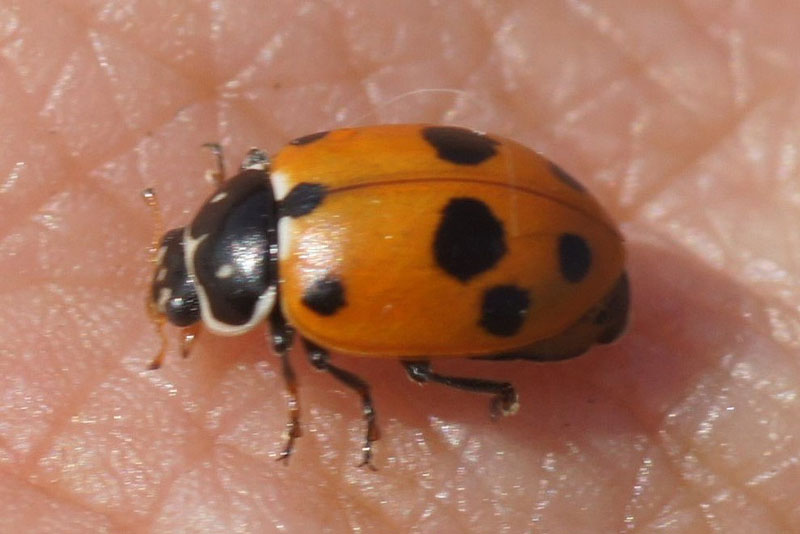
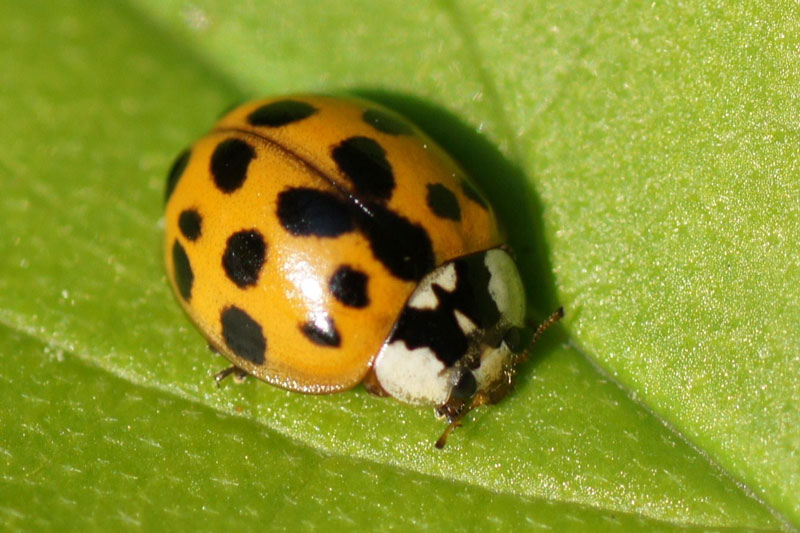
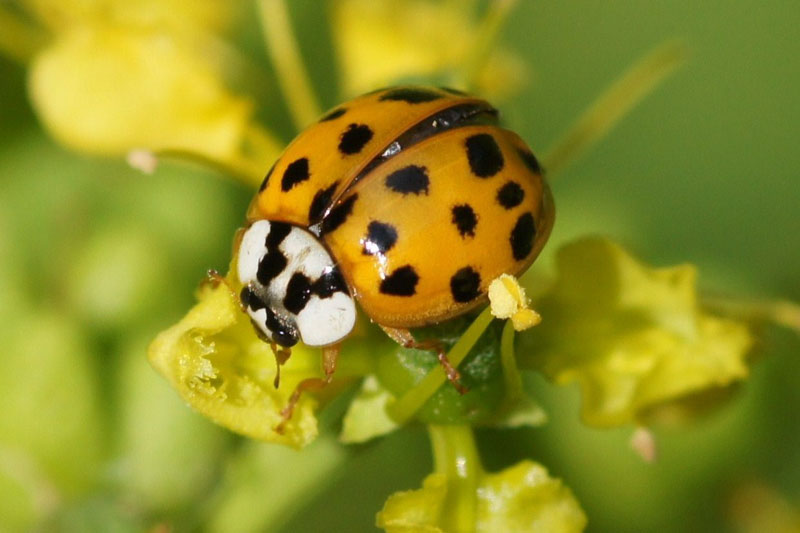
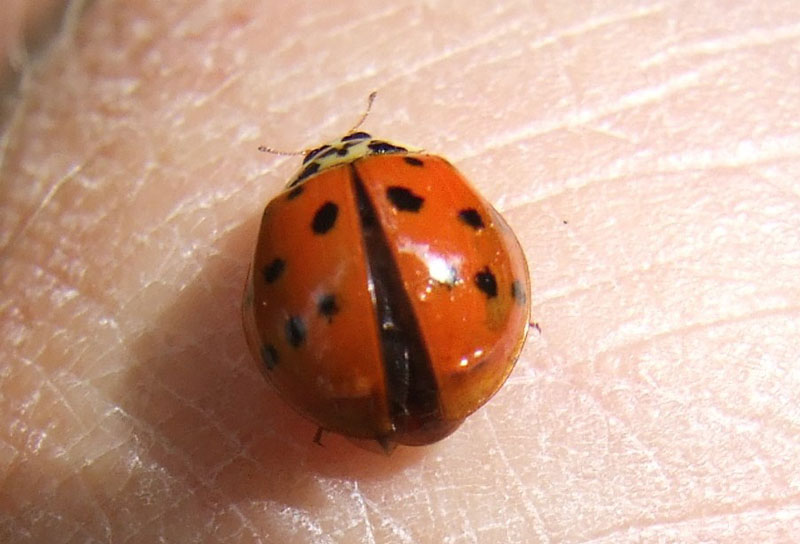
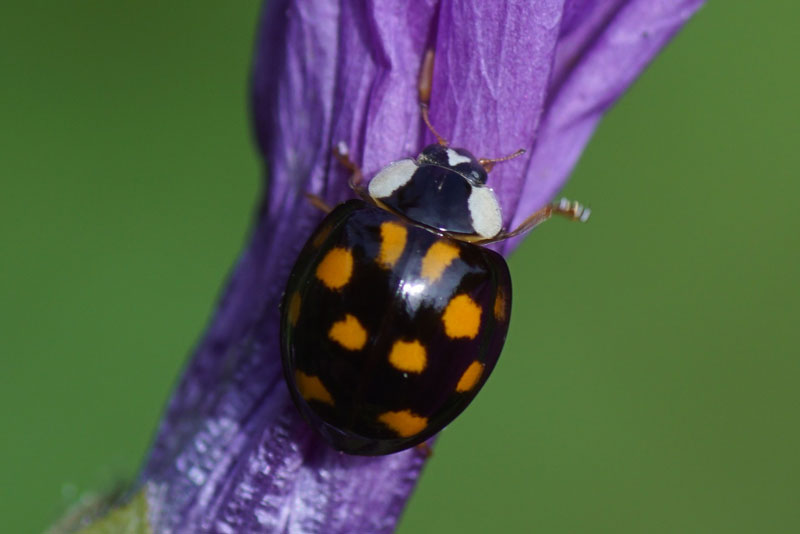
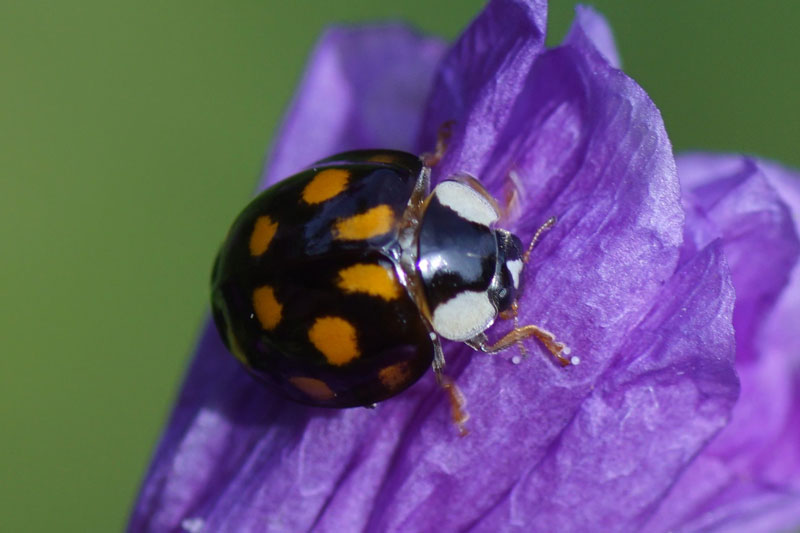
Harlequin ladybird, Multicoloured Asian ladybird, Asian lady beetle,
Japanese ladybug (Harmonia axyridis) Genus Harmonia. Subfamily Coccinellinae.
Family Ladybirds, ladybugs (Coccinellidae).
Harlequin ladybird, Multicoloured Asian ladybird, Asian lady beetle,
Japanese ladybug (Harmonia axyridis) isn't a native ladybird in Europe.
This insect is native to northeastern Asia and has
been introduced In Europe and America to control
agricultural pests. But now it is spreading rapidly throughout the
United States and Europe.
Asian lady beetle
has a black mark on the pronotum that looks like an
"M".
( not always visible) There’s a wide variation in background colour and
number of spots.
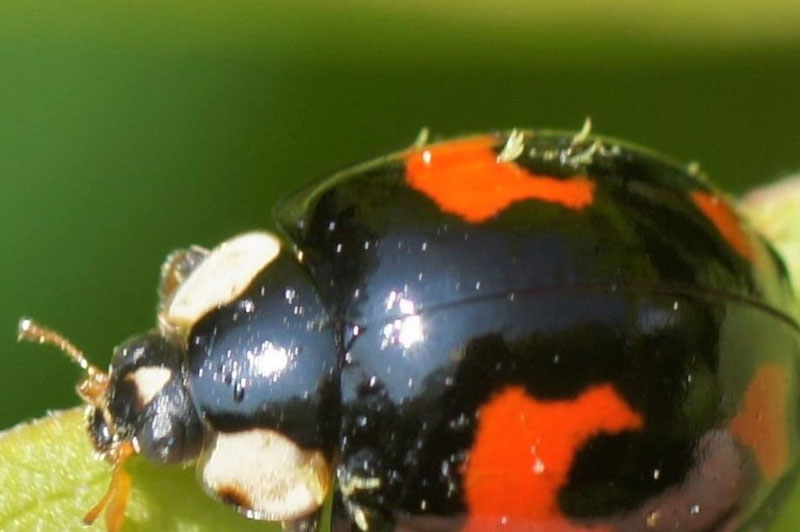
The elytra usually display a wide transverse
"keel" at the apex.
They have all kinds of colours and several numbers of dots. They have pale brown legs. Just like the other ladybirds they
hibernate in clusters.
Length: 5 - 8 mm. May - November
12 May 2007 I saw the first Multicoloured Asian ladybird (Harmonia
axyridis) in the garden. Now it is the most common ladybird.
In 2003 the first Asian ladybirds were found in the Netherlands. In 2004 in
Belgium and England.
German: Asiatische Marienkäfer
French: Coccinelle asiatique multicolore
|
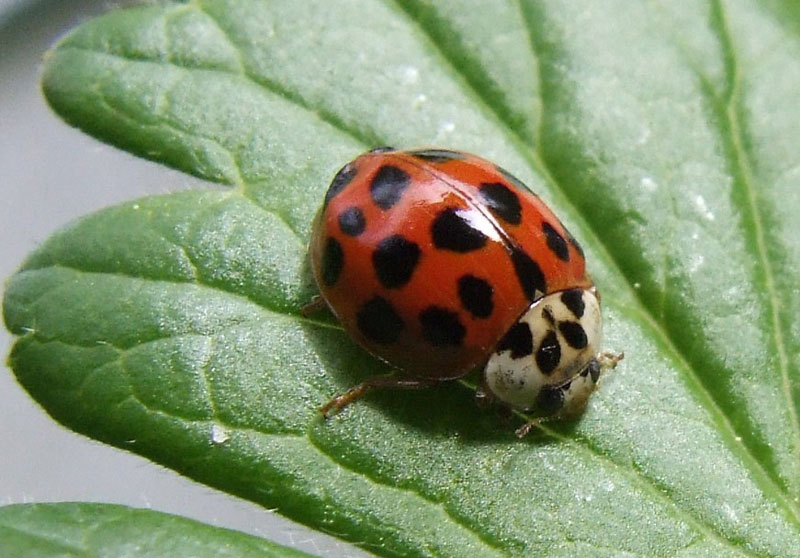
| Harlequin ladybird, Multicoloured Asian ladybird, Asian lady beetle,
Japanese ladybug (Harmonia axyridis)
Variation in colour: Harmonia axyridis f. succinea orange/red with
0-19 black spots. The most of my "Asians" belong to this
variation in colour.
|
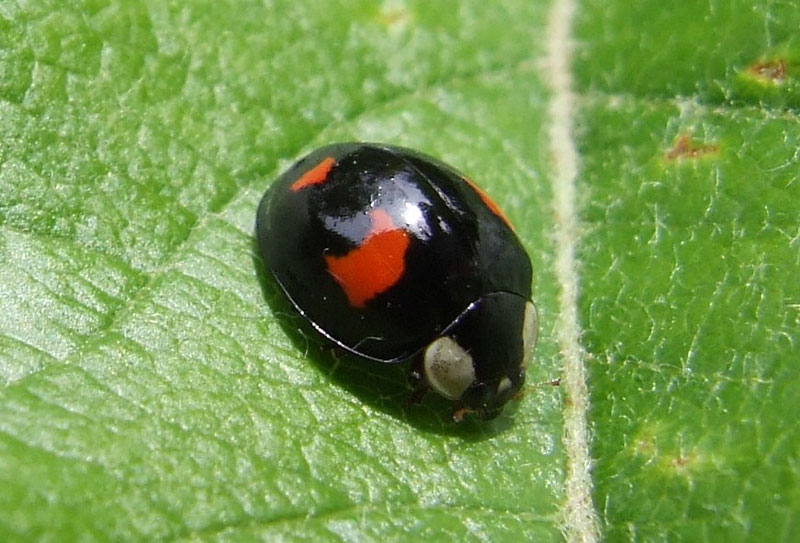
| Harlequin ladybird, Multicoloured Asian ladybird, Asian lady beetle,
Japanese ladybug (Harmonia axyridis) Genus Harmonia. Subfamily Coccinellinae.
Family Ladybirds, ladybugs (Coccinellidae).
Variation in colour: Harmonia
axyridis f. conspicua black with two
spots. Photo 20-05-2007, 4-7-2012, 7-7-2012.
|
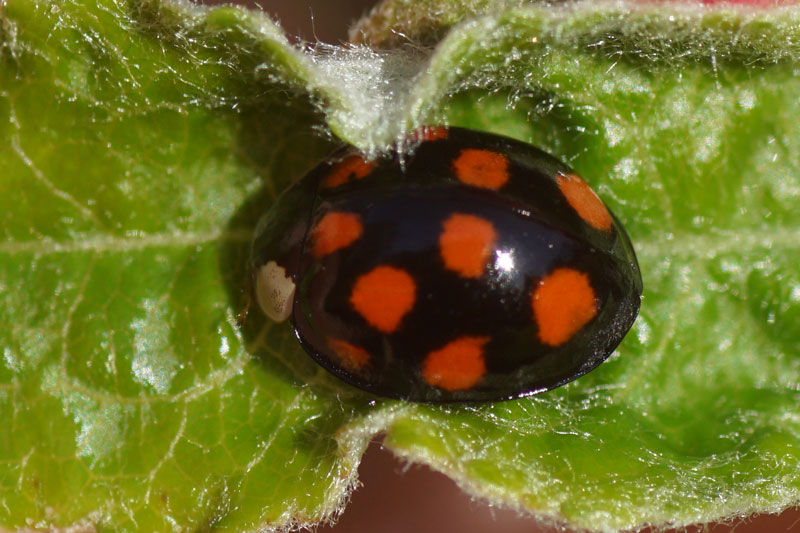
| Harlequin ladybird, Multicoloured Asian ladybird, Asian lady beetle,
Japanese ladybug (Harmonia axyridis) Genus Harmonia. Subfamily Coccinellinae.
Family Ladybirds, ladybugs (Coccinellidae).
Variation in colour:
Harmonia axyridis f. axyridis black with twelve spots. Photos
30-6-2019. 9-5-2021: Now with red spots.
|
| Harlequin ladybird, Multicoloured Asian ladybird, Asian lady beetle,
Japanese ladybug (Harmonia axyridis) Genus Harmonia. Subfamily Coccinellinae.
Family Ladybirds, ladybugs (Coccinellidae).
Variation in colour: Harmonia
axyridis f.
spectabilis black with four spots. Photo 20-05-2007, 4-7-2012, 7-7-2012.
|
The first Asian ladybird on the photo to the right has only six dots. The black mark on the pronotum
don't looks like an
"M". The patron is similar to the Ten-Spot Ladybird Beetle
(Adalia decempunctata) Like the Asian ladybird it has a wide transverse
"keel" at the apex. The Ten-Spot
Ladybird Beetle is smaller (3,5 - 5 mm)
The second Asian ladybird has no dots. Maybe because it is very young. Photos 16-6-2009 and 8-7-2009. |
| Dark Multicoloured Asian ladybirds (Harmonia
axyridis)
These photos were taken in November 2007. Multicoloured Asian
ladybirds lay eggs until late in the year. Later than the other species. The beetles, which
pupate are darker then.
Probably because it takes longer to emerge. (Because it gets colder, darker, moister) The last
beetle was deformed. |
Multicoloured Asian ladybirds (Harmonia
axyridis). Larvae and pupa. Photos 2007.
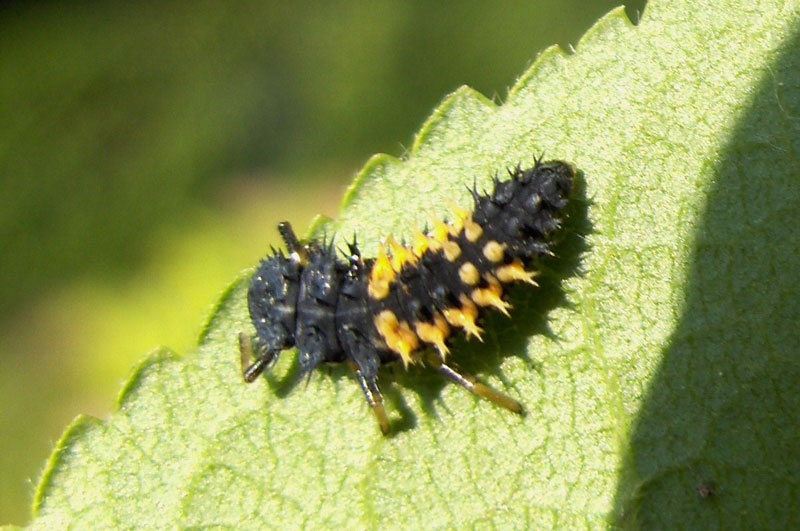
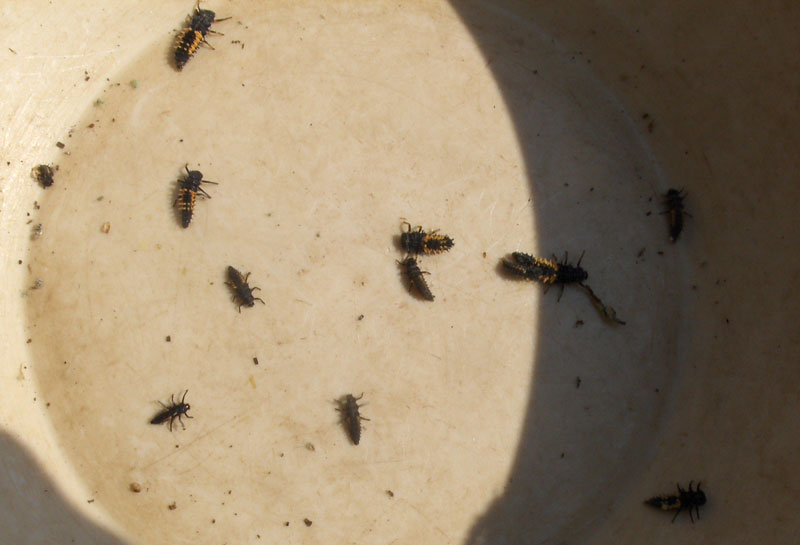
The larvae are black / blue-gray. Orange L-shaped spot on each side withe 4 orange spines. They
are voracious predators. If there are too few aphids, they are also eat larvae of other ladybirds. The
pupa can be recognized by the white spines at the end of the flayed skin.
In 2007 I saw the first Harmonia axyridis. I saw many. In the middle picture, I had
shaken a branch of plum tree. The right picture is of a pupa on a plum. |
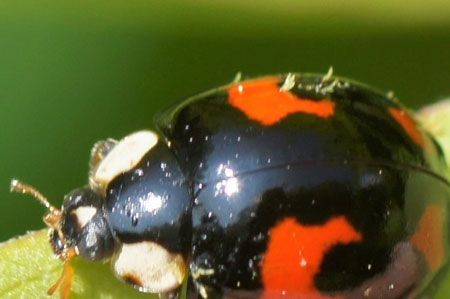 Hesperomyces harmoniae. Family of
fungy Laboulbeniaceae. An ectoparasitic fungus on an Asian ladybird.
Hesperomyces harmoniae. Family of
fungy Laboulbeniaceae. An ectoparasitic fungus on an Asian ladybird.
Hesperomyces virescens is only known from ladybirds. It was assumed that H. virescens is actually a complex of species that are difficult to identify. The Hesperomyces host Harmonia axyridis is now considered a separate species. Namely Hesperomyces harmoniae.
They can be confused with yellow pollen. Hesperomyces virescens is one of the few types of
Laboulbeniales, which pierce the host's chitin pantser. Photo: 13-6-2017.
An extensive research can be found on the website
from Danny Haelewaters
www.dannyhaelewaters.com/
.
|
One species I have photographed in France:
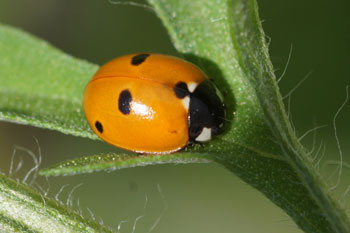
5-spot ladybird (Coccinella
quinquepunctata). Subfamilie typical ladybirds (Coccinellinae). Family
ladybirds / ladybugs (Coccinellidae). They feed on aphids and larvae of leaf beetles. This ladybird
also lives in the Netherlands. But unfortunately not in our garden. The
spots at the rear and of the elytra can be small. Then they are more difficult to recognize.
Length 3.5-5 mm.
|
And a species from Slovenia:
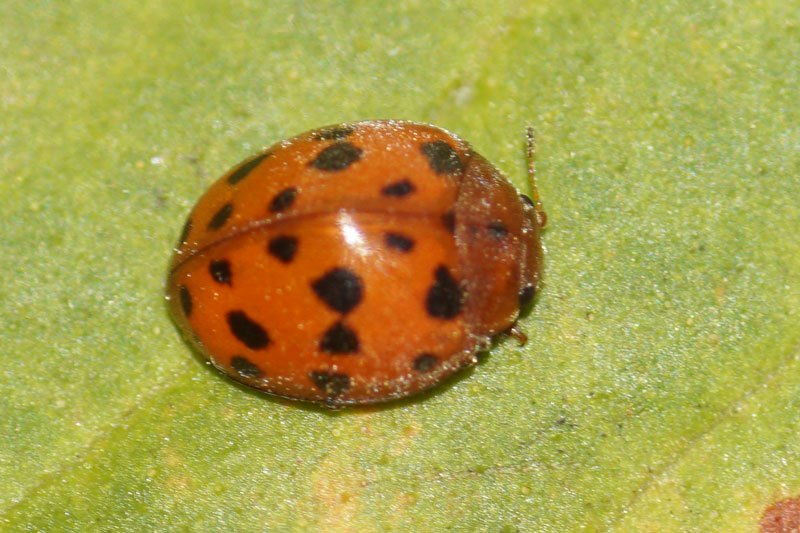
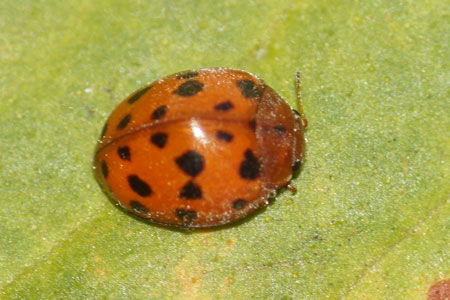 24-spot ladybird (Subcoccinella vigintiquatuorpunctata).
Subfamily Epilachninae. Family
ladybirds / ladybugs (Coccinellidae). 24-spot ladybird (Subcoccinella vigintiquatuorpunctata).
Subfamily Epilachninae. Family
ladybirds / ladybugs (Coccinellidae).Is not common in the Netherlands, but it also occurs in the dunes with me. Unfortunately I haven't seen it here yet. It does not eat aphids, but grasses and herbs. The head is orange-red. The hairy elytra usually have a large number (24), sometimes partly fused black dots. Length 3-4 mm. Photo 13-9-2019.
|
Subfamily Scymninae.
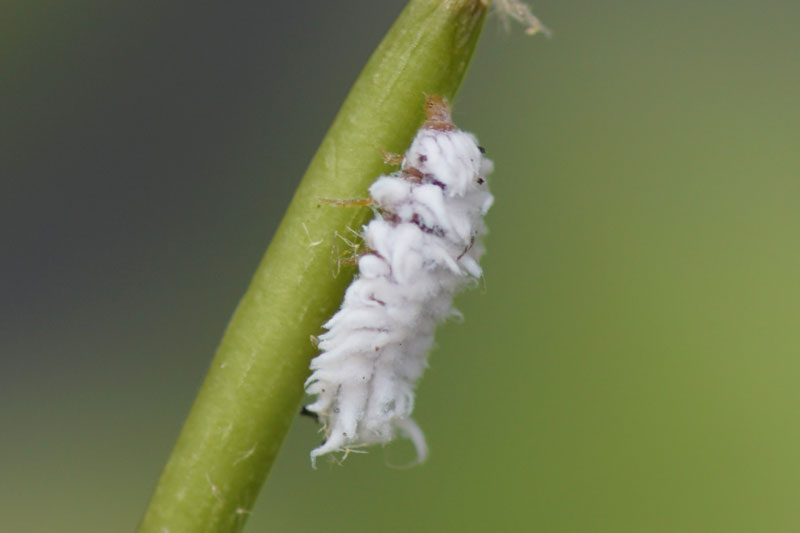
Ladybugs, which are unknown to many people. They are very tiny ladybugs of about 2 mm. In the Netherlands there are 25 known species, including 23 native species.
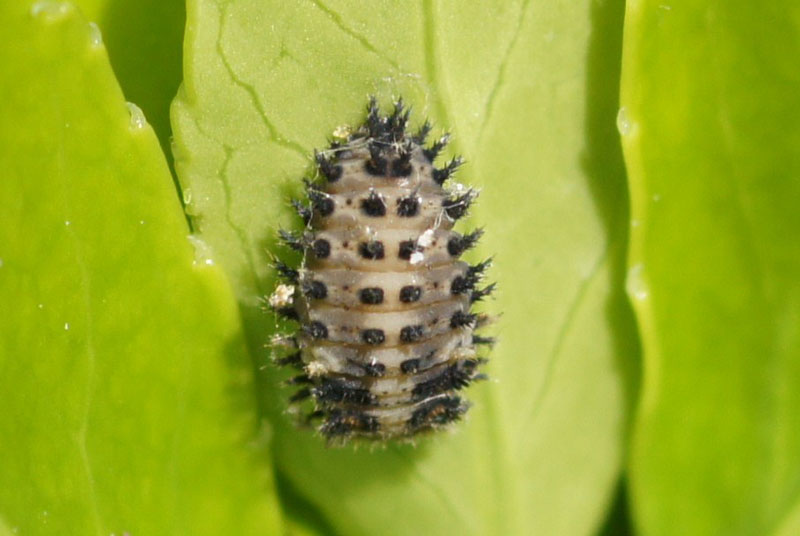
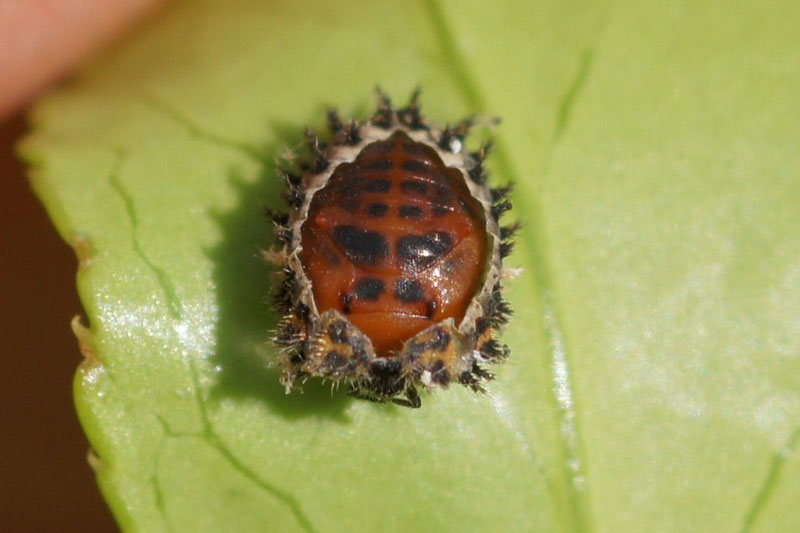
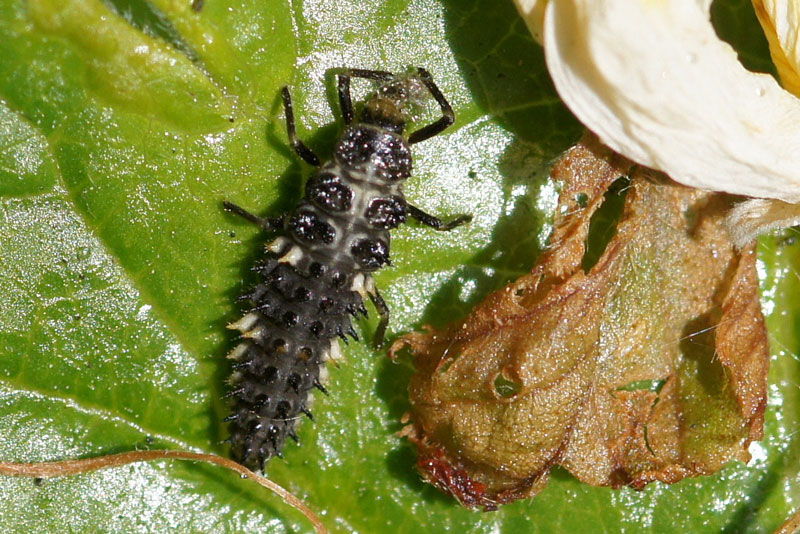
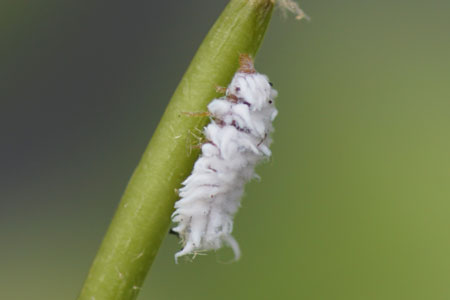 Larva of the subfamily Scymninae. Family
ladybirds / ladybugs (Coccinellidae).
Larva of the subfamily Scymninae. Family
ladybirds / ladybugs (Coccinellidae).
The larvae of the subfamily Scymninae secrete white wax hairs. That woolly white wax covered almost the entire larva. Photo 7-7-2019.
|
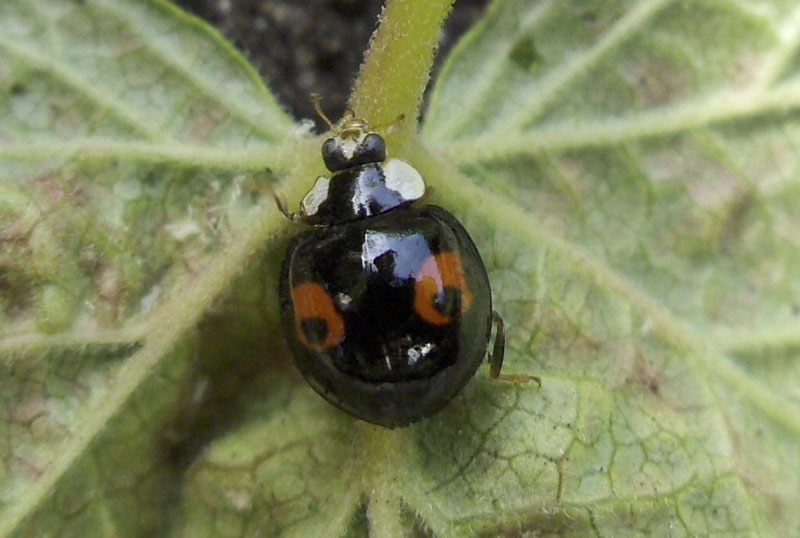
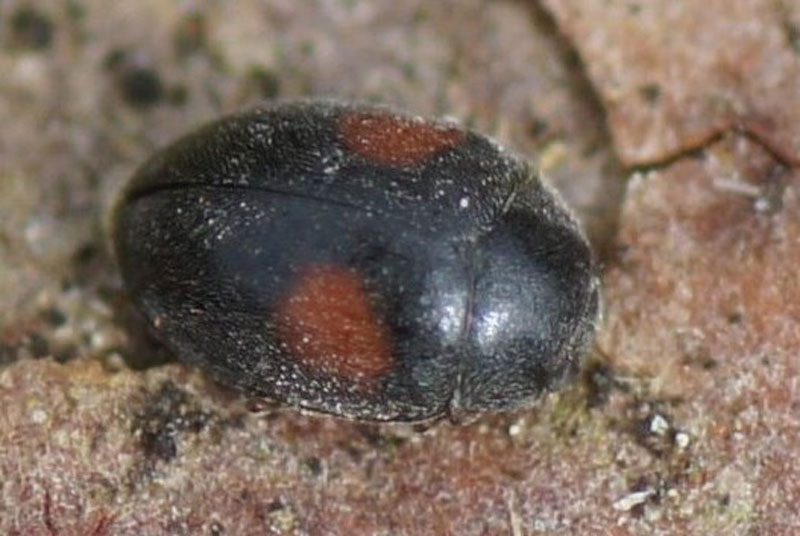
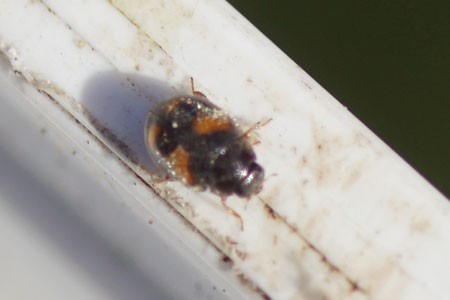 Ivy Ladybird (Nephus quadrimaculatus). Genus Nephus.
Subfamily Scymninae. Family
ladybirds / ladybugs (Coccinellidae).
Ivy Ladybird (Nephus quadrimaculatus). Genus Nephus.
Subfamily Scymninae. Family
ladybirds / ladybugs (Coccinellidae).
A small, hairy, black ladybug with two orange-red spots on each elytra. I actually thought it was another one of the unidentifiable small black ladybugs when it walked over the edge of my bowl. Because it also contained an interesting parasitic wasp, I didn't pay much attention to it. It wasn't until I looked at the photo that I noticed the spots. I had shaken it from the ivy on our wall. It grows in ivy on the sunny side.
Length 1.5-2.5mm. Photo 14-10-2023.
|
 .. ..
 . .
 . .
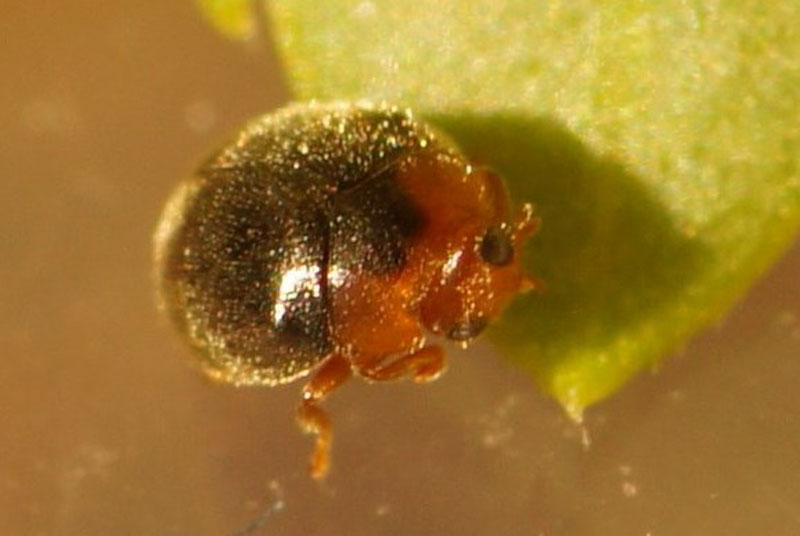
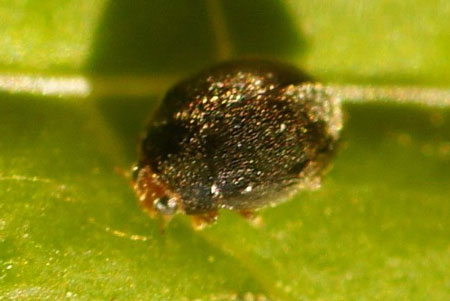
 Scymnus spec. Genus Scymnus.
Subfamily Scymninae. Family
ladybirds / ladybugs (Coccinellidae). Maybe a female Scymnus auritus,
but to have certainty they need to be under the microscope.
Scymnus spec. Genus Scymnus.
Subfamily Scymninae. Family
ladybirds / ladybugs (Coccinellidae). Maybe a female Scymnus auritus,
but to have certainty they need to be under the microscope.
In 2014 I saw the first Scymnus. Before I could make a clear picture of the 2 mm large
beetle, it had disappeared.
Dark and hairy. Head, legs and backside are orange red. It looks like Scymnus
auritus.
Photos 20-4-2014.
|
 .. ..
 . .
 . .
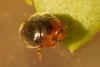 . .
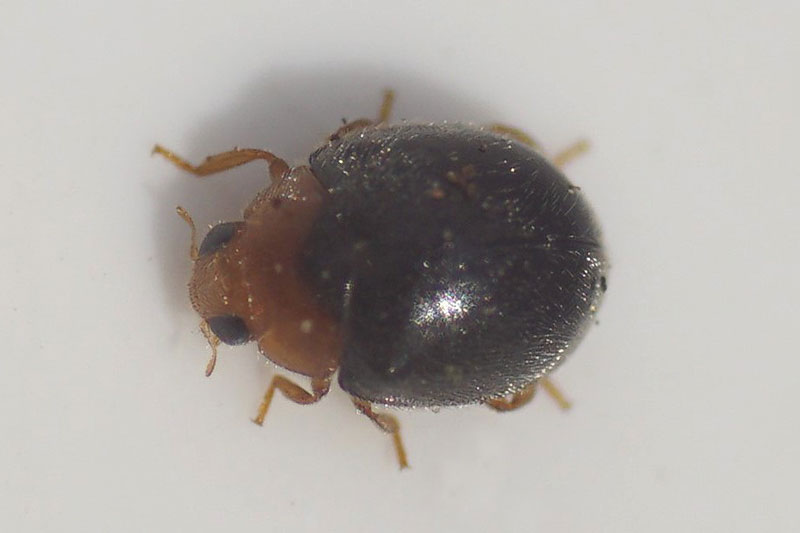
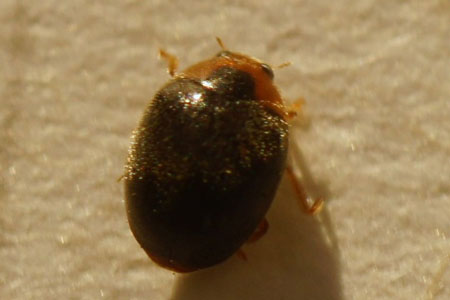
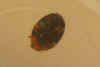 Scymnus spec. Genus Scymnus.
Subfamily Scymninae. Family
ladybirds / ladybugs (Coccinellidae). Maybe a male Scymnus auritus, but to have certainty they need to be under the
microscope.
Scymnus spec. Genus Scymnus.
Subfamily Scymninae. Family
ladybirds / ladybugs (Coccinellidae). Maybe a male Scymnus auritus, but to have certainty they need to be under the
microscope.
Two days later I saw another Scymnus. This ladybug flew away before I could take more pictures.
Dark and hairy. Cup, legs, antennae and back are orange. Maybe it's a male Scymnus
auritus. In the male, the pronotum is orange red with black in the middle. The pronotum of the female is the completely black.
Food: mites. Length 2-2,5 mm. Photos 22-4-2014.
|
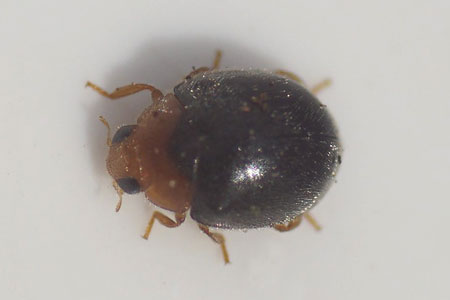 .. ..
 Scymnus rubromaculatus. Male. Genus Scymnus.
Subfamily Scymninae. Family
ladybirds / ladybugs (Coccinellidae).
Scymnus rubromaculatus. Male. Genus Scymnus.
Subfamily Scymninae. Family
ladybirds / ladybugs (Coccinellidae).
Wide oval, 1.8-2.3 mm, rather curved. Only the male's head and pronotum are red. Antenna and mouth parts are yellow. Looks like Scymnus auritus, but it has a black
edge at the end of the elytra. Photos 2-4-2019.
|
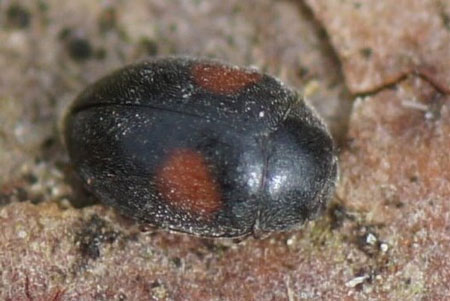 .. ..
 Scymnus spec. Genus Scymnus.
Subfamily Scymninae. Family
ladybirds / ladybugs (Coccinellidae). It looks like Scymnus schmidti, Not
in the garden, but in the dunes about 4 km from our house.
Scymnus spec. Genus Scymnus.
Subfamily Scymninae. Family
ladybirds / ladybugs (Coccinellidae). It looks like Scymnus schmidti, Not
in the garden, but in the dunes about 4 km from our house.
This Scymnus was slightly larger. Scymnus schmidti has a red spot on the black, hairy
elytron. But the black form of Scymnus frontalis and Scymnus mimulus has also these spots. Unfortunately, antennae and legs are not visible.
Length 2,5 - 3 mm.
Photos 25-6-2014. |
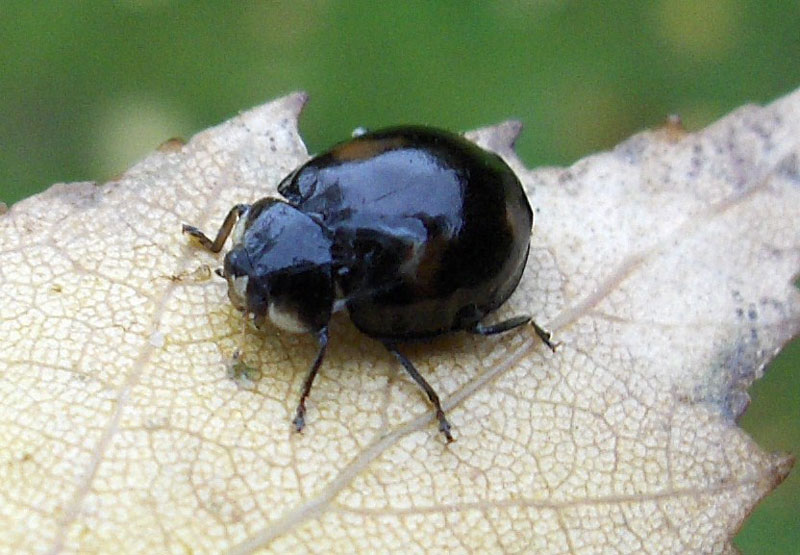
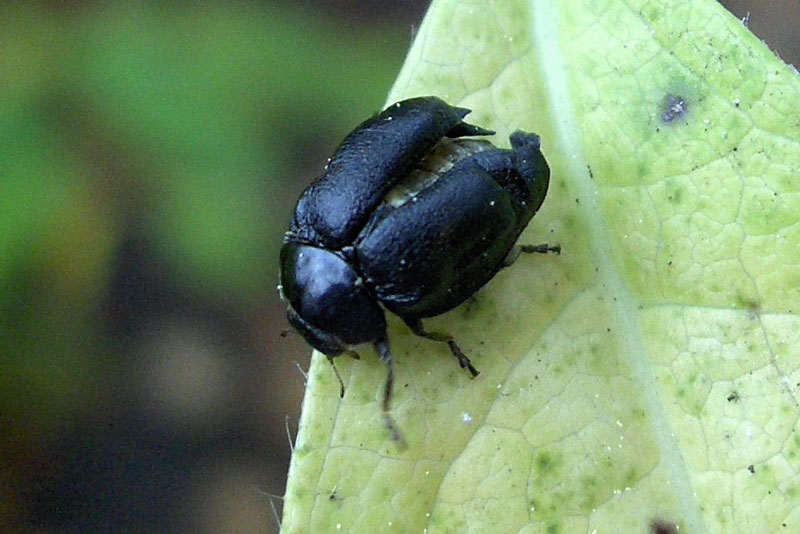
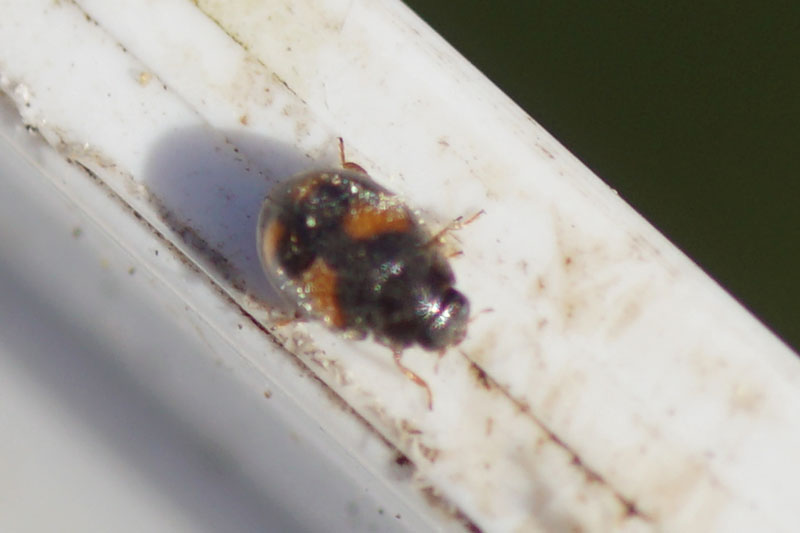
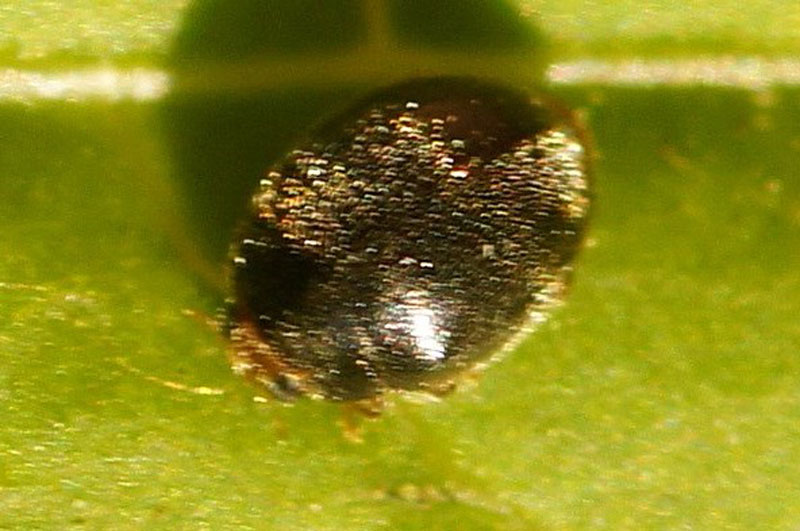
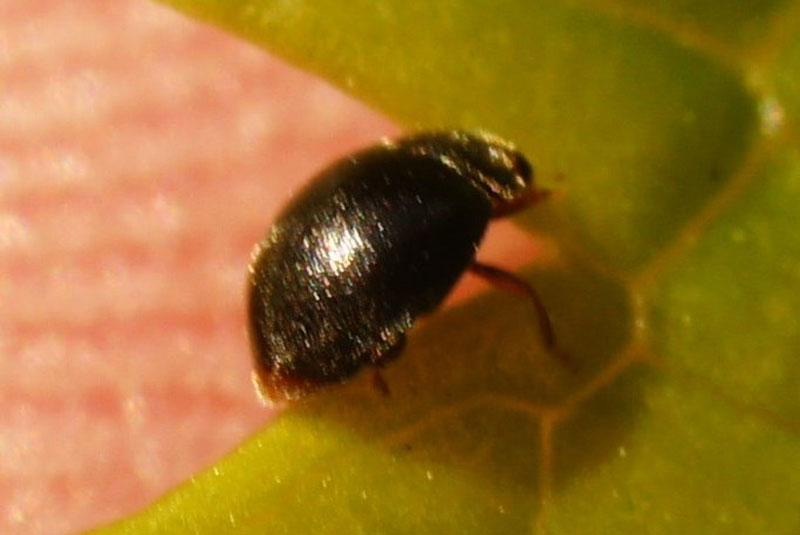
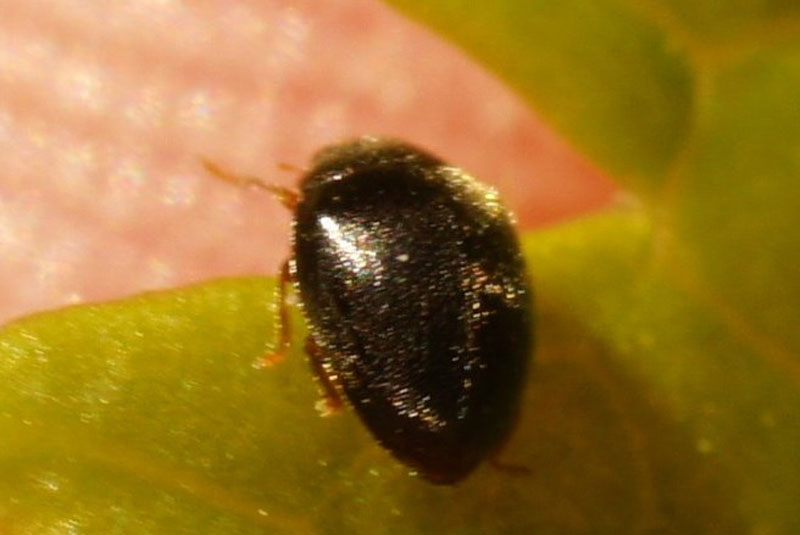
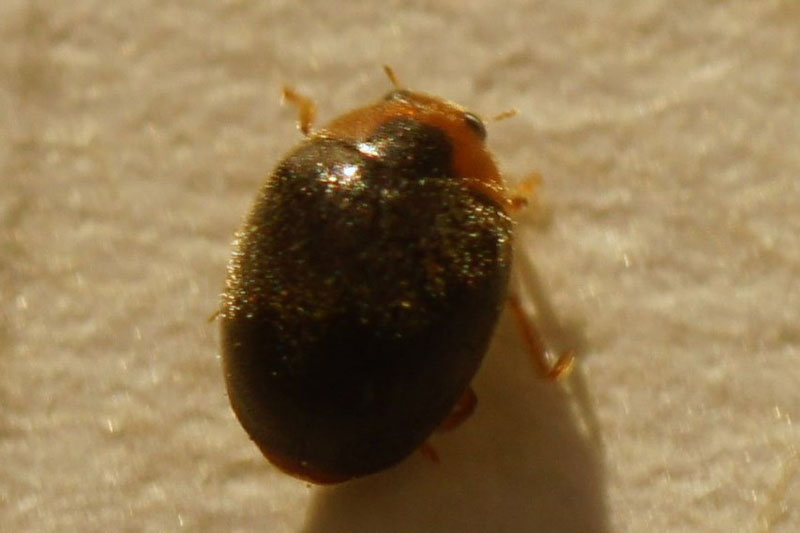
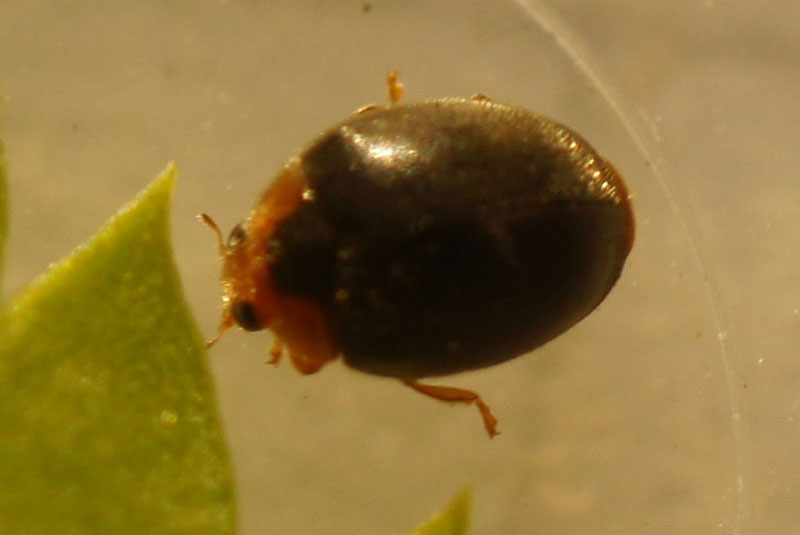
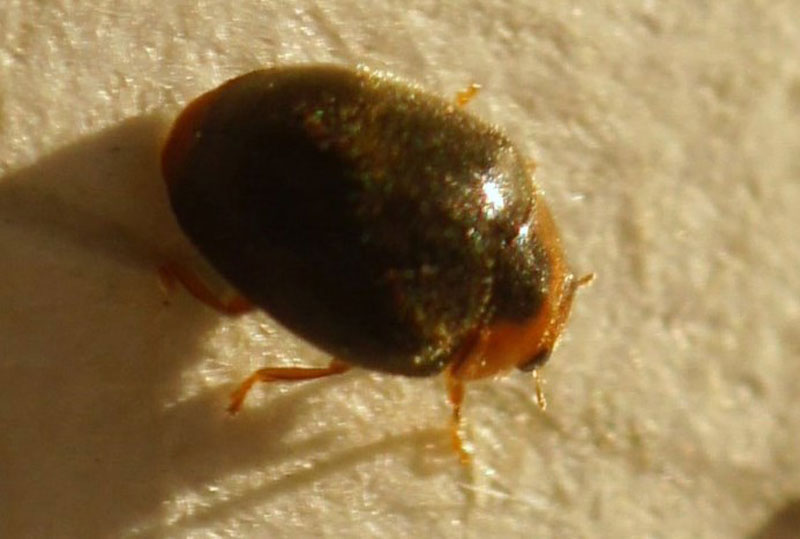
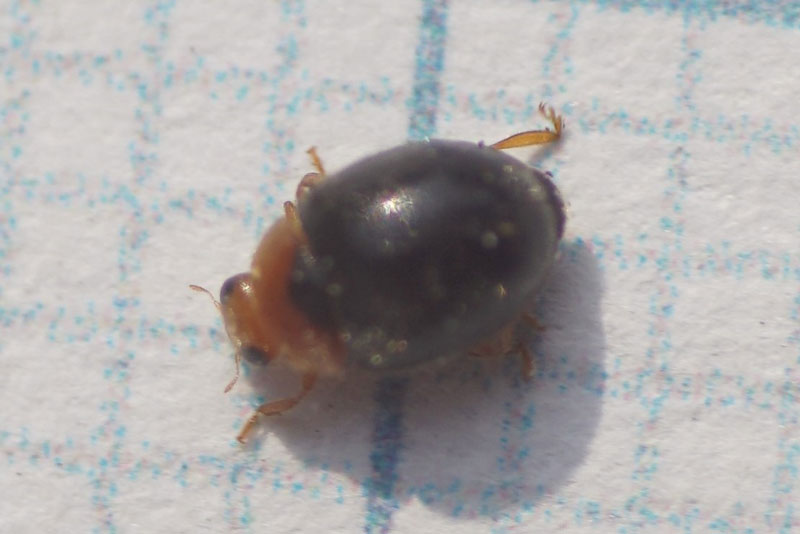
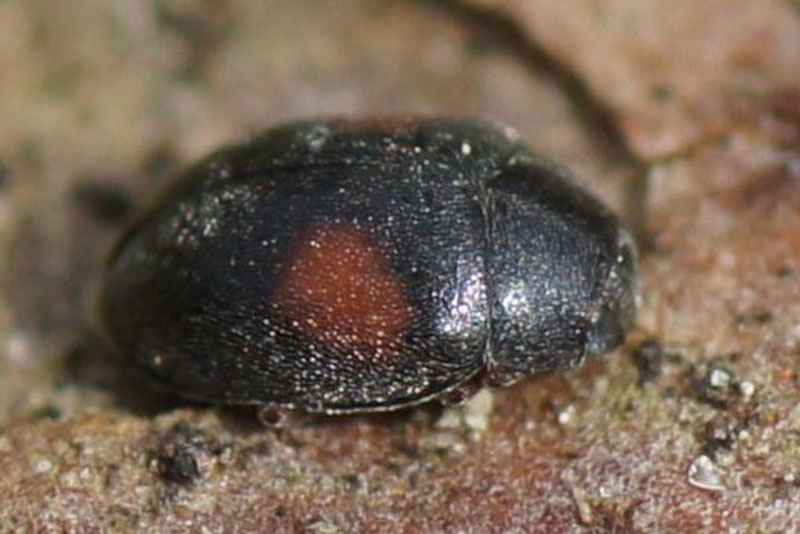
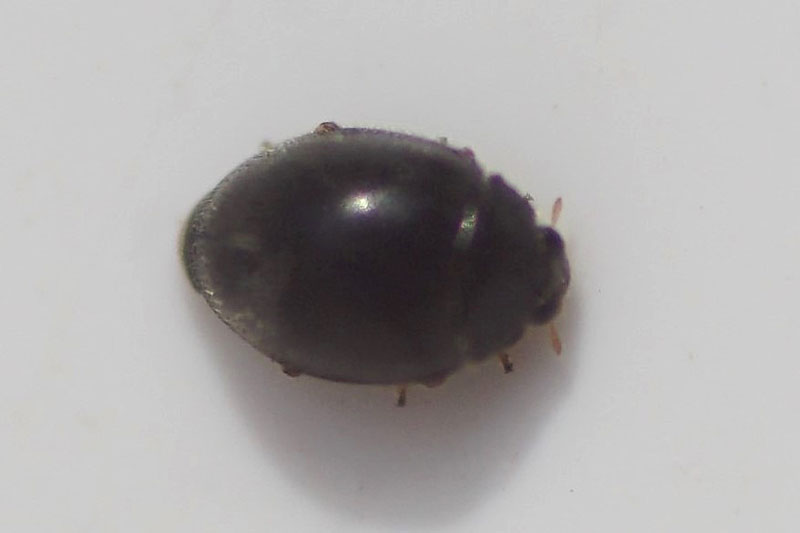
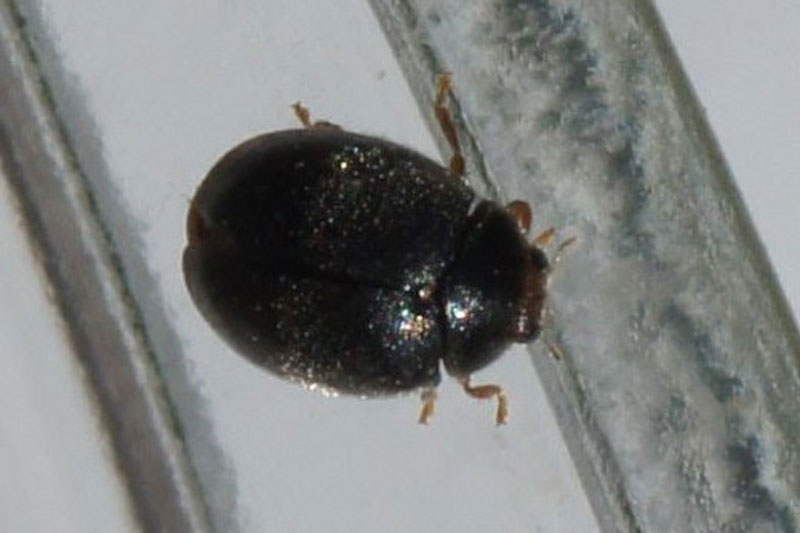
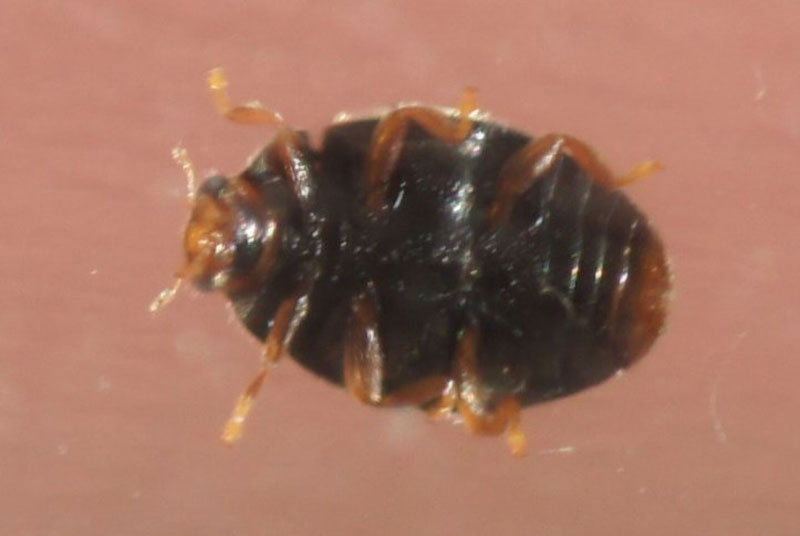
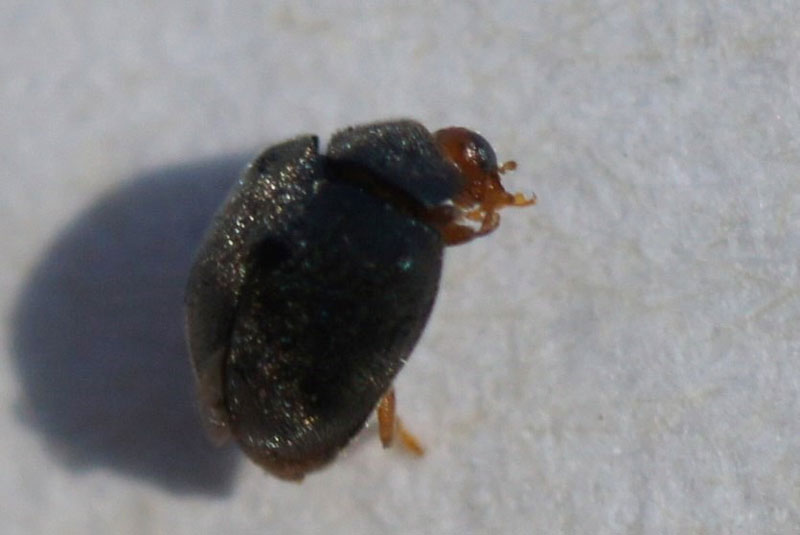
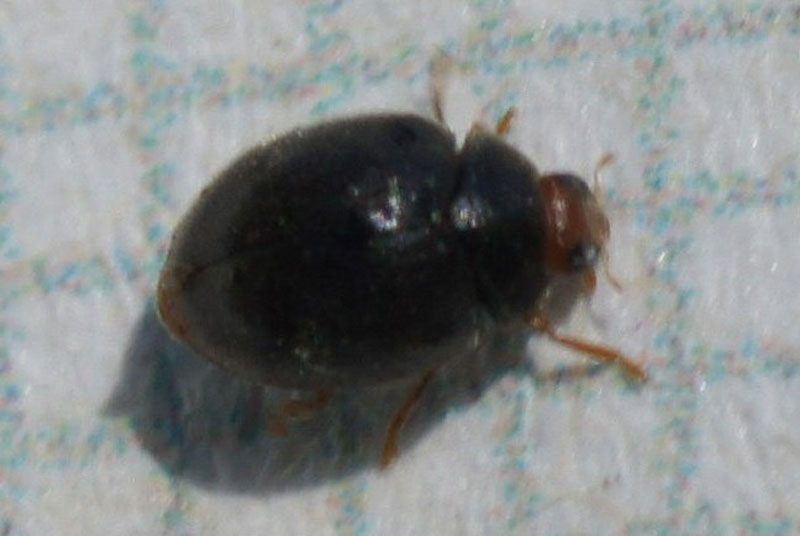
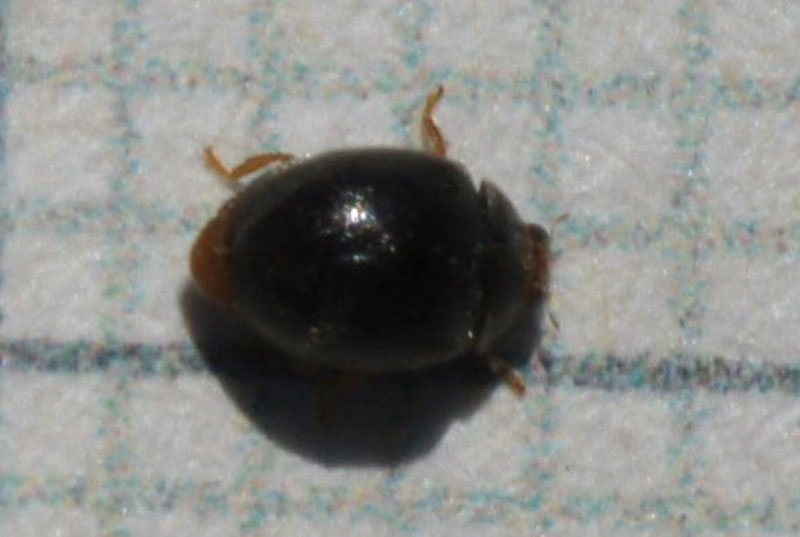
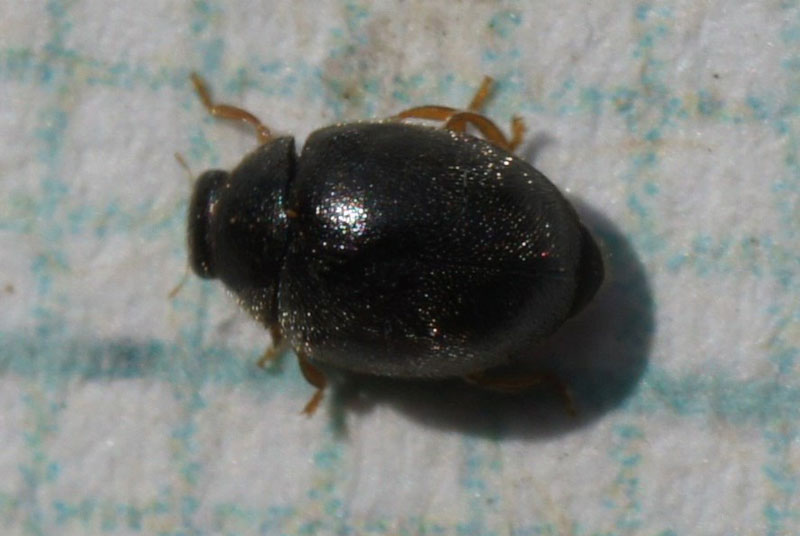
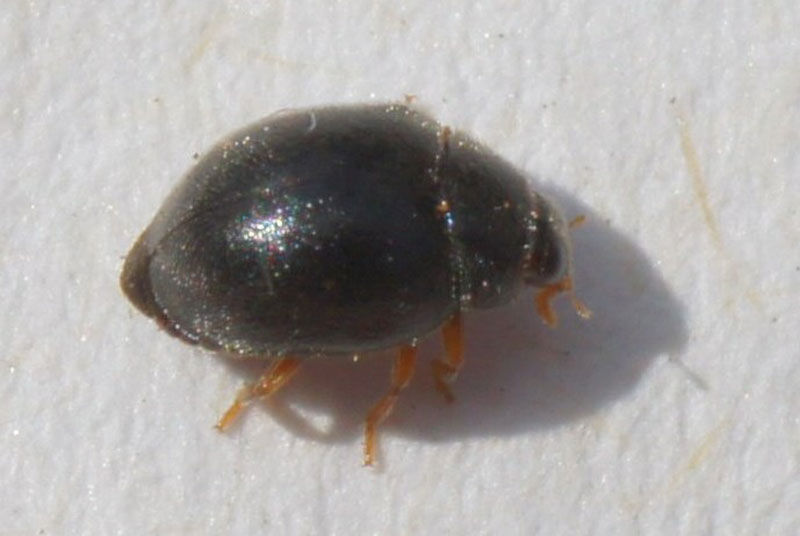
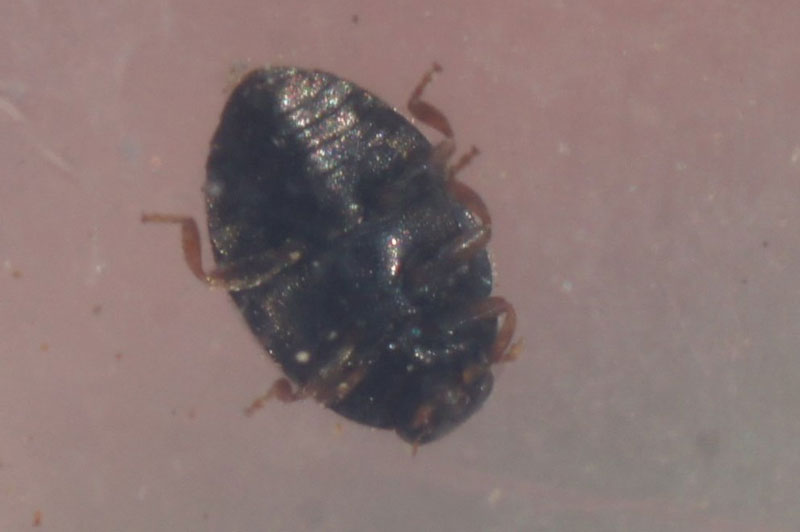
Black species from the subfamily Scymninae, which can not be determined from a picture at all. They can belong to the following genera: Scymnus, Nephus and (for black species) also Stethorus. These genera and species are usually to determine only after microscopic examination. (Jan Cuppen thanks for the explanation). I can send them for examination, but I know again no name, when I find the next small black ladybird. So I let them go.
An exception:
| Stethorus punctillum Synonym: Stethorus pusillus
Very similar to Scymnus ater en Scymnus nigrinus.
Different from black Scymnus species due to their hair on the wing seam, which is directed towards the sides of the Scymnus species, but with Stethorus the hair is parallel to the seam.
various spider mites and small aphid species.
1,2-1,5 mm. Very small! Photos 3-10-2018.
 Detail of the hairs.
 |
| Subfamily Scymninae: Scymnus,
Nephus or Stethorus.
 Photos 30-6-2015.
|
| Subfamily Scymninae: Scymnus,
Nephus or Stethorus.
 Photos 30-6-2015.
|
| Subfamily Scymninae: Scymnus,
Nephus or Stethorus.
 Photos 18-9-2015.
|
I want to thank everyone, who has helped me on "waarneming.nl" to identify.
Nederlands /
Dutch
 
Subpage beetles:
Ground
beetles (Carabidae)
Leaf
beetles (Chrysomelidae)
Snout
beetles, weevils Longhorn
beetles, similar to longhorn beetles
Rove
beetles (Staphylinidae)
Small
beetles
Subpage France: Insects
France
|