|
Subpage beetles:
Ground
beetles (Carabidae)
Leaf
beetles (Chrysomelidae)
Snout
beetles, weevils Longhorn
beetles, similar to longhorn beetles
Ladybirds,
Ladybugs, Coccinellidae
Rove
beetles (Staphylinidae)
Small
beetles
 Nederlands /
Dutch Nederlands /
Dutch
Leaf beetles in the garden
Leaf beetle (Chrysomelidae).
There are many species of the family of leaf beetles. They usually have striking
colours. They are almost all herbivores. And therefore often harmful.
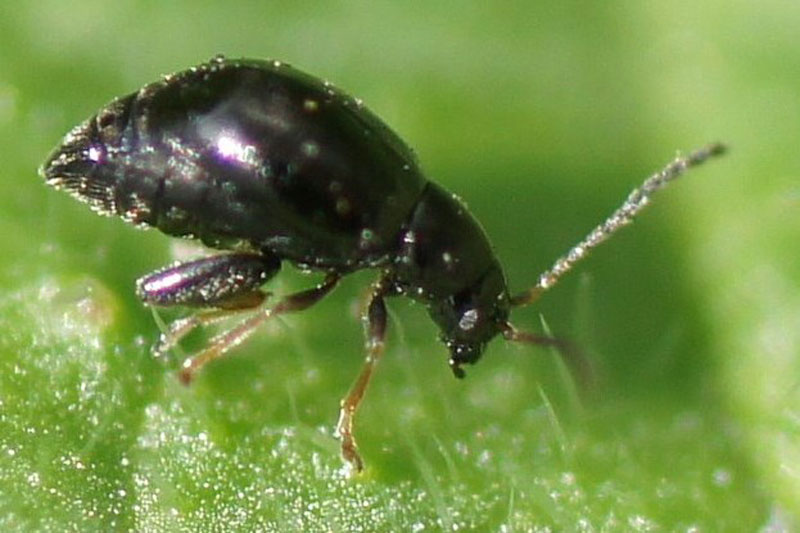
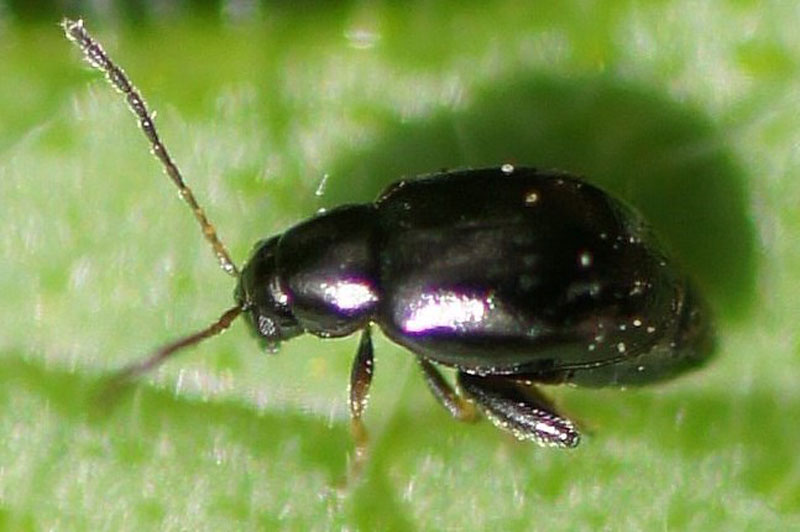
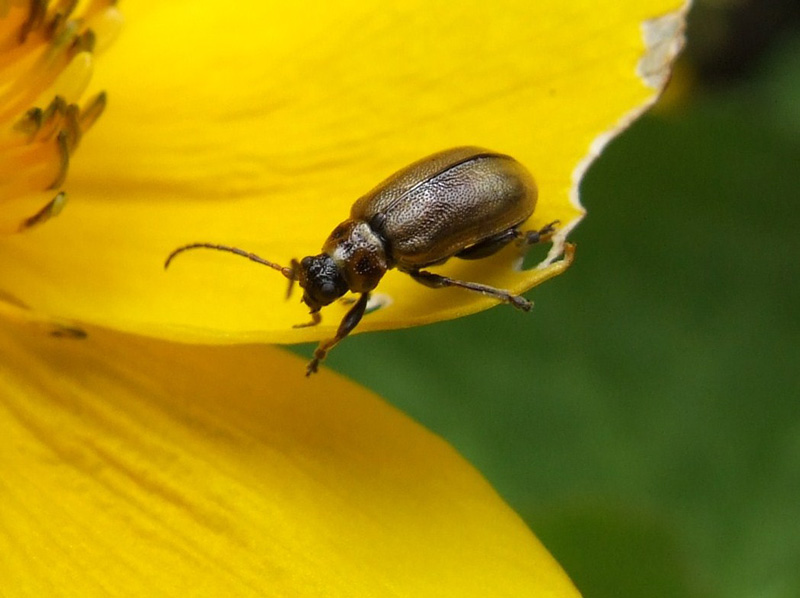
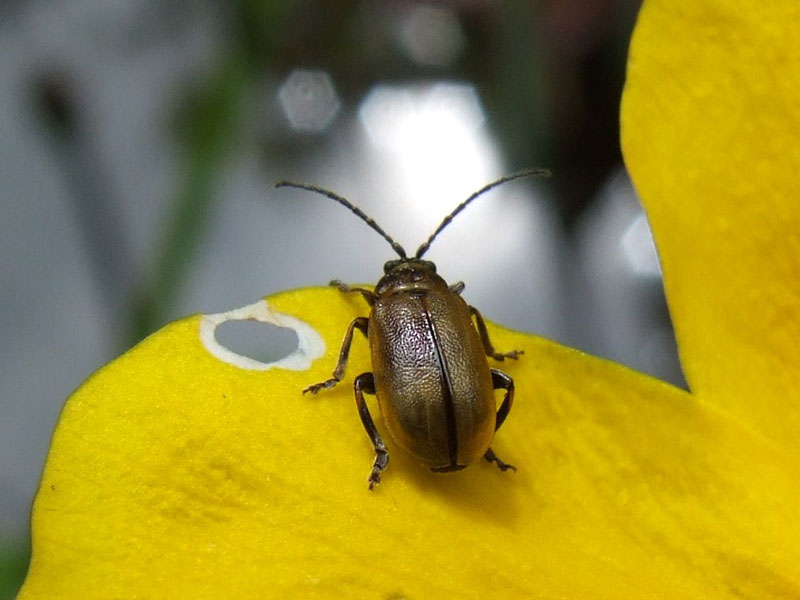
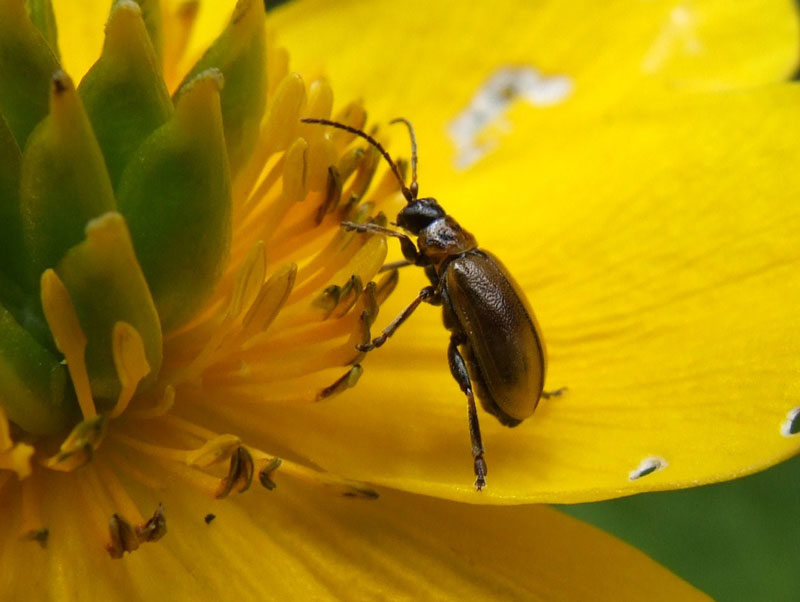
Flea beetle. Subfamily Alticinae.
Many small leaf beetles are good jumpers. They are recognizable by the muscular hind legs. There are many
species.
 .. ..
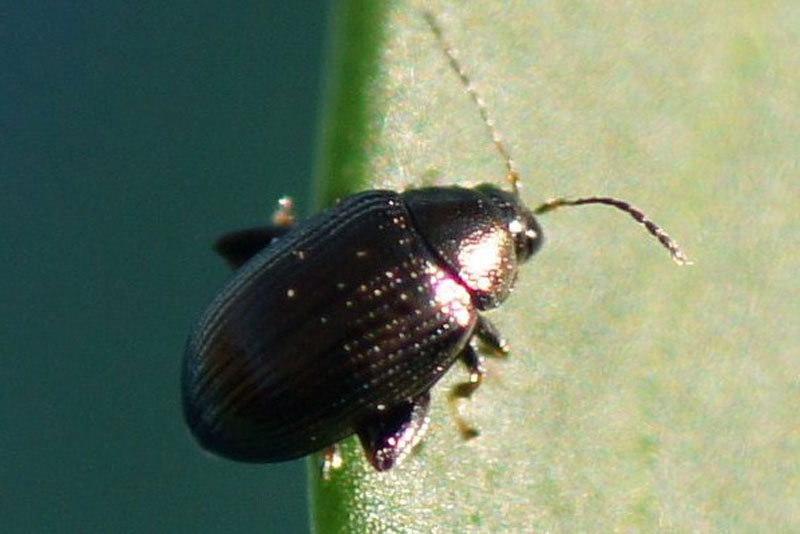
 Alticinae, maybe an Aphtona or Longitarsus-speci. Family
Chrysomelidae.
Alticinae, maybe an Aphtona or Longitarsus-speci. Family
Chrysomelidae.
Lots of flea beetles are from a photo unrecognizable.
Length about 2 mm. Photos 11-10-2012.
|
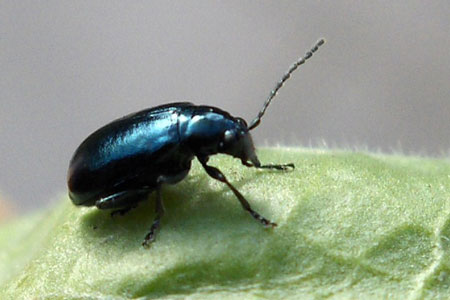 .. ..
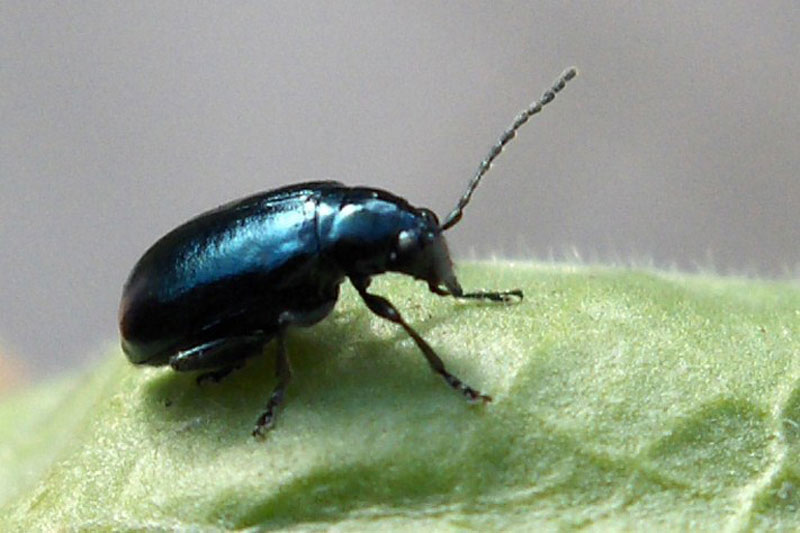
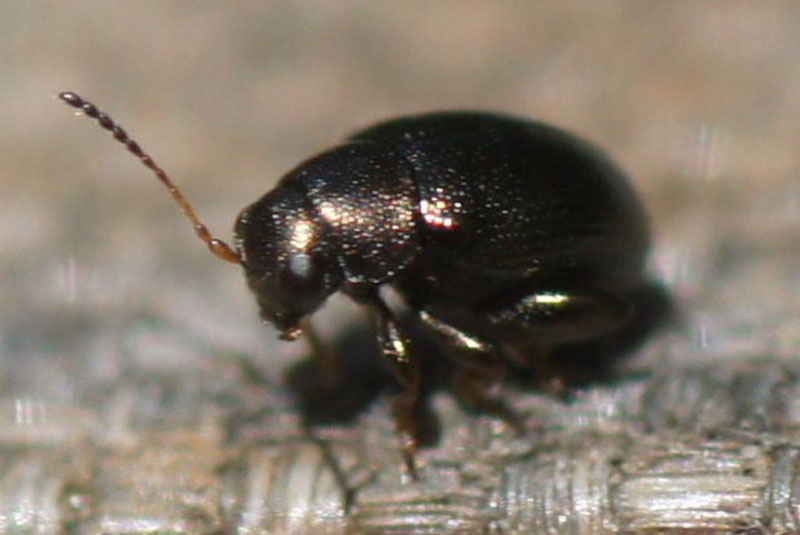
 Altica oleracea synonym Haltica oleracea. Subfamily
Alticinae. Family Chrysomelidae.
Altica oleracea synonym Haltica oleracea. Subfamily
Alticinae. Family Chrysomelidae.
It lives on the Evening
Primrose. That's the difference with other blue flee beetles. It's also a
good jumper. It damages the plant. But the plant will survive. Length 3 - 4 mm.
Photos 1-4-2008.
|
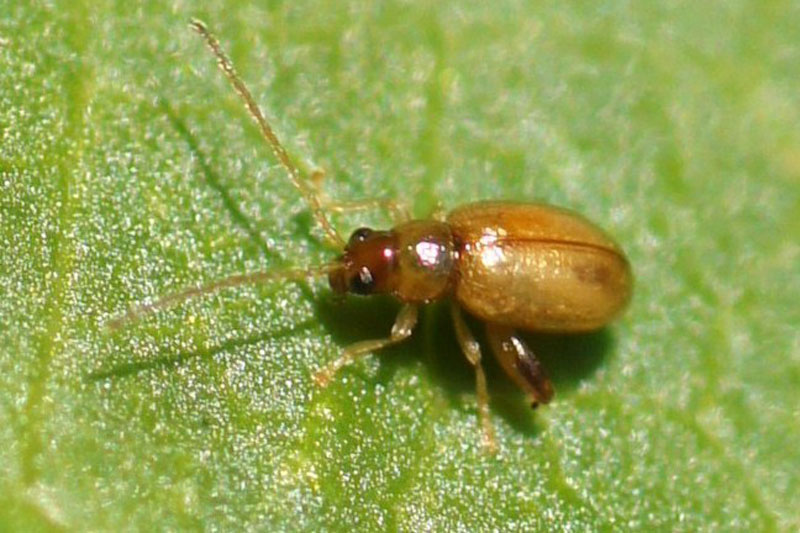
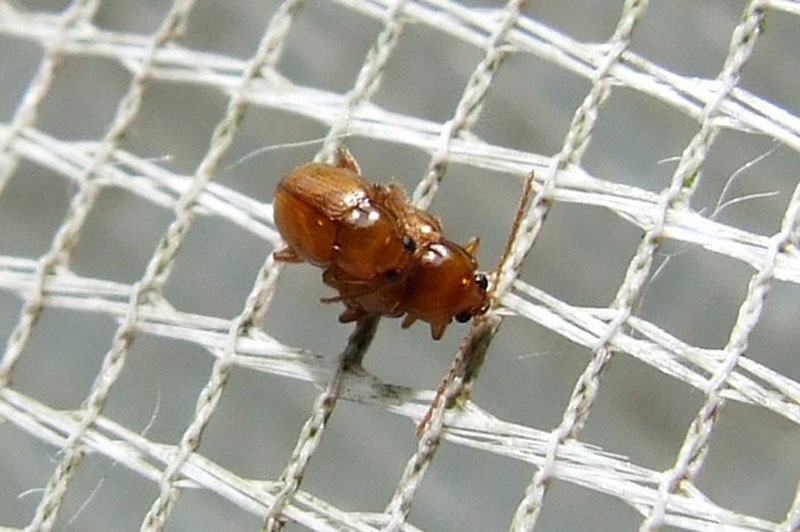
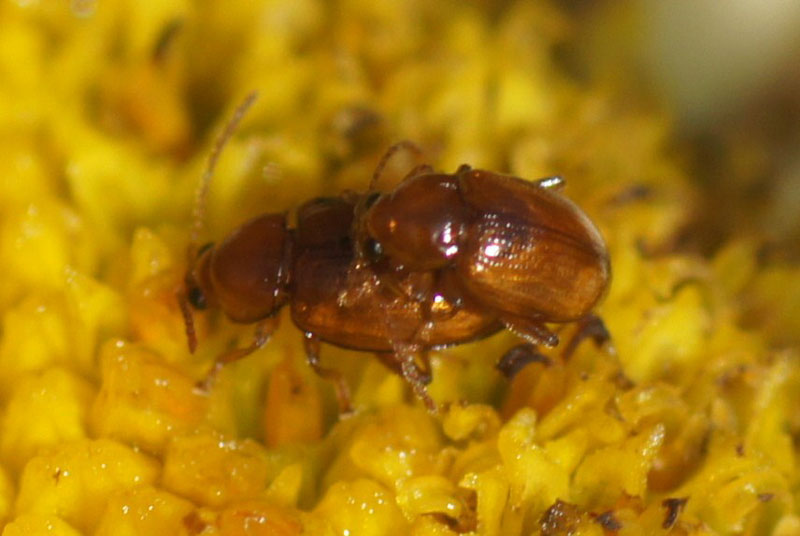
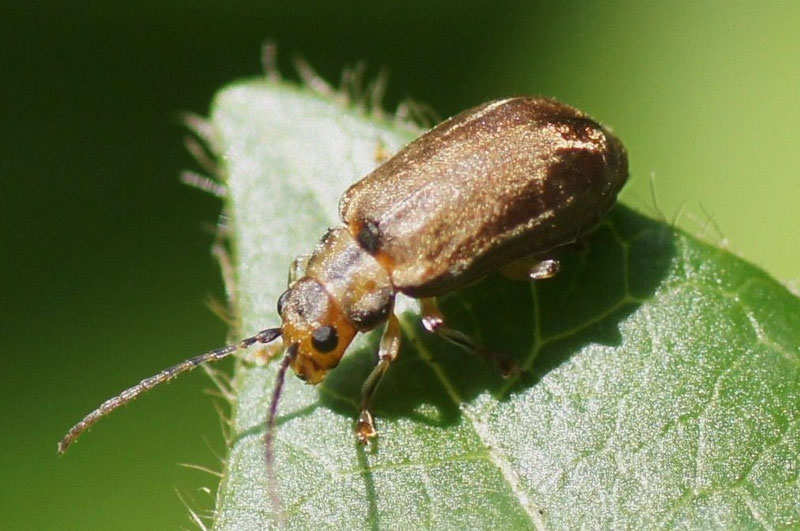
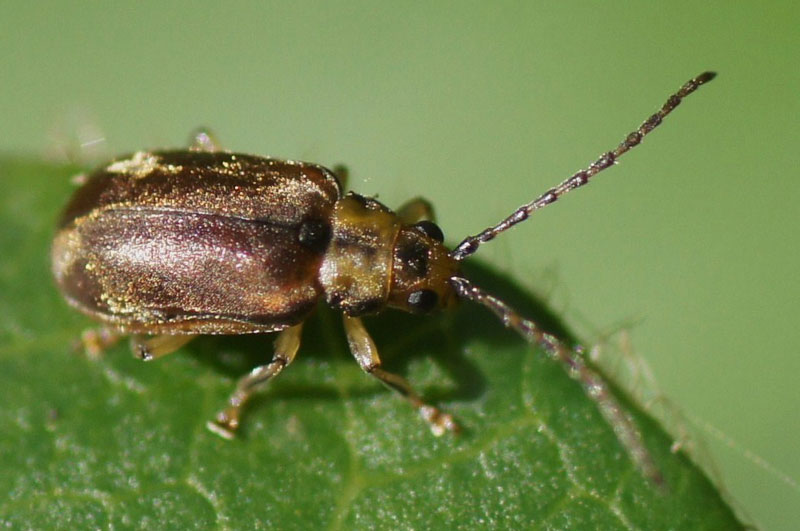
Subfamily Galerucinae.
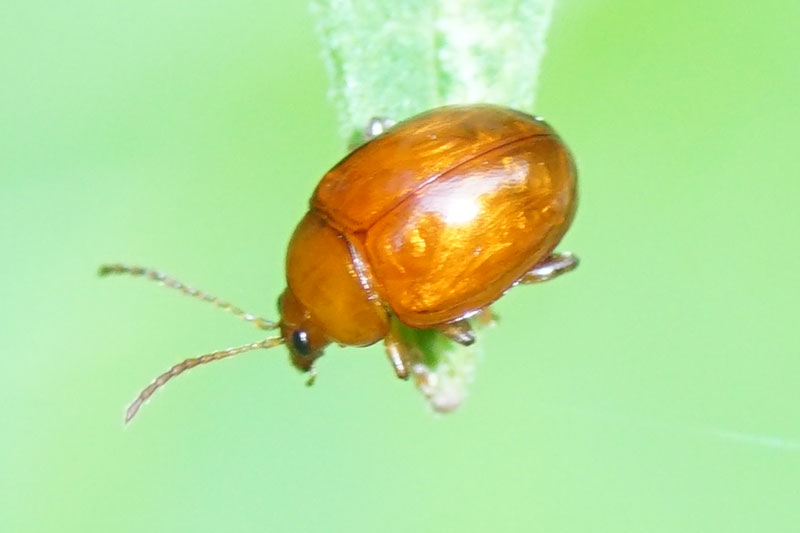
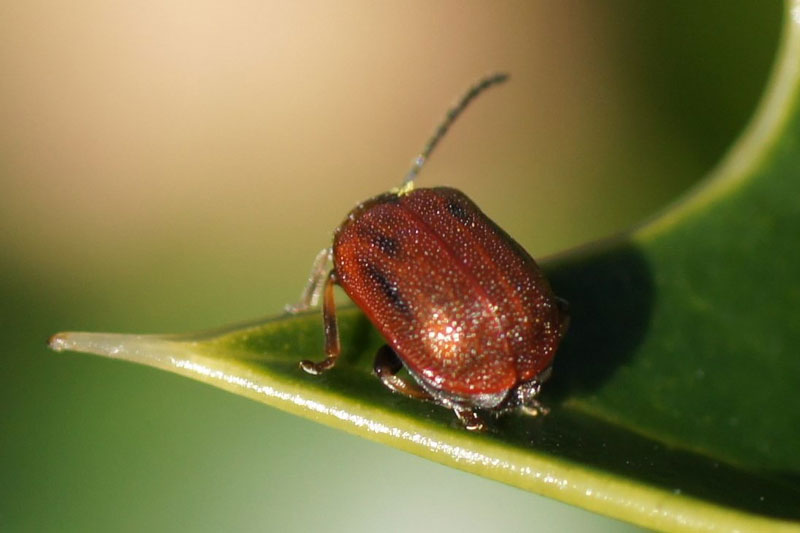
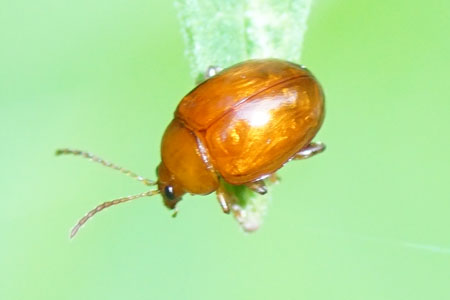 Sphaeroderma. Sphaeroderma rubidum or Sphaeroderma testaceum
Subfamily Galerucinae.
Family Chrysomelidae.
Sphaeroderma. Sphaeroderma rubidum or Sphaeroderma testaceum
Subfamily Galerucinae.
Family Chrysomelidae.Sphaeroderma rubidum and Sphaeroderma testaceum are difficult to distinguish from a photo.
There is a detailed explanation on Waarneming
(in Dutch). Photo 2-7-2025.
|
Subfamily Halticinae.
Sometimes you can find Chaetocnema
in the subfamily Halticinae. Like in Coleonet.de.
Sometimes in in the subfamily Galerucinae.
Like in Bugguide.
Not jumping leaf beetles.
Subfamily Bruchinae.
Subfamily Cassidinae.
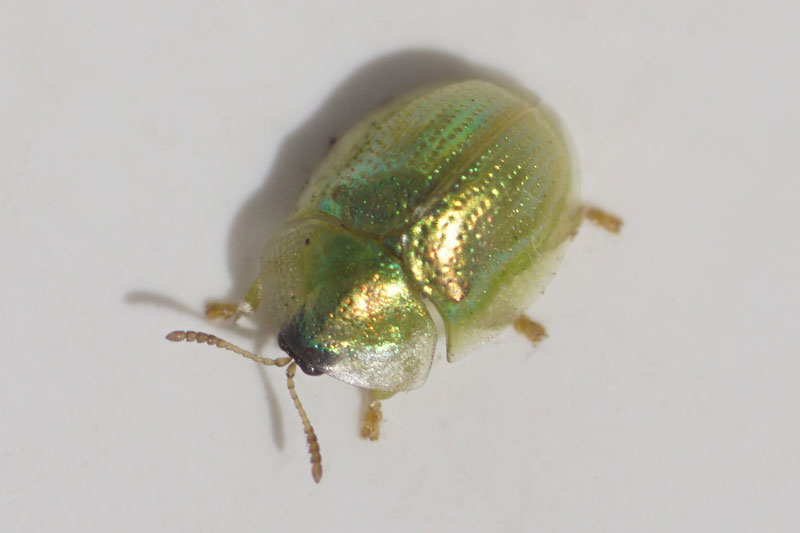
 Cassida margaritacea. Subfamily Cassidinae. Family Chrysomelidae. Not in the garden, but in a meadow about 3 km from our house.
Small and shiny. Yellow with a green sometimes purple sheen. The rows of dots are even. The head is black.
Length 3.5-4.5 mm.
Host plants are among others called spurry (Spergula), Silene and
Centaurea.
Europe, Asia Minor. Photo's 18-8-2018.
|
Subfamily Criocerinae.
 .. ..
 . .
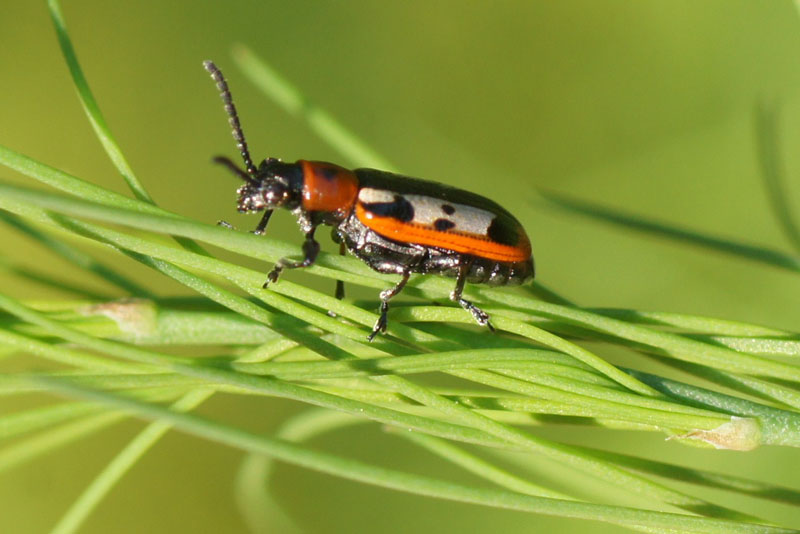
 Common asparagus beetle (Crioceris asparagi). Tribe Criocerini. Subfamily Criocerinae. Family
Chrysomelidae.
Common asparagus beetle (Crioceris asparagi). Tribe Criocerini. Subfamily Criocerinae. Family
Chrysomelidae.
The asparagus beetle has shiny, blue-black elytra with a red border. On the elytra are white spots. Sometimes there is more white, as you see the left photo. The thorax is red. The head, legs and antennae are black. The larvae
are brownish gray, olive green and also feed like the beetle on the asparagus.
They pupate after about three weeks in the soil. There are two generations per year. The roots of the asparagus are not happy
eaten.
Length about 6 mm.
April - September.
Europe, North America, Asia. Photos 4-6-2012.
 Larva.
|
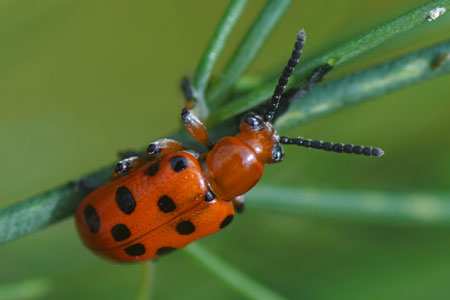 .. ..
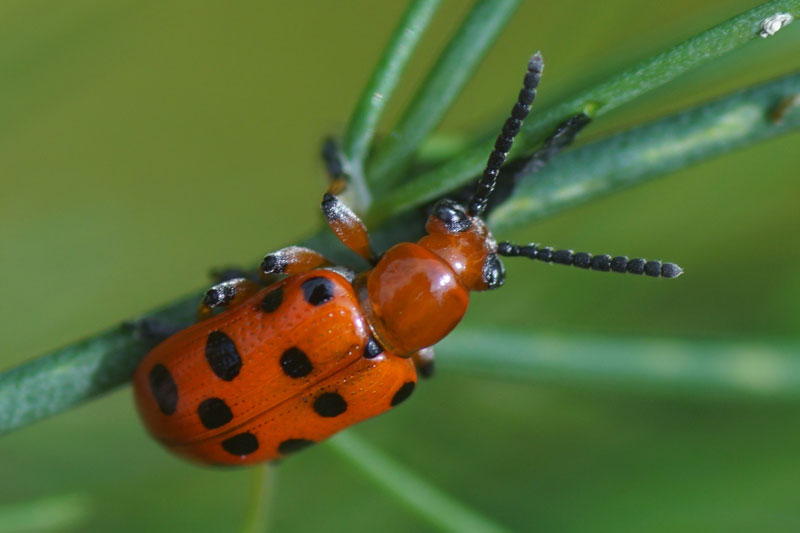
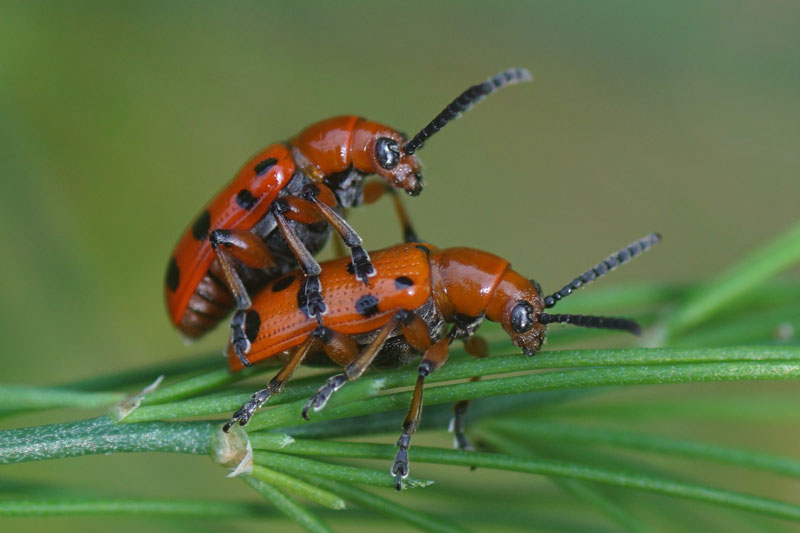
 Spotted asparagus beetle (Crioceris duodecimpunctata). Tribe Criocerini. Subfamily Criocerinae. Family
Chrysomelidae.
Spotted asparagus beetle (Crioceris duodecimpunctata). Tribe Criocerini. Subfamily Criocerinae. Family
Chrysomelidae.
The spotted asparagus beetle has shiny, red elytra with black spots. The
thorax and head is also red. Black antennae. The larva is brown-yellow. In 2019 I saw this
spotted asparagus beetle for the first time.
Length about 6 mm. Europe, North America, Asia. Photos 4-6-2012.
|
 .. ..
 . .
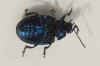 . .
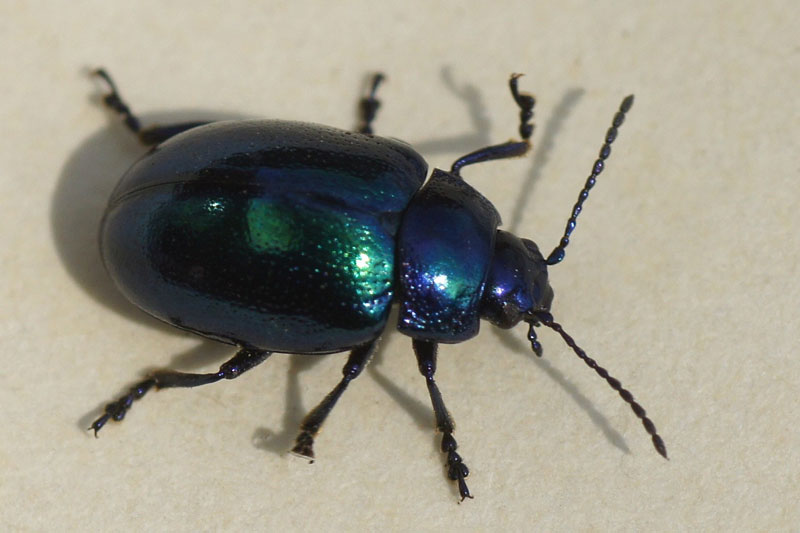
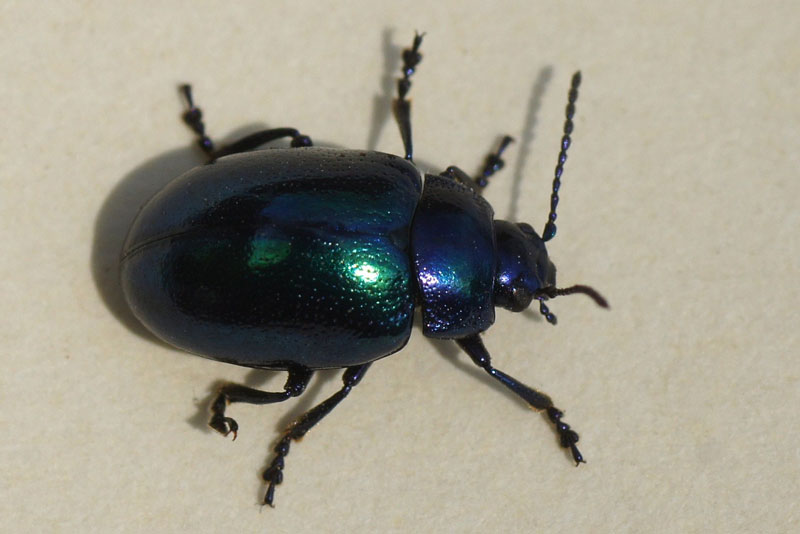
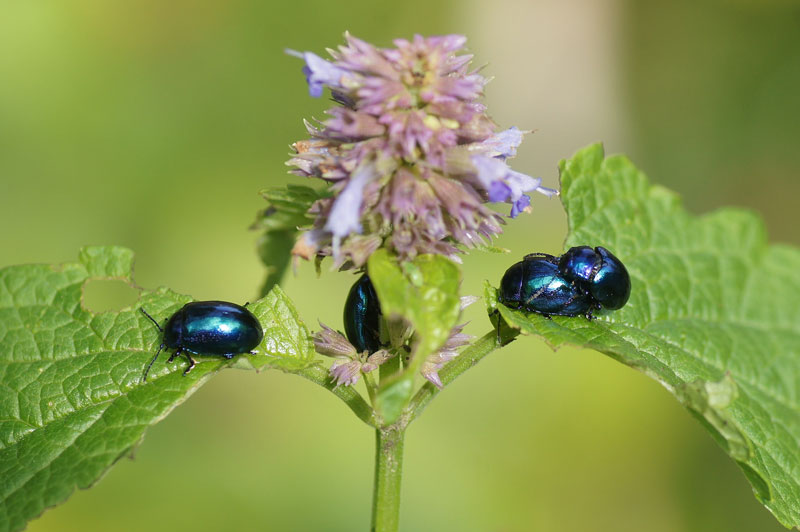
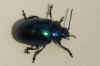
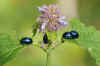 Blue mint beetle. (Chrysolina coerulans). Tribe Criocerini. Subfamily
Criocerinae. Family Chrysomelidae.
Blue mint beetle. (Chrysolina coerulans). Tribe Criocerini. Subfamily
Criocerinae. Family Chrysomelidae.
The colour of the metallic shiny shields is variable. Blue, blue violet, blue-green, blue-black, green or coppery. The legs and antennae are
of the same colour as the body.
Host: Different kinds of mint (Mentha). They like also our Anise hyssop (Agastache
foeniculum).
Length: 6.5 - 9 mm.
Europe, Middle Asia and Asia Minor. April - September.
Photos 2-5-2013, 8-7-2013, 18-9-2013.

 Larva of the blue mintbeetle.
 |
 .. ..
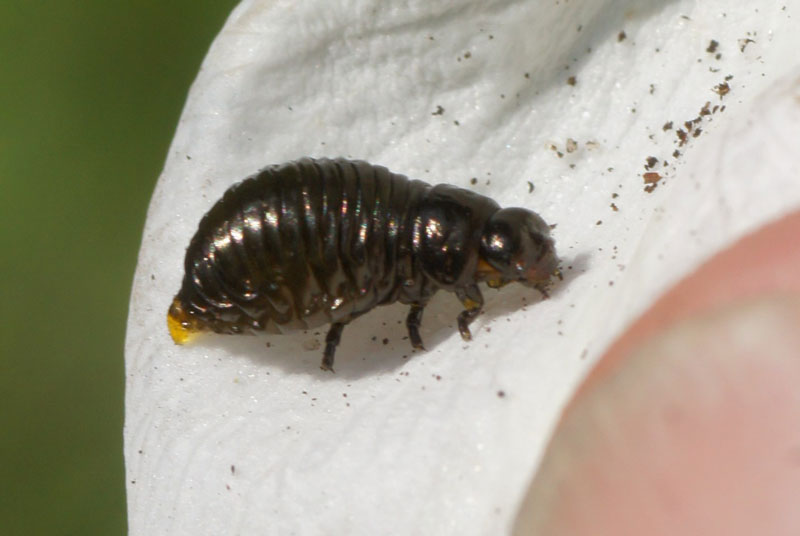
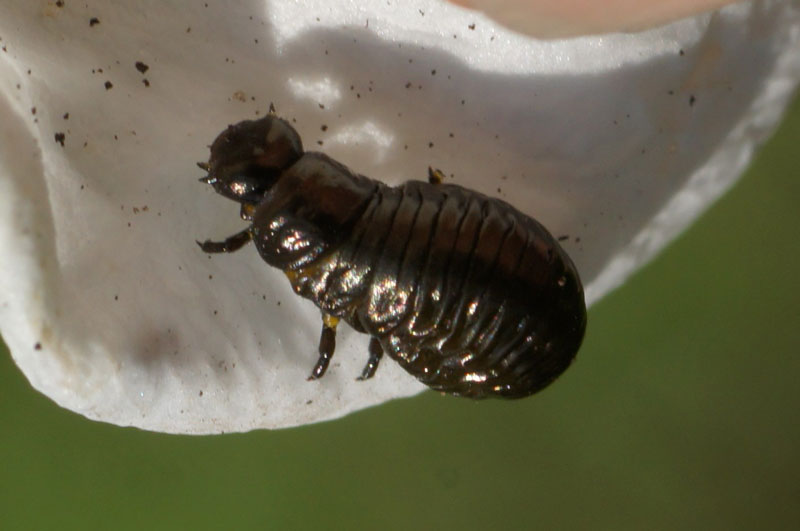
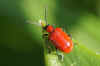 Scarlet lily beetle (Lilioceris lilii). Tribe Criocerini.
Subfamily Criocerinae. Family Chrysomelidae.
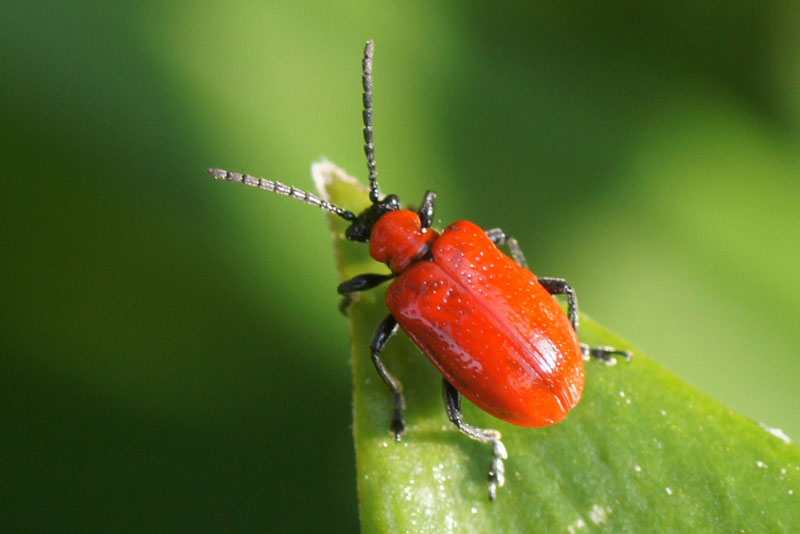
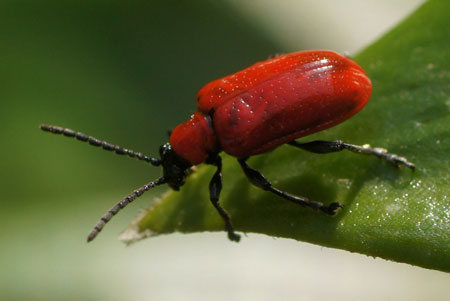
Scarlet lily beetle (Lilioceris lilii). Tribe Criocerini.
Subfamily Criocerinae. Family Chrysomelidae.
This shiny, bright red beetle likes lilies and other members of the family
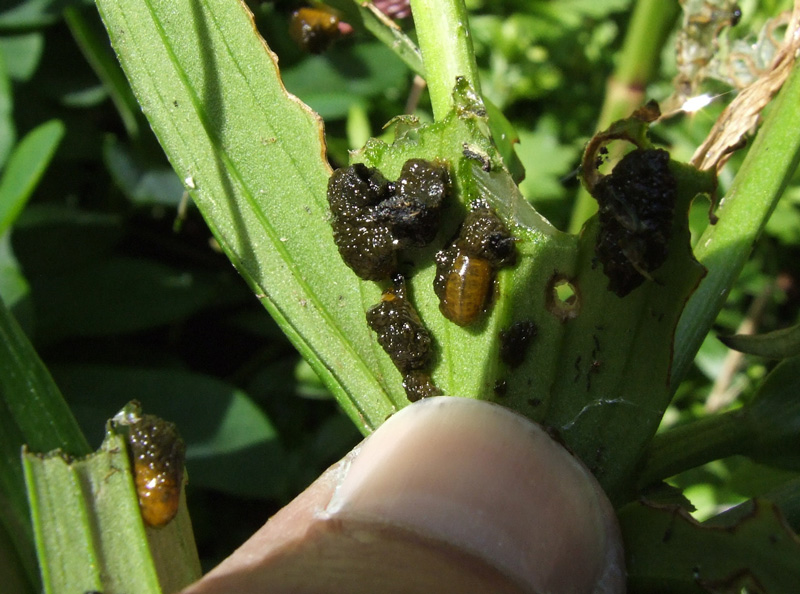
Liliaceae. But the most damage is caused by the larvae.
The beetle don't taste well for birds. The beetle uses the red colour to
warn enemies. The larvae make a protective shield with their own frass.
They overwinter as adults. For several months the females lay eggs on the
underside of a leave. The larva pupate in the ground.
Length: 8 -11 mm. Photos 20-8-2012, 13-6-2009.
German: Lilienhähnchen French: criocère
du lis
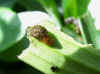
 Larva.
|
 .. ..
 . .
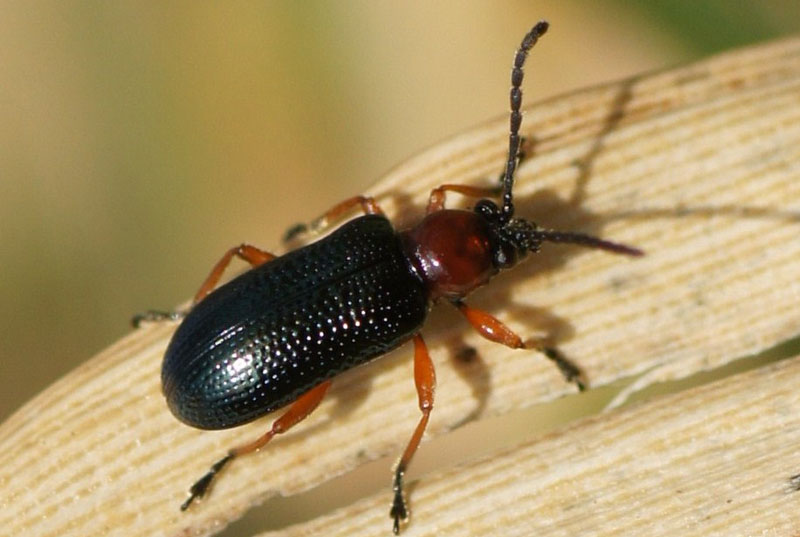
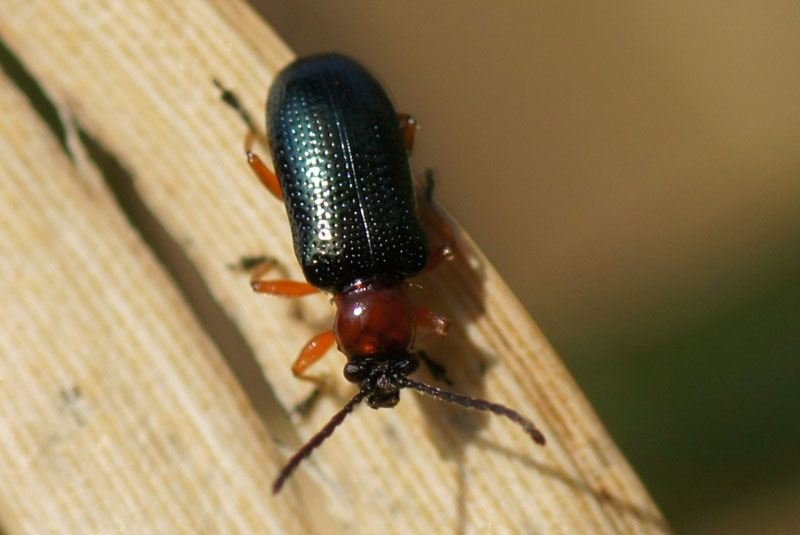
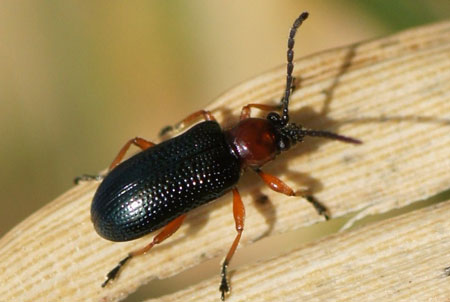
 Oulema melanopus or Oulema duftschmidi. Tribe Lemini.
Subfamily Criocerinae. Family Chrysomelidae.
Oulema melanopus or Oulema duftschmidi. Tribe Lemini.
Subfamily Criocerinae. Family Chrysomelidae.
Oulema melanopus and Oulema duftschmidi are very similar.
The pronotum and legs are bright red. The head and carapace are dark blue.
Small, but very striking.
It lives on grasses and cereals.
Length: 4 - 5 mm.
April - September.
Photos 27-3-2012.
|
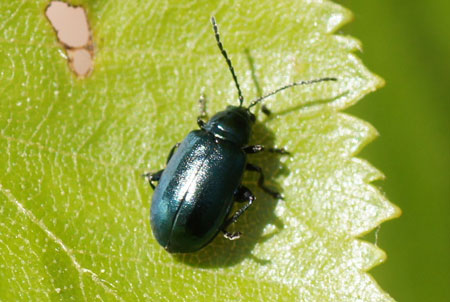 Altica aenescens.
Subfamily Galerucinae. Family Chrysomelidae. Not in
the garden, but in the dunes about 4 km from our house.
Altica aenescens.
Subfamily Galerucinae. Family Chrysomelidae. Not in
the garden, but in the dunes about 4 km from our house.
Shiny blue green.
Both the adult beetle as the larva is to be found especially on the birch. Fortunately not in
our garden. There were many of these beetles on the leaves of the birch trees in the dunes.
Therefore it was possible to identify, for there are very similar species.
Length: 4,5 - 5,5 mm.
April - September. Europe. Photos 27-5-2013.
|
 ... ...
 Alder leaf beetle. (Agelastica alni).
Subfamily Galerucinae. Family Chrysomelidae
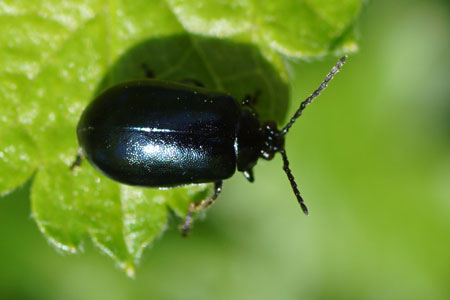
Alder leaf beetle. (Agelastica alni).
Subfamily Galerucinae. Family Chrysomelidae
Shiny blue-black. On alder, can also occur on poplar, hazel and willow.
Length: 6-7mm. April-June. Photos 3-5-2023.
|
Subfamily Cryptocephalinae.
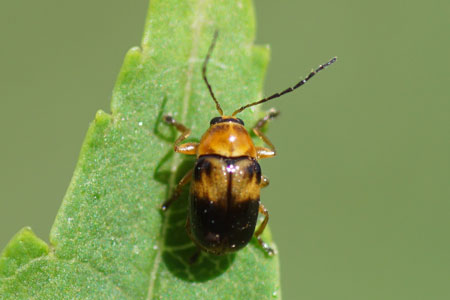 Cryptocephalus pusillus. Subfamily Cryptocephalinae. Family
Chrysomelidae. Not in
the garden, but in the dunes about 3 km from our house.
Cryptocephalus pusillus. Subfamily Cryptocephalinae. Family
Chrysomelidae. Not in
the garden, but in the dunes about 3 km from our house.
The upper side is (especially with the male) with a variable black-brown part (at the shoulders and the rear end back). A yellowish pronotum, sometimes partially orange or brown with the dark ones. Length 2.2-3 mm. They occur in various deciduous trees. The dark beetles can resemble the Cryptocephalus rufipes. April - September. One generation. Europe. Photo 4-7-2019.
|
Subfamily Donaciinae.
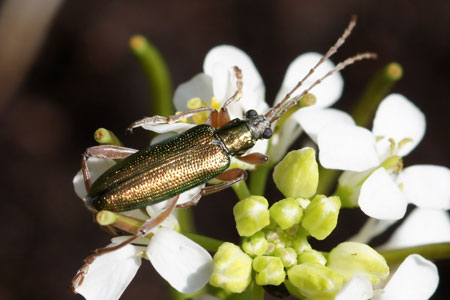 .. ..  . .
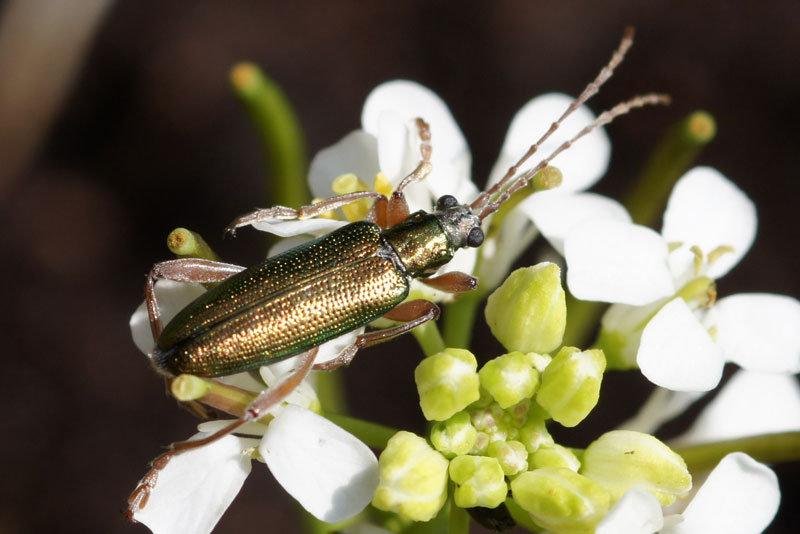
 Donacia clavipes. Subfamily Donaciinae. Family Chrysomelidae.
One
of the few
reed
beetle
species,
which can
be
determined
from
a
photograph.
This
is because of the
following
characteristics:
No
dents
in the
elytron,
yellowish
legs
and
antennae,
rather
long legs.
Cane
Beetles
look
more like shiny,
gold
longhorn
beetles,
than like leaf
beetles.
A
Donacia
has
a
soft
hairy
belly.
By
air between
the
hairs,
they
can float
on water.
You
see them
mostly
along
the
waterside
on
marginal
plants and
floating
water
plants.
This
one sat near
the
pond
with
no-look-look.
The
larvae
live
under
water.
They
breathe
the
air
in the
channels in
the leaf
stems
of
aquatic
plants like
water
lilies.
Length 10 mm.
Late
May
-
October.
Photo 30-5-2010.
|
Subfamily Galerucinae.
 .. ..
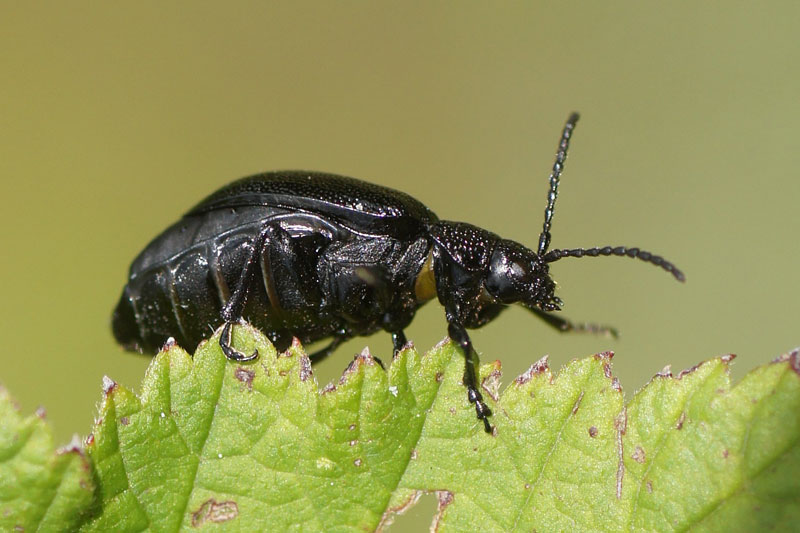
 Galeruca tanaceti. Subfamily Galerucinae. Family Chrysomelidae. Not in
the garden, but in the dunes about 4 km from our house.
Galeruca tanaceti. Subfamily Galerucinae. Family Chrysomelidae. Not in
the garden, but in the dunes about 4 km from our house.
The beetle is dull black and elytra and pronotum are coarsely and densely punctured. The beetle in the picture is a female with greatly enlarged abdomen.
(Because of he eggs)
The eggs are at the same time with as many as 60 is attached to a leaf or stem. They are protected by the secretion of the beetle.
Galeruca tanaceti feeds on a lot of plants! Namely all kinds of plants from the sunflower family
(Compositae or Asteraceae), carnation family (Caryophyllaceae), teasel family
(Dipsacaceae), lily family (Liliaceae), mint family (Labiatae or Lamiaceae), knotweed family
(Polygonaceae) and nightshade family (Solanaceae).
Length: 6 - 10 mm. June - September. Europe, Asia, introduced in North America.
Photos 16-9-2013.
German: Rainfarn-Blattkäfer.
|
 .. ..
 . .
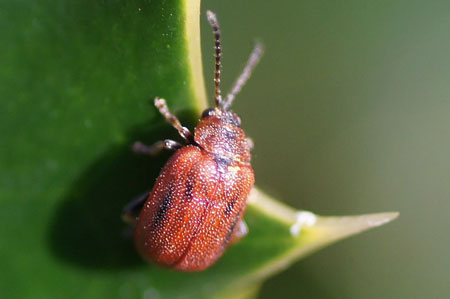
 Hawthorn leaf beetle (Lochmaea crataegi). Subfamily Galerucinae. Family
Chrysomelidae.
Hawthorn leaf beetle (Lochmaea crataegi). Subfamily Galerucinae. Family
Chrysomelidae.
A red leaf beetle with on the side of the elytra a black oblong spot and at the top a small black spot.
The larvae develop in the fruits or flowers of hawthorn. Sometimes in apple or pear. The larvae pupate in the ground.
April - August. Length 4-5 mm.
Native to North Africa. But now also in Northern Europe, Central Asia and Central America.
Photos 6-6-2015.
|
 .. ..
 . .
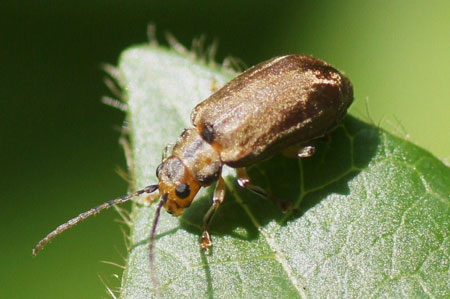
 Viburnum Leaf Beetle (Pyrrhalta viburni). Subfamily
Galerucinae. Family Chrysomelidae.
Viburnum Leaf Beetle (Pyrrhalta viburni). Subfamily
Galerucinae. Family Chrysomelidae.
The Viburnum Leaf Beetle lives on different species of
Viburnum. The Guelder-rose, Water Elder (Viburnum opulus) and the Viburnum
tinus. Here it is on a Viburnum tinus in my garden.
They hibernate as an egg deposited in the branches. They hatch in May. The
greenish-yellow larvae cause much damage, but also the beetles feed on the
leaves. Initial infestations will not kill the plants.
In June, the larvae will pupate in the soil.
Length 5 - 7 mm. Photos 27-8-2012.
Europe, Asia, but now also in North America, Canada (In 1947 for the first
time) and from Canada to the USA .
German: Schneeballblattkäfer. French: Chrysomèle de la Viorne.
 Larva Viburnum leaf beetle.
|
There are many leaf beetles on the Geman site "Kerbtier"
:
Chrysomelidae
(Blattkäfer)www.kerbtier.de
I want to thank everyone, who has helped me (waarneming.nl)
to identify. In particular, Jan Cuppen and Theodoor Heijerman
Nederlands /
Dutch
 
Subpage beetles:
Ground
beetles (Carabidae)
Leaf
beetles (Chrysomelidae)
Snout
beetles, weevils Longhorn
beetles, similar to longhorn beetles
Ladybirds,
Ladybugs, Coccinellidae
Rove
beetles (Staphylinidae)
Small
beetles
|