|
 Nederlands /
Dutch Nederlands /
Dutch
Spring
Information about Spring flowering plants and the pond in spring.
Take also a look at
spring
2007
It is
always surprising, how fast everything buds. At the end of April
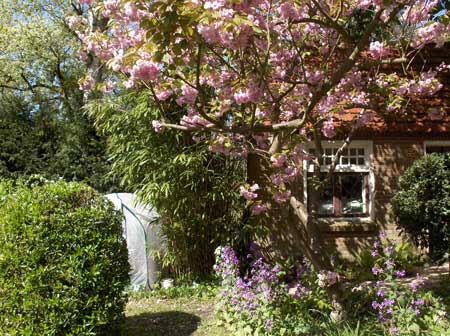
the Japanse Cherry (Prunus serrulata) already gets leaves. Under the tree the honesties
are in bloom. Left a
cardinal bonnet. Beside the little greenhouse: bamboo. The Golden
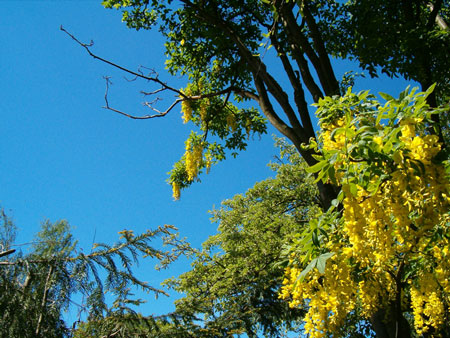
Chain
left of the Japanse Cherry
blossoms in May. The whole tree is toxic! Especially the
pods. My nieces played with them. Then we did not know the danger. Fortunately
nothing
ever
happened. The taxus behind the bamboo is also toxic.
 ..... .....
 |
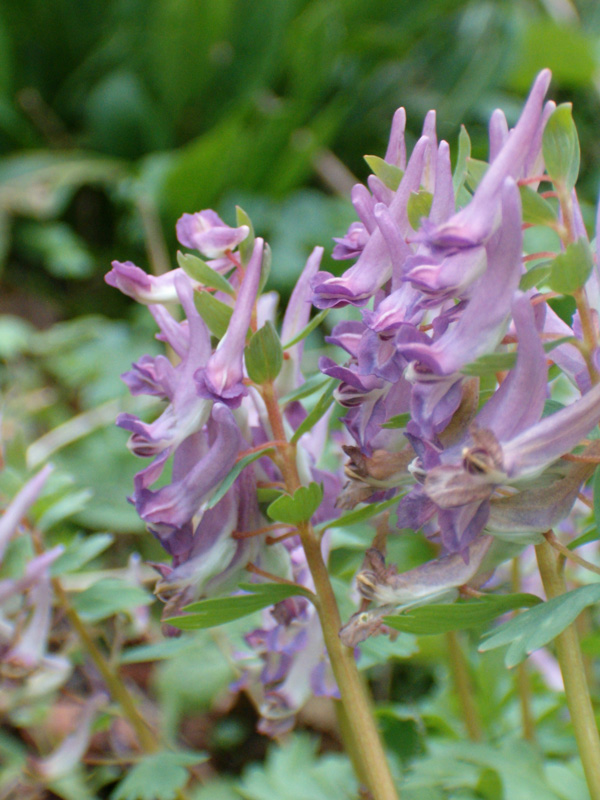
The Corydalis solida
(very similar to the
Bird-in-the-bush -
Corydalis
cava) you see for a short time.
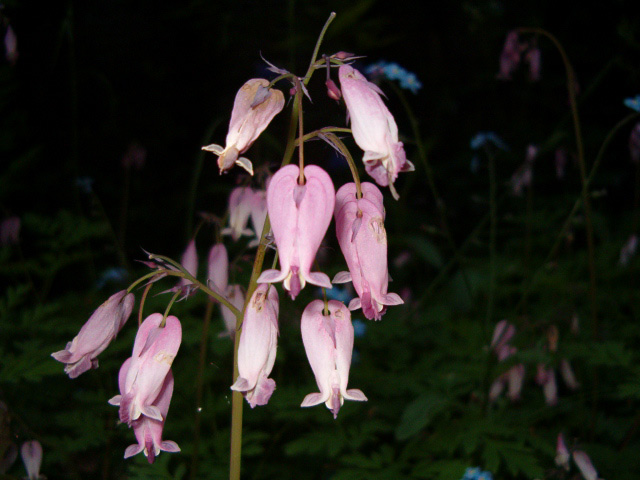
Afterwards it disappeared entirely . The bleeding
heart
(Dicentra formosa) seems also delicate. In fact they are nicer, than the larger ones (Dicentra spectabilis). The colour of the
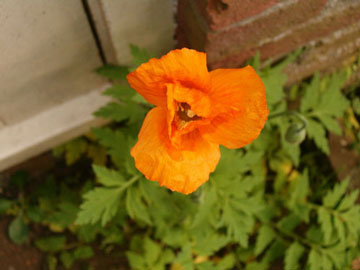
Welsh poppy (Meconopsis cambrica) seems
quite loud, when you look to the other pictures. (pale
culvert, red poppy dubium)
It is
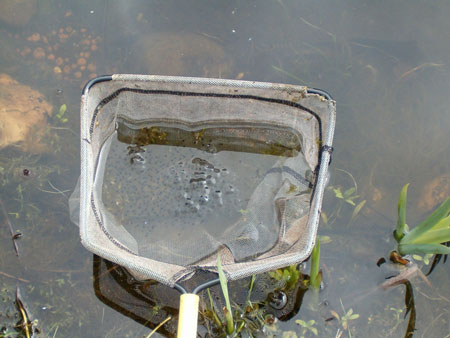
always nice to discover, there’s frogspawn in the pond. The Common Newts
like it too, for they eat all the eggs. Now
I put everything in a landing-net
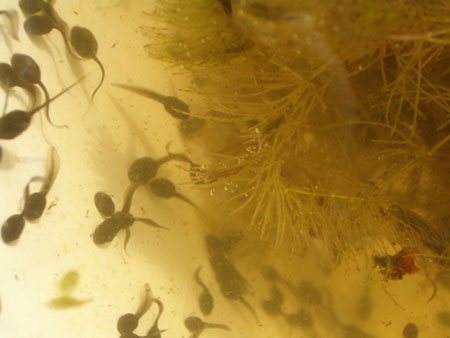
and later it goes into a bucket, which stands at the pond. Strange is, they
keep off the eggs of the toads (a
chain). The frog you can find on the page "animals in the garden".
In 2009 we had a lot of tadpoles. Here a picture with a curious common
pond skater. Information: common
pond skater
When
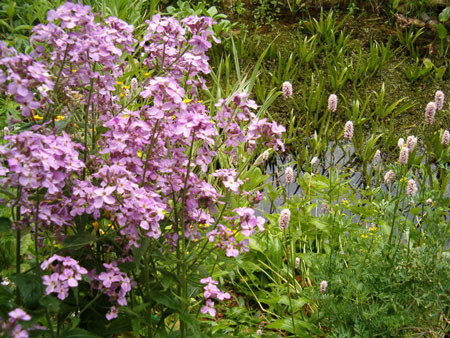
the Dame's rocket or Sweet rocket (Hesperis matronalis) and the Bistort (Persicaria bistorta) appear,
it’s almost the end of spring. Bethleham
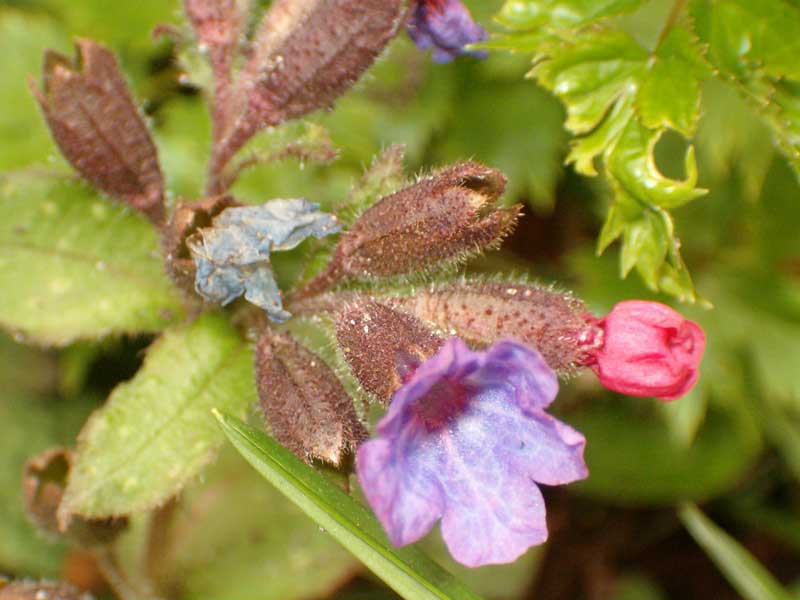
Sage (Pulmonaria) has beautiful flowers with all kinds
of colours. You can see these colours also at the other members of the
Borage family. (e.g. comfrey, forget-me-not,
viper's
bugloss)
 ..... .....
 |
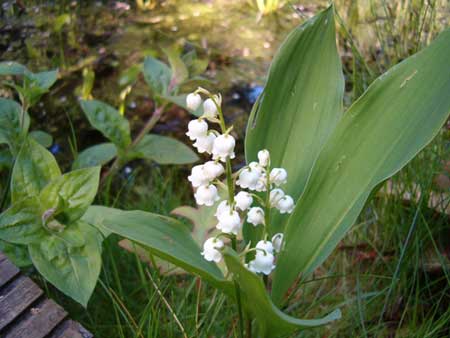 The Lily of the Valley
(Convallaria) grows throughout the garden like gardenweeds, but the flowers are
beautiful.
The Lily of the Valley
(Convallaria) grows throughout the garden like gardenweeds, but the flowers are
beautiful.
|
 As
last, because it is so magnificent: cornflower!!!! (Centaurea
cyanus)
As
last, because it is so magnificent: cornflower!!!! (Centaurea
cyanus)
|
Much more
information about plants at spring
2007
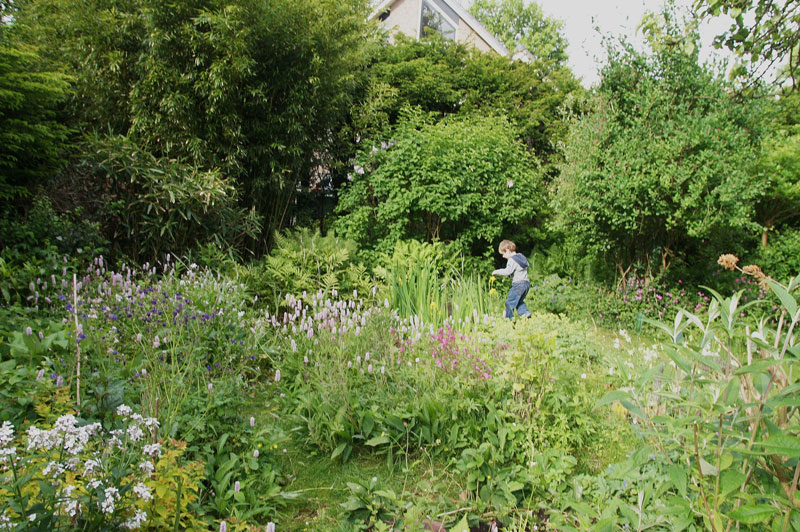
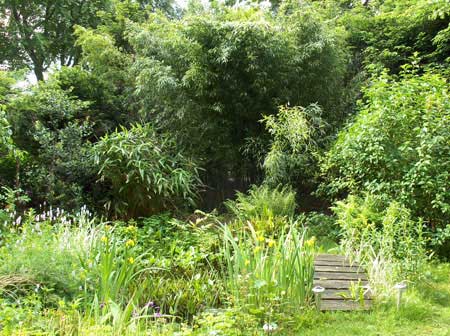
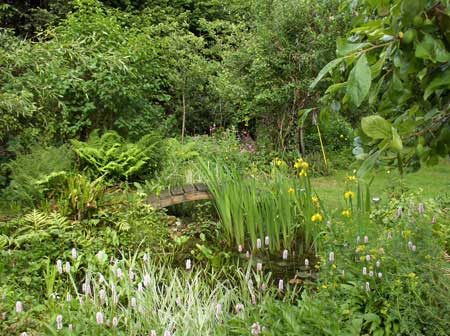
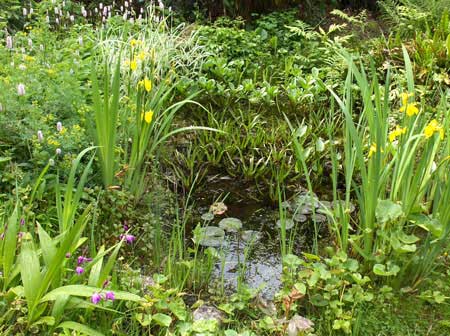
The pond 2007 Three
photos end of May.
The
pond is about 3 by 3 meters. It seems smaller by the Buckbean and
the Water-soldier. I offen sit on
the little bridge to look at the pond. At the other site and at the front
there are little swamps. Behind one of the swamps there’s a hill. In
summer I plant cacti and
euphorbia’s on it.
On
the side there are several ferns. The Hart's tongue Ferns (Asplenium
scolopendrium) reseed themselves and come up everywhere. The other ones get new
runners.
There
are also several types of bamboos. The Bamboo is kept from expending by
special foil around the roots.
Under
water grows a lot of Hornwort (Ceratophyllum demersum) grows
It’s
a good pond oxygenator.
The pink flowers are of the Bistort
(Persicaria bistorta) This plant belongs to the knotweed
family.
Furthermore is flowering the Yellow Flag Iris and the Chinese ground orchid (Bletilla) are flowering. The marsh marigold (Caltha
palustris) and
the Cuckoo
Flower (Cardamine
pratensis)
are already out of flower.
 ..... .....
 |
 |
Birds May 2010.
 ..... .....
|
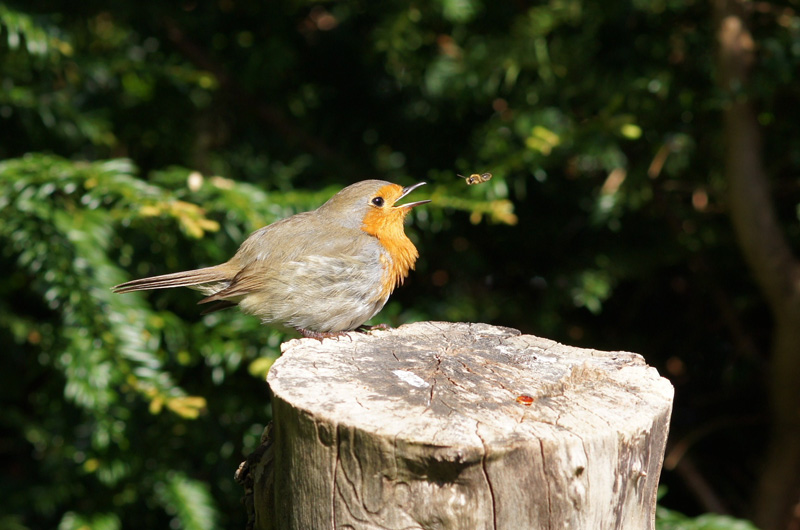
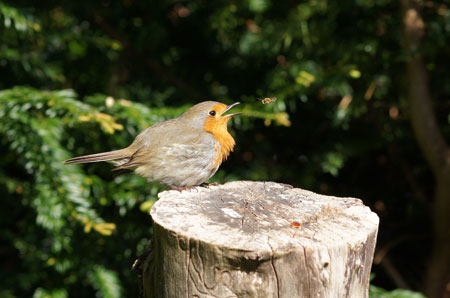
| European Robin (Erithacus rubecula). Family Old World flycatcher
(Muscicapidae).
This robin sits on a wood stump of an old apple tree. It is also the home for all kinds of insects. In the evening you see often bumblebees sitting in the setting sun.
If you look carefully you will see an inattentive bee flying in the
direction of the robin. But it escaped just in time. Photo 5-5 2010. |
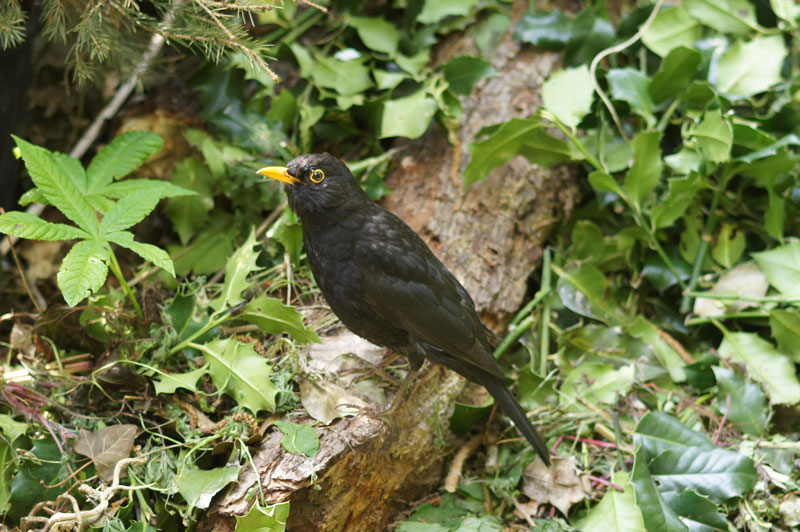
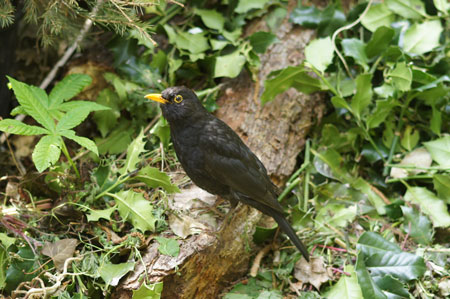
Common Blackbird (Turdus merula). Familie Thrushes (Turdidae).
An old trunk of a pear tree near the compost heap. This blackbird looks or
there is anything to be found to eat.
Photo May 2010.
|
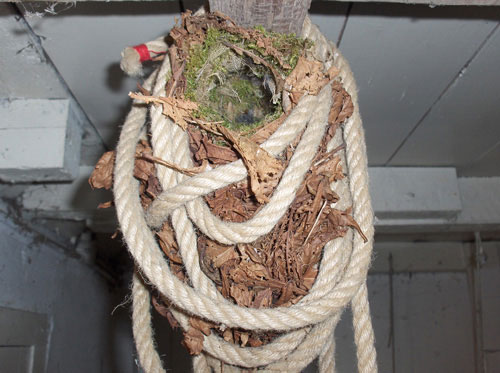 .. ..
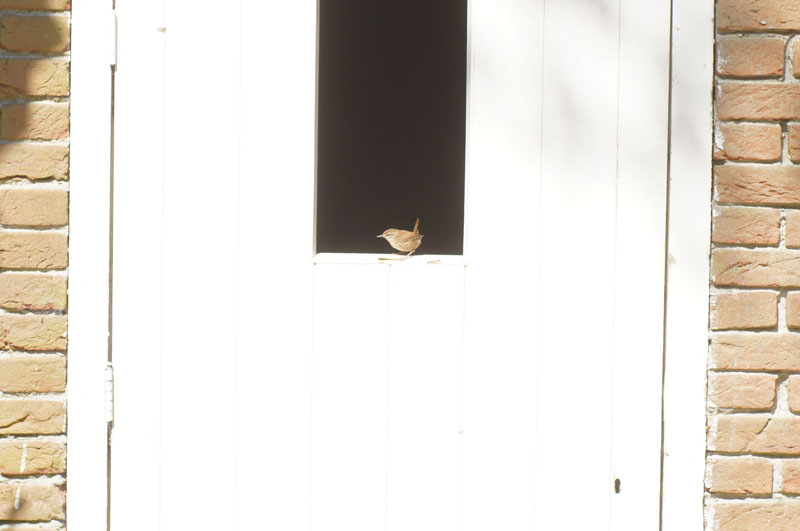
 Wren (Troglodytes). Family Troglodytidae. Photo 5-5-2013.
 |
|
Today (April 1 2007) I saw a wren fly into the garage. Later, when I took a look, I saw this nest in the ropes.
This year (2008, a year later) we had wrens again.
Now six years (2013) later the nest still hangs in the ropes in the garage. Every year it
has been repaired by a wren. Here it goes into the garage.
|
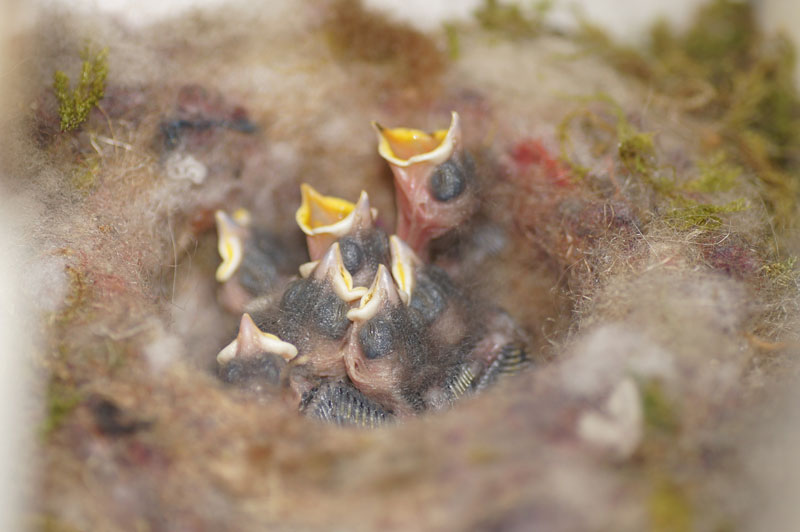
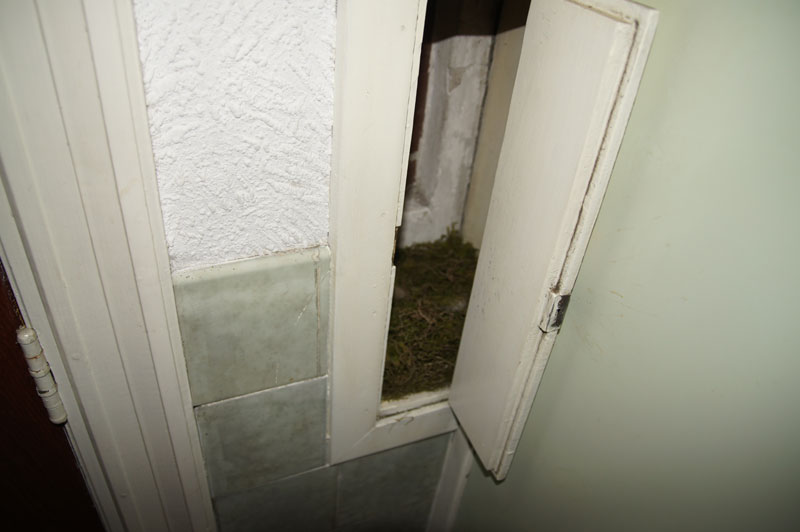
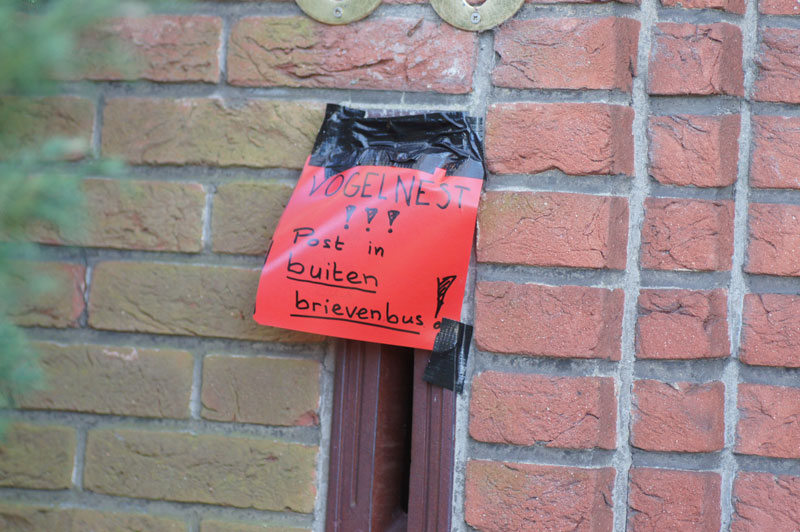
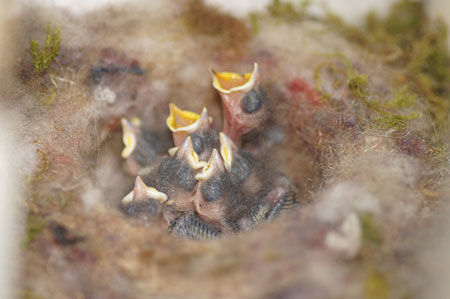
Nest of tits in the mailbox.
 .. ..
 . .
 Photos April, May 2013.
 |
|
The wall is a mailbox. Underneath we have another mailbox. This year (2013) a tit
has made a nest. So no post in this mailbox.
|
 ..... .....
 |
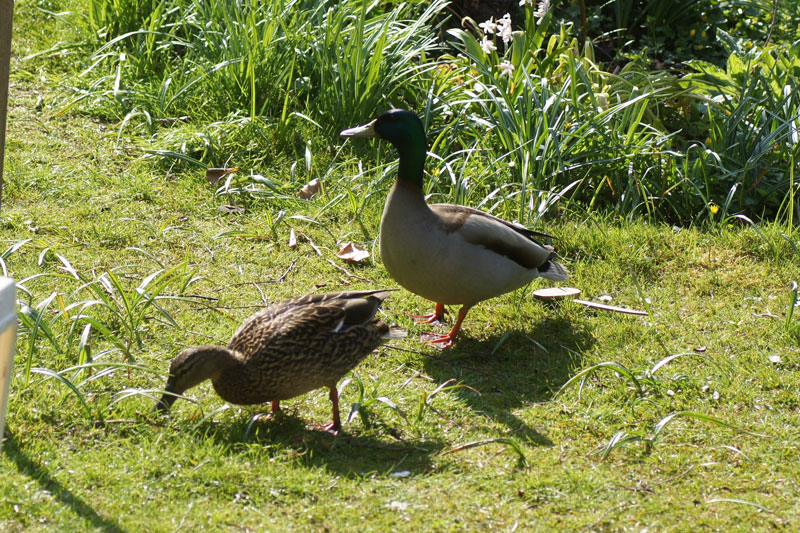
| Wild duck (Anas platyrhynchos). Family Anatidae. Very occasionally there are wild ducks in our pond, even though we live in the middle of
the village without water nearby.
Photo 24-4 2013.
|
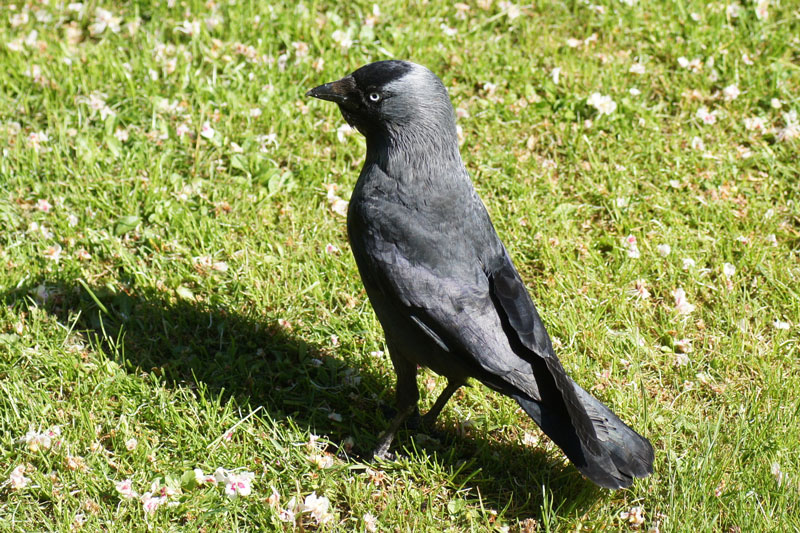
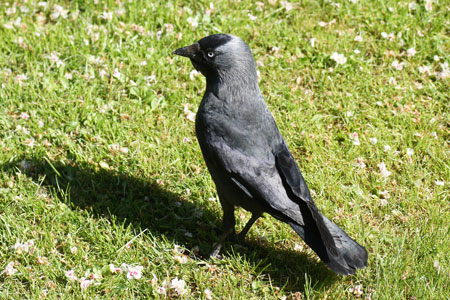
Western Jackdaw (Corvus monedula, Coloeus monedula). Crow family
(Corvidae). In the chimney of the shed we had this year a nest of
Western Jackdaws. They are therefore not shy.
You can recognize them by the white iris of the eyes. The iris other corvids are dark.
Photo 2-6-2013. |
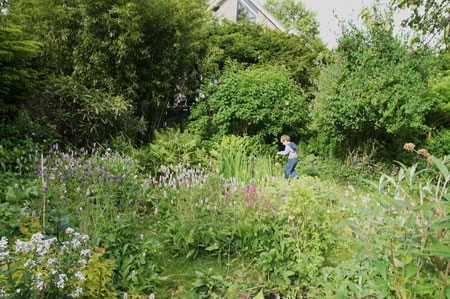
Photos bridge pond in 2013.
The girders of the bridge were bad. I made a new bridge. This time, a flat bridge.
 ..... .....
 |
Maurice, our grandson.
Here is Maurice on the bridge. By all plants you can not see the bridge very well.
Photo 16-6-2013.
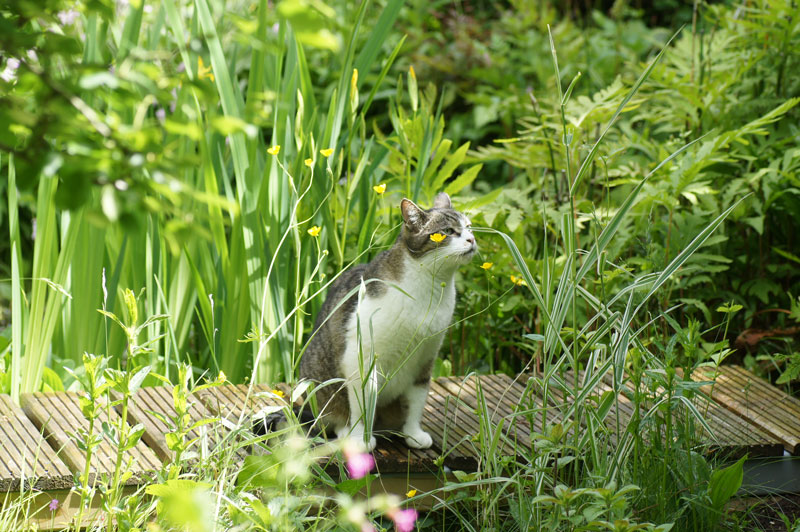
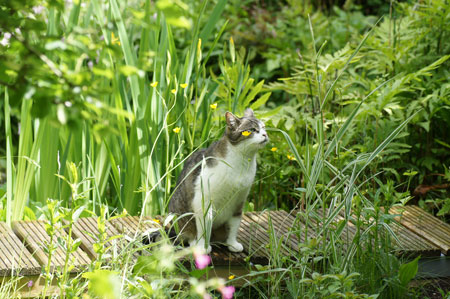
Oscar the cat of our daughter (Died in 2020).
Oscar was satisfied with the bridge.
Photo 16-6- 2013. |
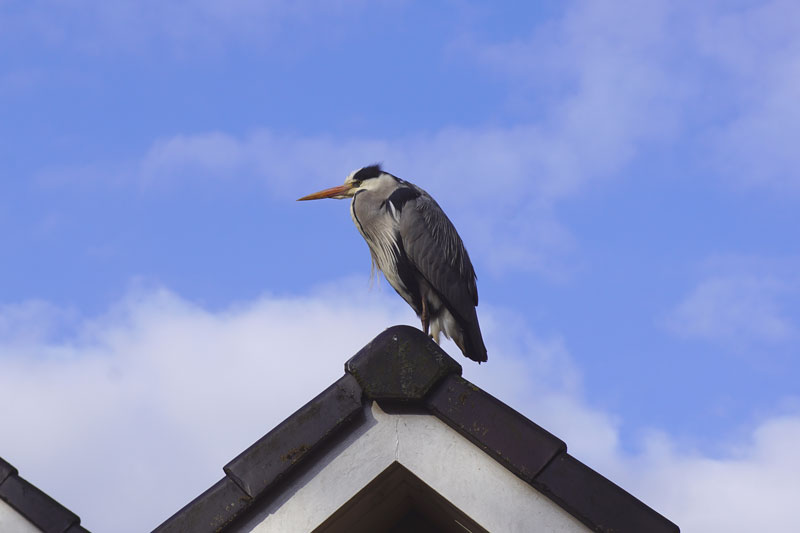
Grey heron (Ardea cinerea) in de tuin in april 2021.
Often in winter and late winter we have a heron that is looking for our frogs. But when it gets warmer and the frogspawn is in the pond, they are gone. There is, I think, plenty of food to be found in places without scary people around. This year it was very cold in April. Yet there was already frogspawn. That's why the blue heron kept coming. The day after this photo,
it took a frog. I have now placed a net above the frogspawn and bamboo across the pond. Not pretty, but unfortunately necessary.
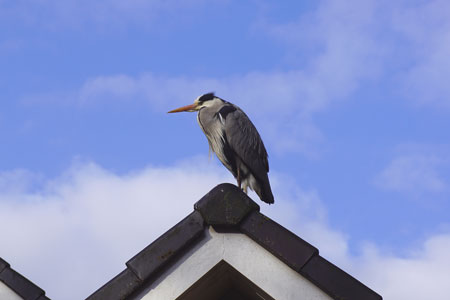 ..... ..... 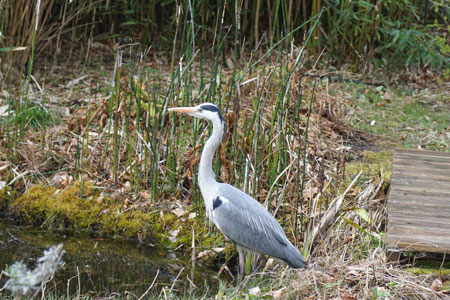 Grey heron (Ardea cinerea), family Ardeidae. Photos 8-4-2021.
 |
Nederlands /
Dutch
 
Subpage Summerflowers: Summer
flowering shrubs.
|

 .
.
 .
.
 .
.
 .
.