|
 Nederlands /
Dutch Nederlands /
Dutch
Moths: Tortrix moths, leafrollers,
Trotricidae in the garden
Subpage butterflies
and moths:
Butterflies
Owlet
moths, Noctuidae Geometer
moths Pyralidae,
Crambidae Concealer
moths, Oecophoridae
Moths
That
moths fly at
night is understandable. Nevertheless
there are about hundred
species, which fly by day and sometimes
they also are beautiful
coloured.
A characteristic of moths are the long feelers,
or antennae,
which
are
unclubbed at the end.
They are often comb-like,
feathery or filamentous.
Most
moths have no bright colours (brown, grey, white or black) and often with
patterns of which help camouflage them during the day.
Moths
tend to have stout and hairy bodies to conserve heat during the cooler nights.
There’s a coupling of the forewing with the hindwing. Unlike
moths, butterflies generally hold their wings together above their backs when
resting.
|
Family Tortrix moths, Leafrollers
(Tortricidae).
It is a large
family with over 6.300 described species. The
caterpillars roll the leaves of their foodplant and fixed with silk.
Damage results of course from the larvae feeding within the rolled leaves.
These small moths rest with the wings folded back.
|
Subfamily Olethreutinae.
Tribe Endotheniini.
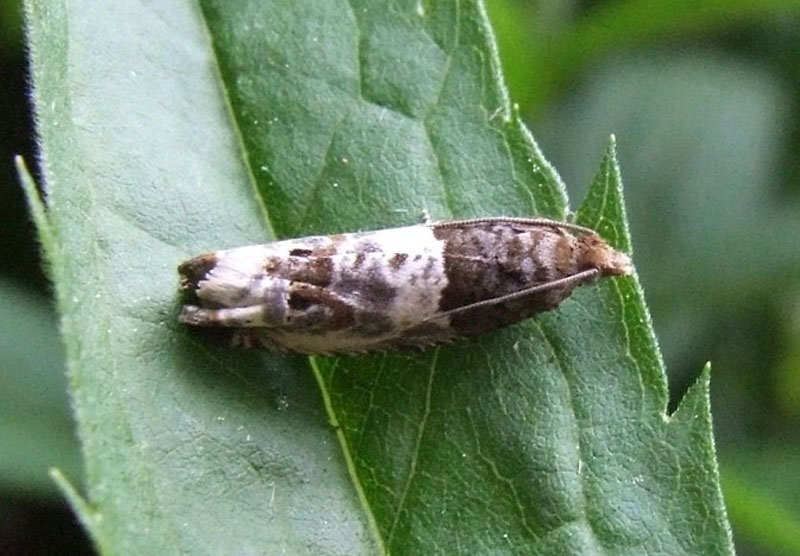
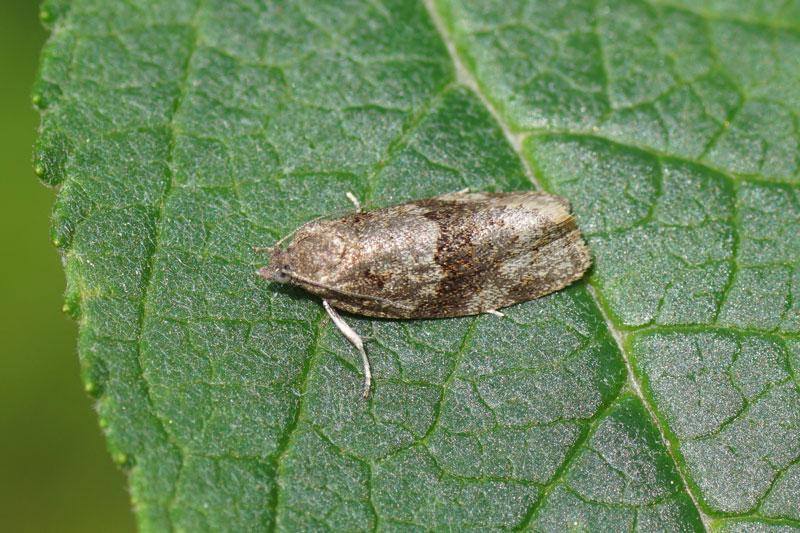
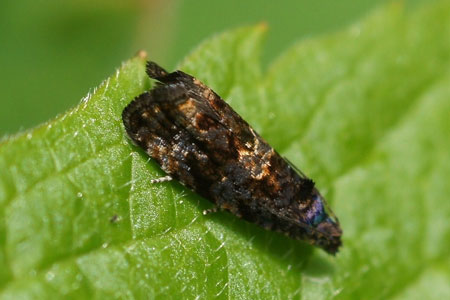 Endothenia ustulana. Tribe Endotheniini. Subfamily Olethreutinae. Family tortrix moths, leafrollers (Tortricidae).
Other resembling the species are E. gentianaeana March, E. marginana and E. oblongana
Host plants: Bugleweed, ground pine or carpet bugle (Ajuga), self-heal, woundwort or lamb's ears (Stachys) and Jewelweeds (Impatiens). The larva lives in the roots. It actually flew near bugleweed.
In the Netherlands, very rare. Photo 20-6-2010. |
Tribe Eucosmini.
 .. ..
 . .
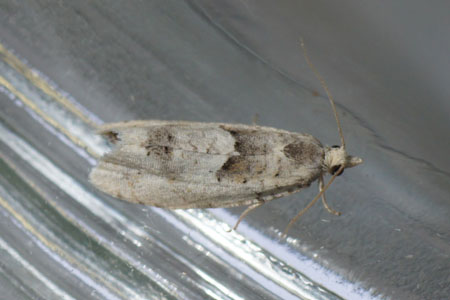
 Epinotia bilunana. Tribe Eucosmini. Subfamily
Olethreutinae. Family tortrix moths, leafrollers (Tortricidae).
Epinotia bilunana. Tribe Eucosmini. Subfamily
Olethreutinae. Family tortrix moths, leafrollers (Tortricidae).
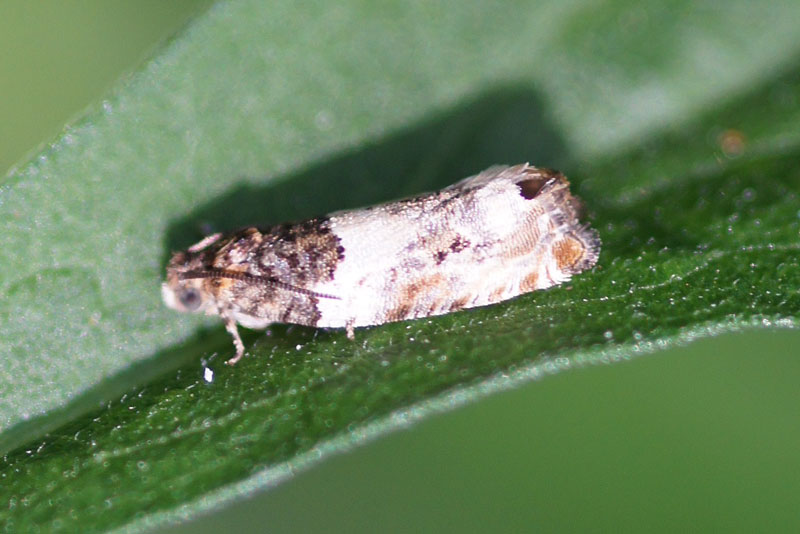
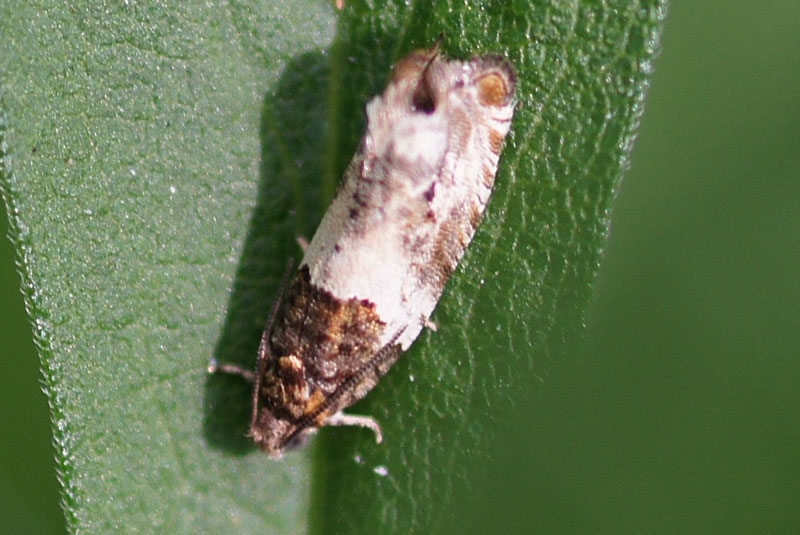
A grey-white or cream-white moth with a dark gray markings.
They are active from dusk into the night. Host plants: Birch, the caterpillars feeds on the catkins.
May-August one generation. It overwinters as a caterpillar. Wingspan: 13-17 mm. Europe. Photos 22-7-2015. |
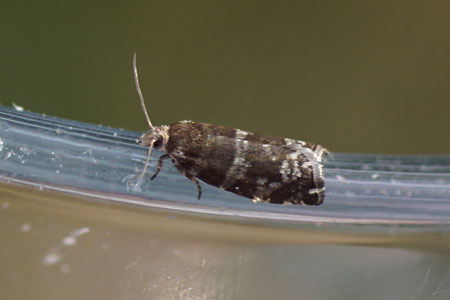 .. ..
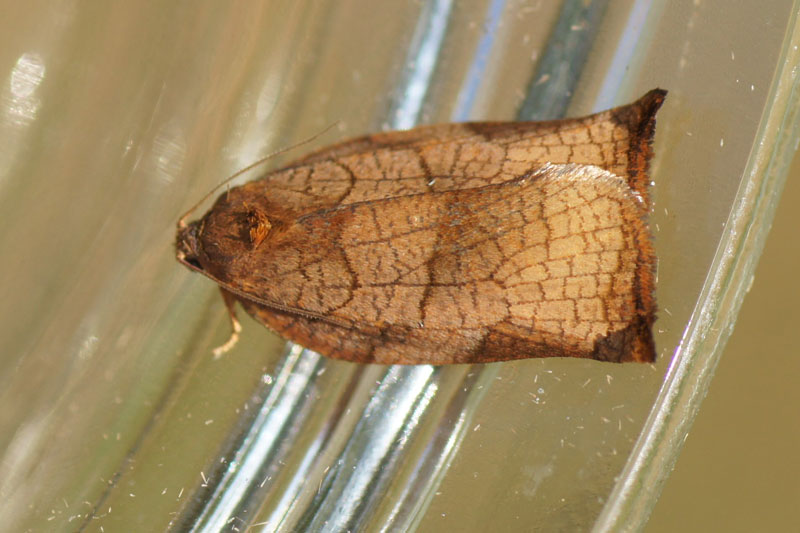
 Epinotia tedella. Tribe Eucosmini. Subfamily
Olethreutinae. Family tortrix moths, leafrollers (Tortricidae).
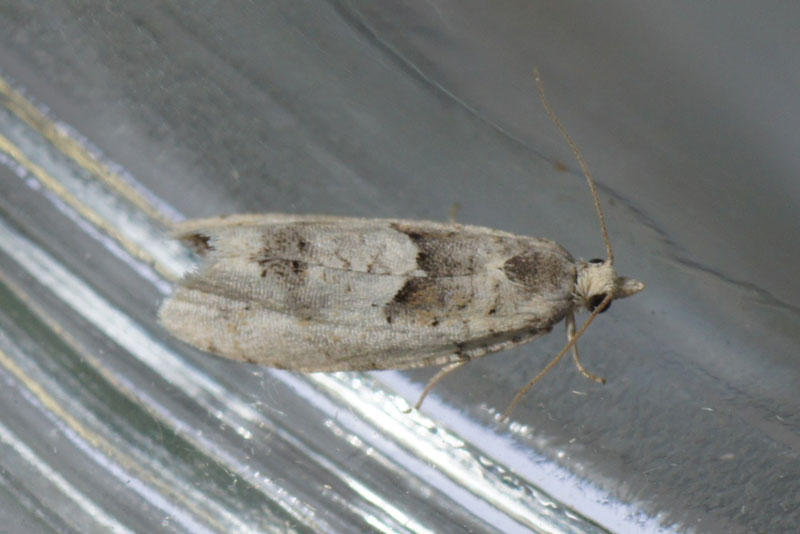
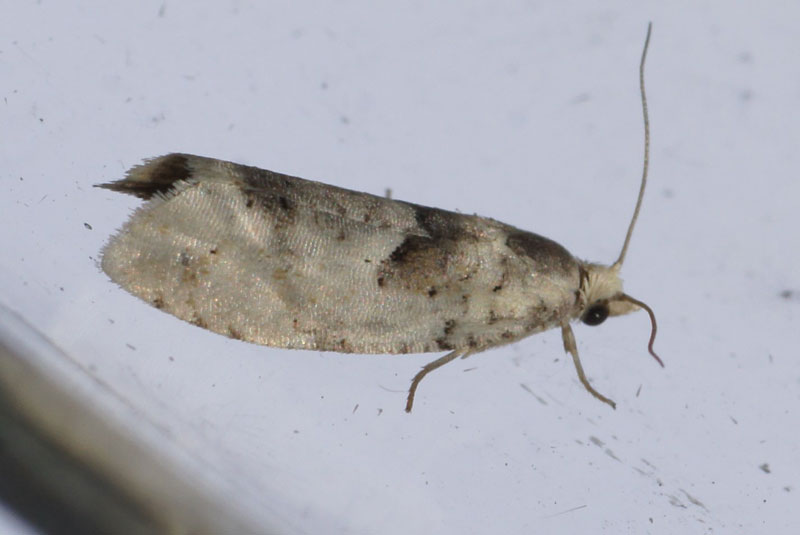
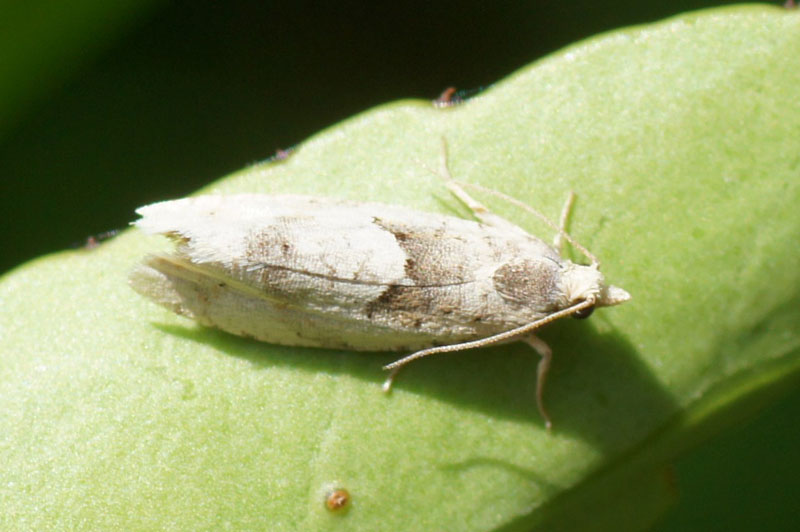
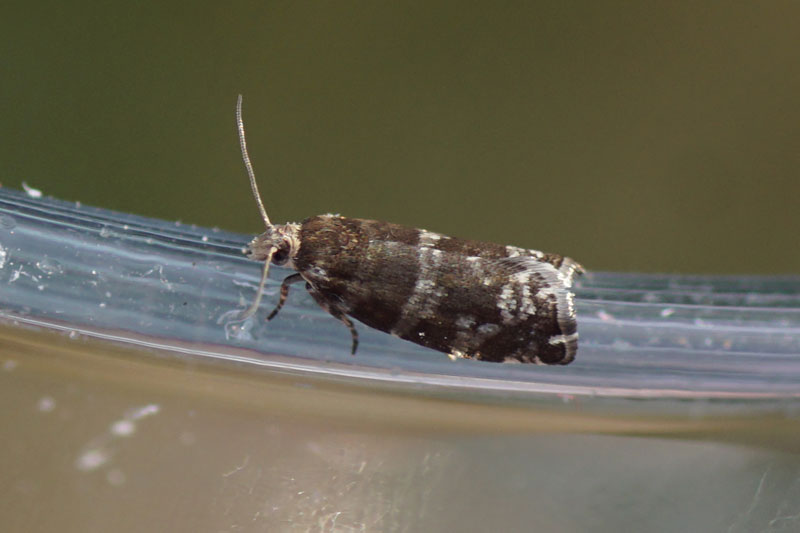
Epinotia tedella. Tribe Eucosmini. Subfamily
Olethreutinae. Family tortrix moths, leafrollers (Tortricidae).
A whitish face. Variable, from light brown to dark brown forewings with white markings.
Host plants: Spruce (Picea), European silver fir (Abies alba), Juniperus and Scots pine (Pinus sylvestris)
April-June, sometimes second generation in August. Hibernates as a caterpillar, sometimes as a pupa. Wingspan:
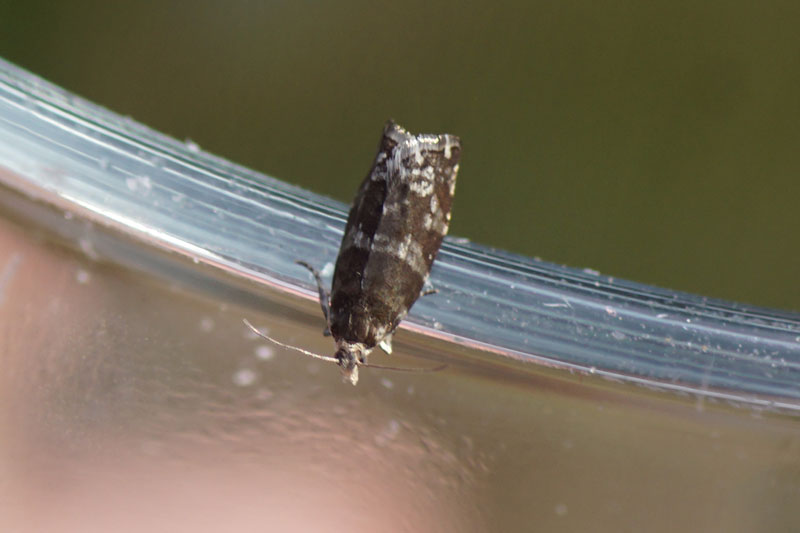
10-13 mm. Europe. Photos 10-2-2023 (In the room, Probably born in the house, because it was the middle of winter. On the edge of a glass). |
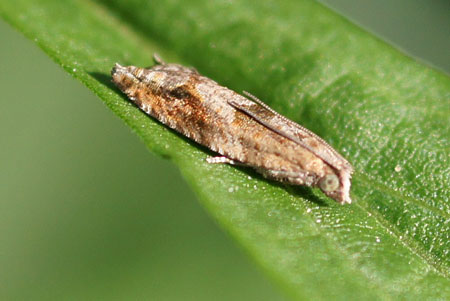 .. ..
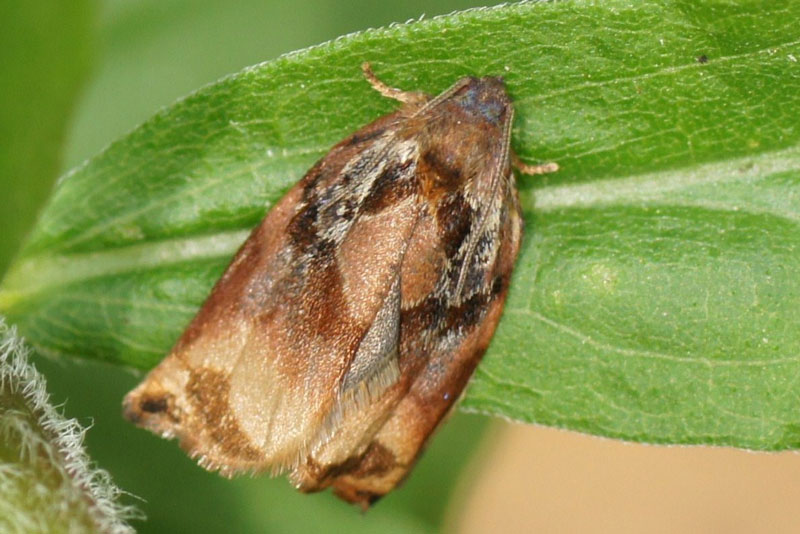
 Holly tortrix moth, Holly leaf tier, Blackheaded fireworm (Rhopobota naevana). Tribe Eucosmini. Subfamily
Olethreutinae. Family tortrix moths, leafrollers (Tortricidae).
Holly tortrix moth, Holly leaf tier, Blackheaded fireworm (Rhopobota naevana). Tribe Eucosmini. Subfamily
Olethreutinae. Family tortrix moths, leafrollers (Tortricidae).
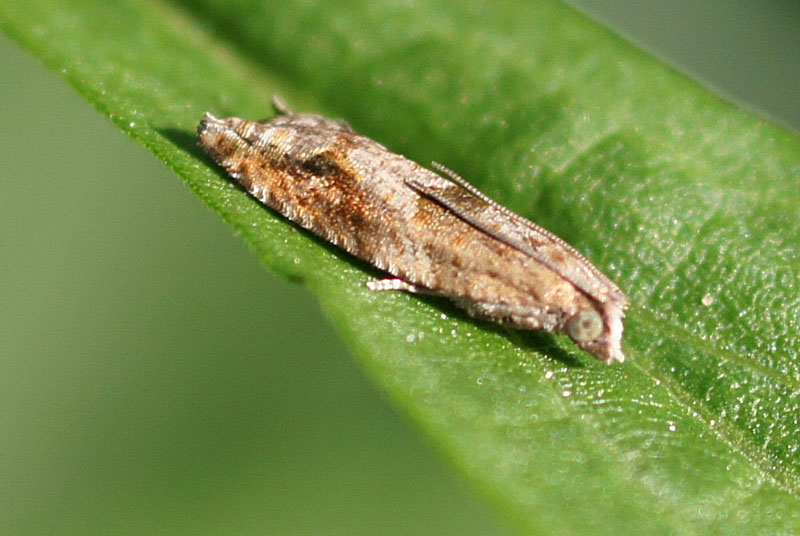
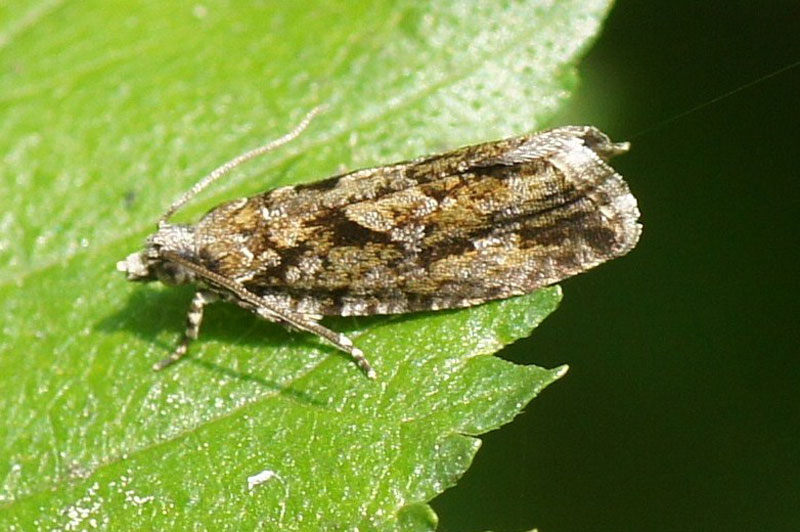
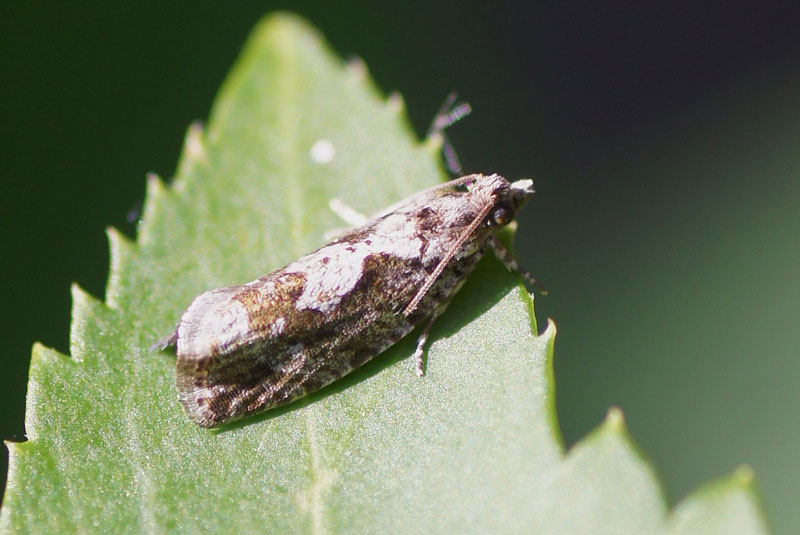
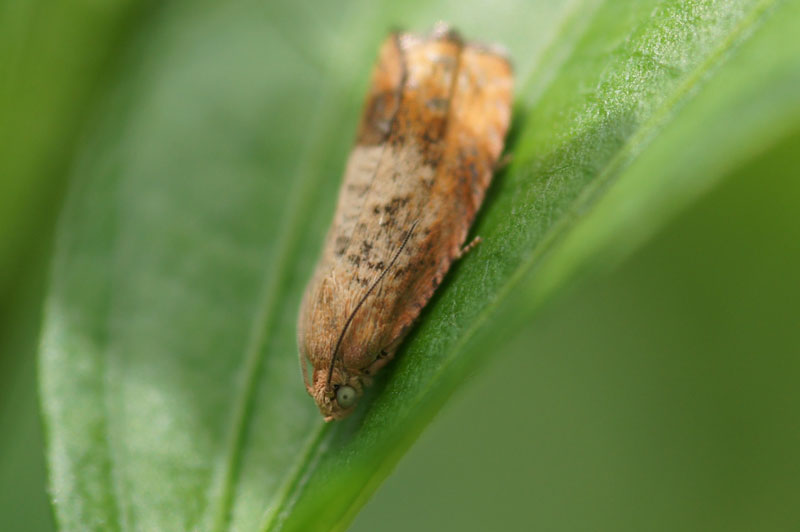
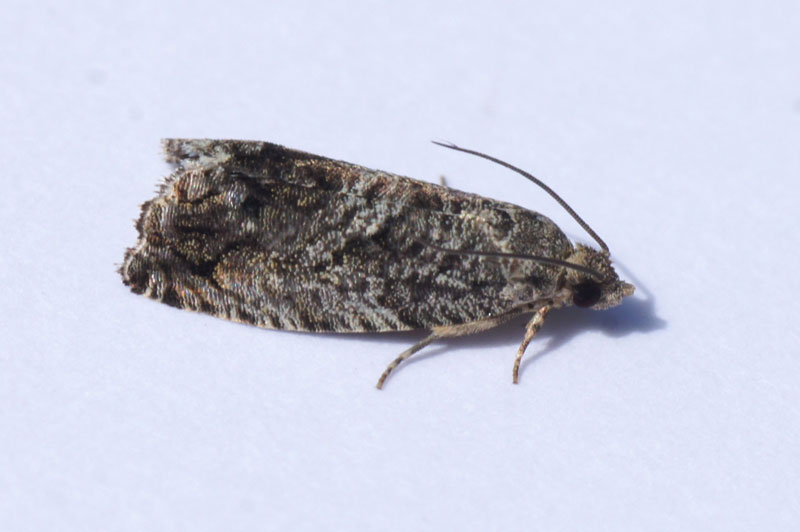
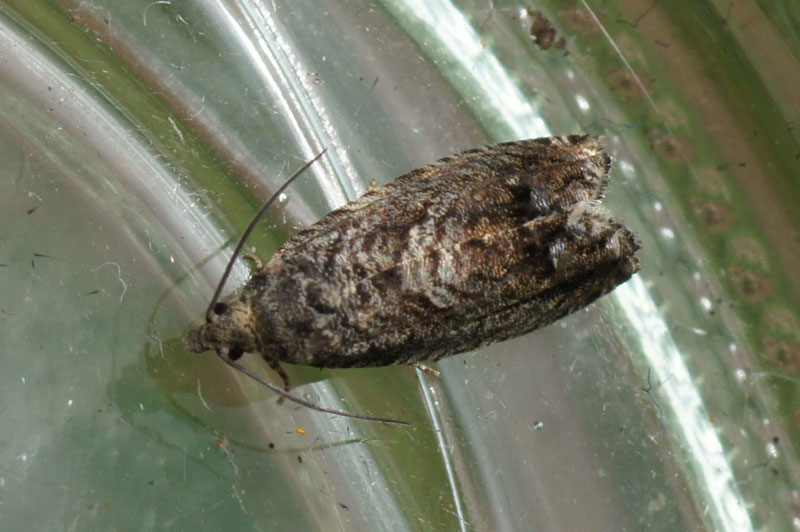
A rather variable leafroller. But recognizable by the pale spot on the back. On the back of the wings, he is usually a square gray spot. It looks like the E. immundana.
The larvae feed on eg. with holly, blueberry, hawthorn, pear, lilac. April-June. Wingspan: 12-16 mm. Photos 5-7-2011.
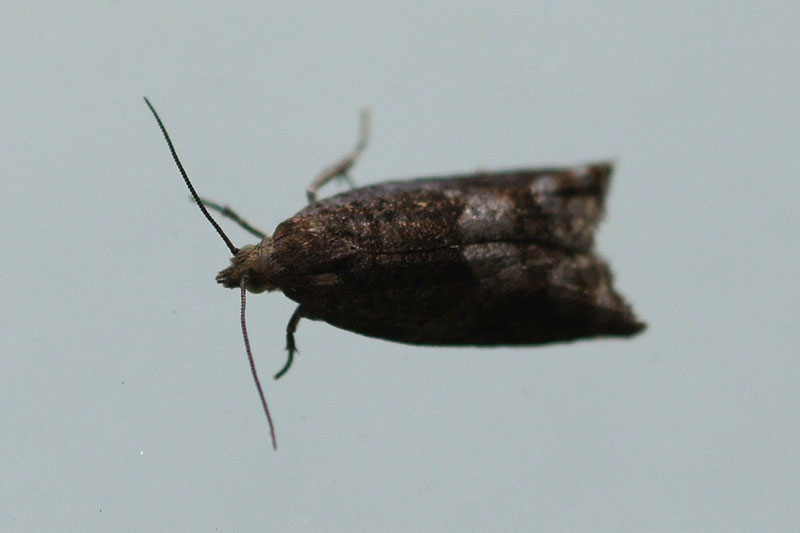
A much darker Holly tortix moth:  Photo 9-7-2011.
|
 .. ..
 Zeiraphera
isertana. Tribe Eucosmini. Subfamily Olethreutinae. Family tortrix moths, leafrollers
(Tortricidae). Zeiraphera
isertana. Tribe Eucosmini. Subfamily Olethreutinae. Family tortrix moths, leafrollers
(Tortricidae).
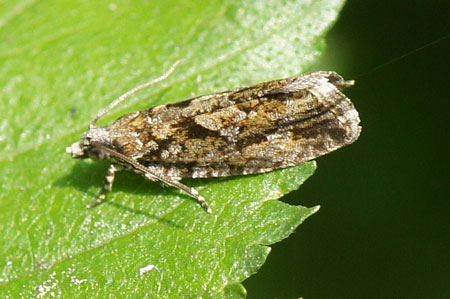
A vaiable moth. Often with a pale dorsal blotch and well defined markings. Often brown with olive green.
They are active from late afternoon. Host: Oak. June-August One generation. The egg overwinters.
Wingspan: 13-18 mm. Europe, Near East. Photos 19-6-2012, 8-7-2013. |
Tribe Grapholitini.
 Cydia
amplana. Tribe Grapholitini. Subfamily Olethreutinae. Family tortrix moths, leafrollers
(Tortricidae). Cydia
amplana. Tribe Grapholitini. Subfamily Olethreutinae. Family tortrix moths, leafrollers
(Tortricidae).
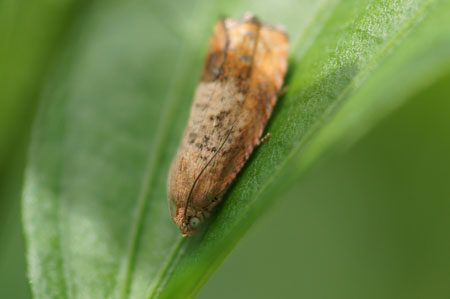
Larvae found in September and October. They feed on chestnuts, hazelnuts, walnuts, beechnuts and acorns. They pupate in the soil.
In orchards of walnut trees they can be harmful. July, August.
Wingspan: 16-20 mm. Europe, Asia Minor. Photo 2-8-2010. |
 .. ..
 . .
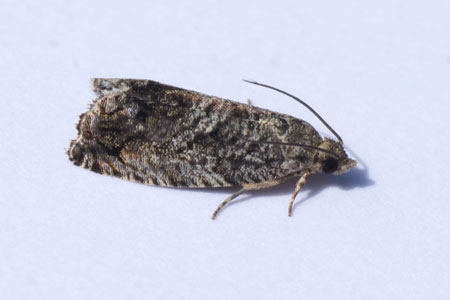
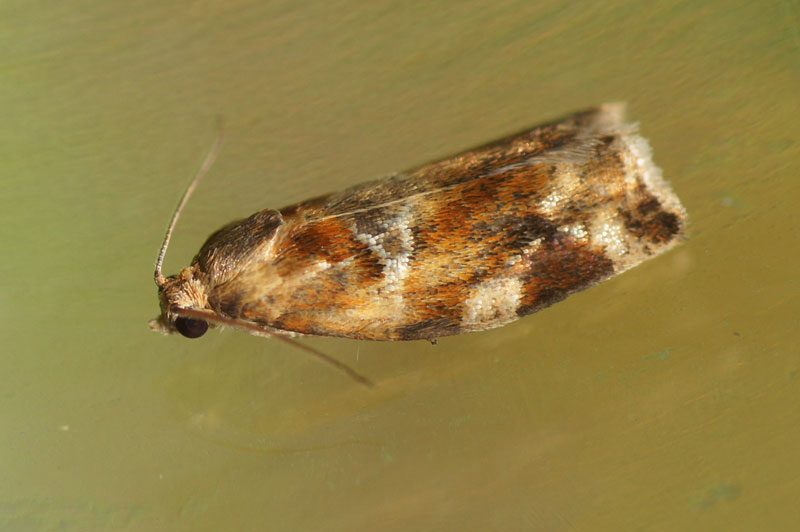
 Beech moth (Cydia fagiglandana). Tribe Grapholitini. Subfamily Olethreutinae. Family tortrix moths, leafrollers
(Tortricidae).
Beech moth (Cydia fagiglandana). Tribe Grapholitini. Subfamily Olethreutinae. Family tortrix moths, leafrollers
(Tortricidae).
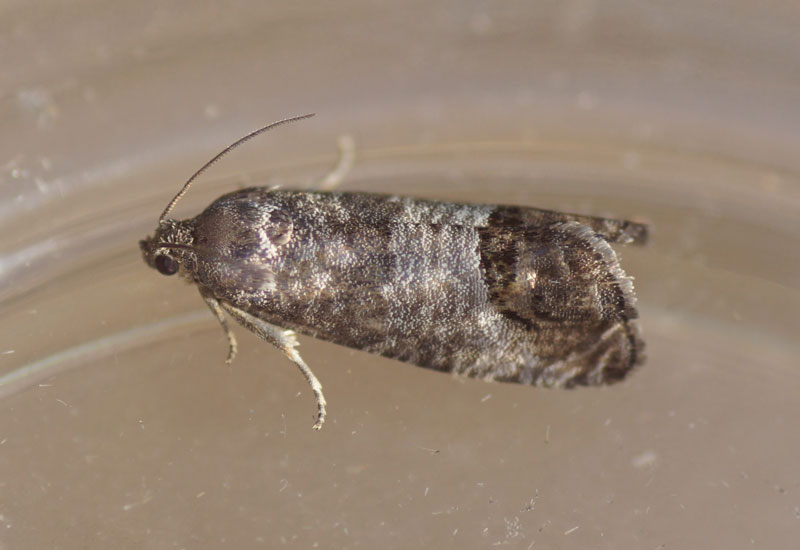
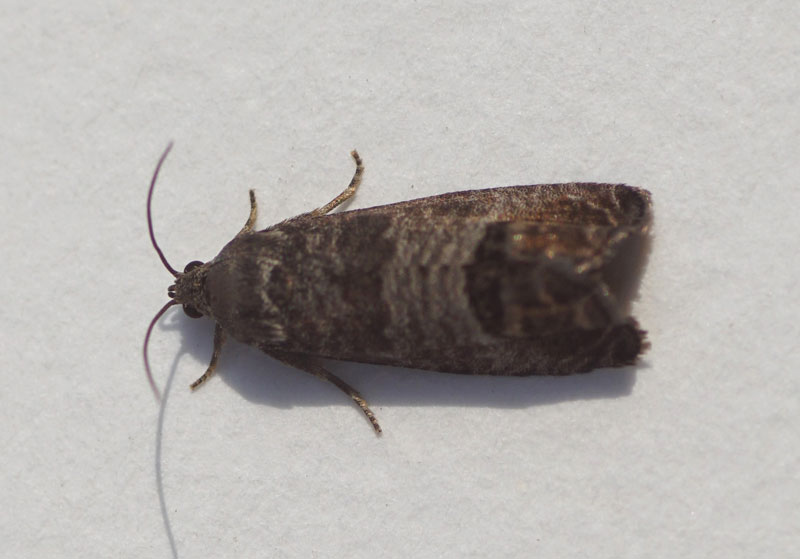
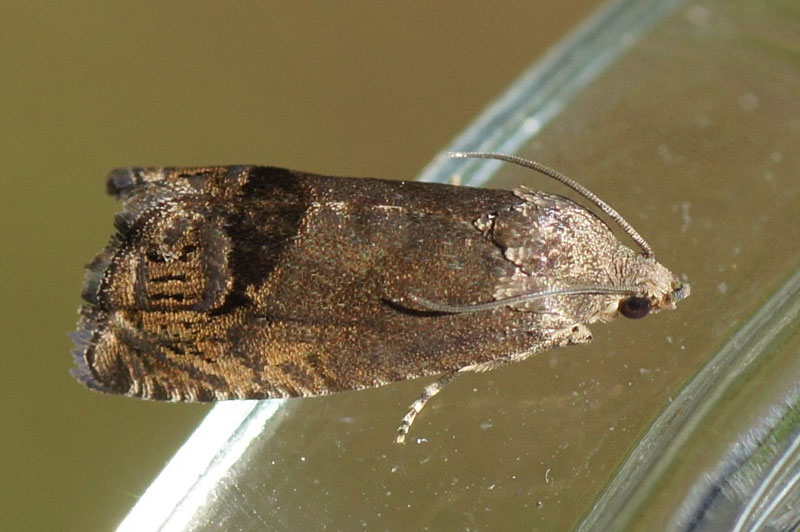
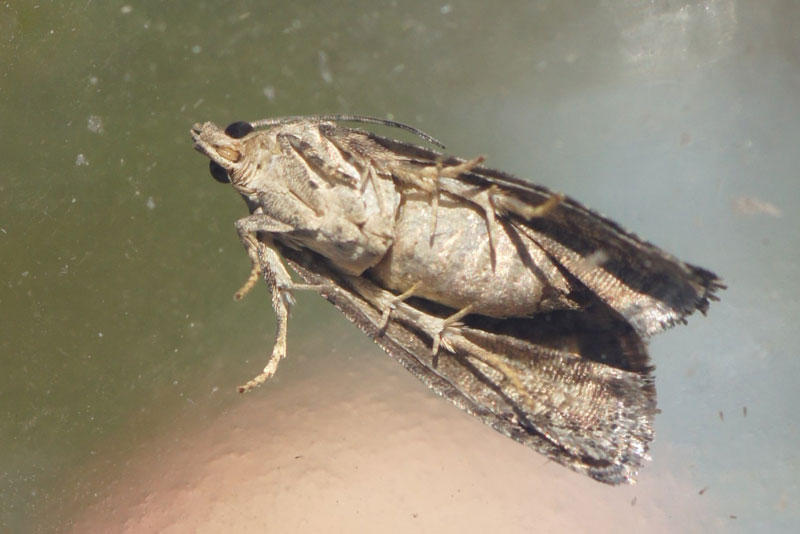
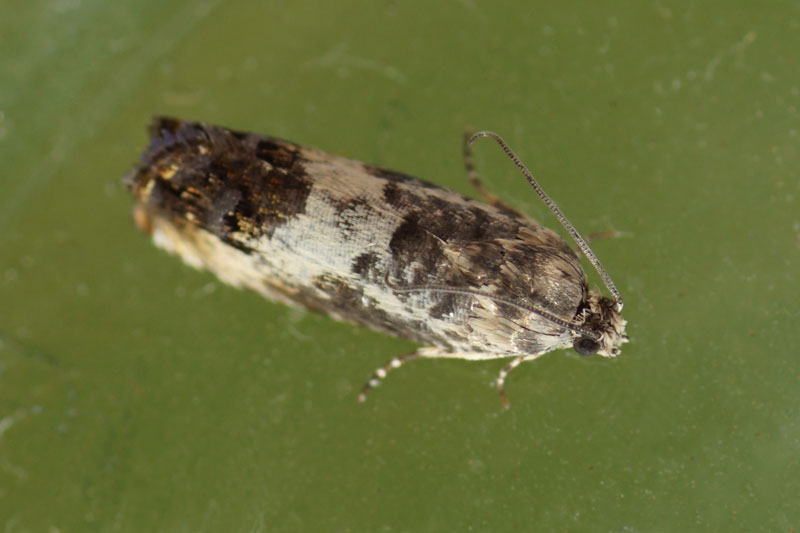
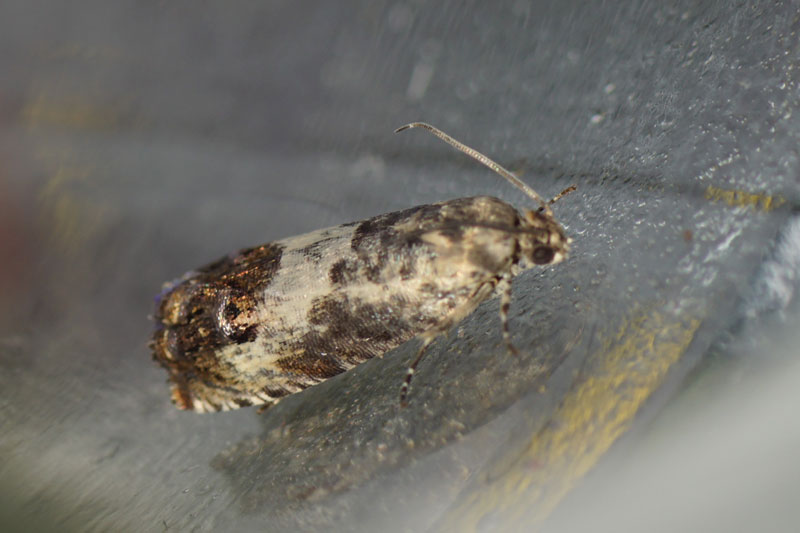
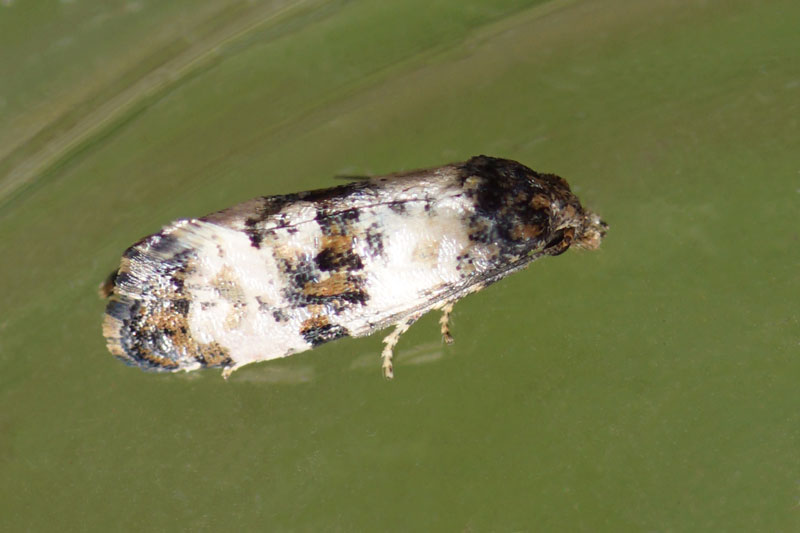
A brown-grey moth with white and black markings. The caterpillar feeds on beech (Fagus sylvatica) )the caterpillars live in the beechnuts) and rarely on oak (Quercus).
Wingspan 12-16 mm. April - September. The caterpillars overwinter. Photos 22-7-2015. |
 .. ..
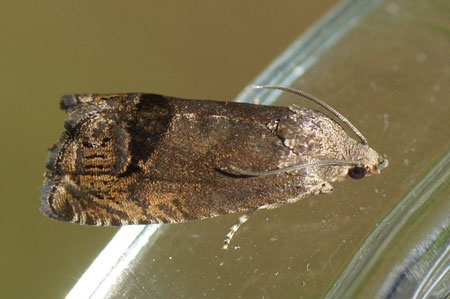
 Codling moth (Cydia pomonella). Tribe Grapholitini. Subfamily Olethreutinae. Family tortrix moths, leafrollers
(Tortricidae). Codling moth (Cydia pomonella). Tribe Grapholitini. Subfamily Olethreutinae. Family tortrix moths, leafrollers
(Tortricidae).
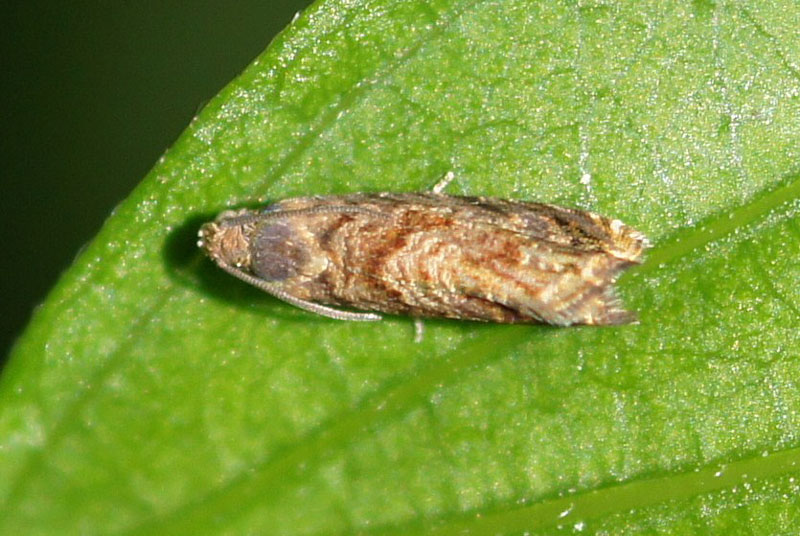
The codling moth is greyish with light grey, wavy cross stripes and a copper-coloured stain at the end of the wings.
The caterpillar lives on fruits such as apple, pear, apricot, peach, plum, cherry, hawthorn, chestnut, fig.
Wingspan 14-22 mm.May - June and August - September. Two generations. Four generations are possible in warm countries. They overwinter in a cocoon.
Originally only in Europe, now worldwide. Photos 4-8-2018. German: Apfelwickler. French: Le carpocapse des pommes et des poires. |
 .. ..
 . .
 Chestnut Tortrix, Acorn Moth (Cydia
splendana). Tribe Grapholitini. Subfamily Olethreutinae. Family tortrix moths, leafrollers
(Tortricidae).
Chestnut Tortrix, Acorn Moth (Cydia
splendana). Tribe Grapholitini. Subfamily Olethreutinae. Family tortrix moths, leafrollers
(Tortricidae).
A variable tortix moth. The forewings of this moth are grey-brown with a dark brown spot, but they also can be brown or gray and have a whitish part before the dark spot.
The caterpillars feed on chestnuts and acorns. They overwinter as a caterpillar.
Wingspan: 12-26 mm. May, September. Europe, Asia Minor. Photos 23-7-2014. German: Späte Kastanienwickler, Eichenwickler. French: carpocapse des châtaignes. |
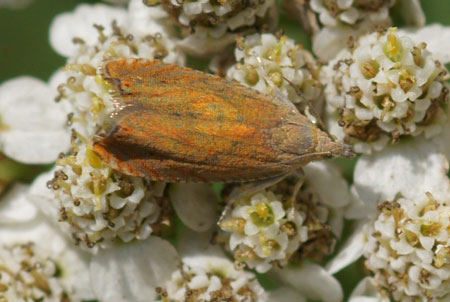 Dichrorampha
vancouverana. Tribe Grapholitini. Subfamily Olethreutinae. Family tortrix moths, leafrollers
(Tortricidae). Dichrorampha
vancouverana. Tribe Grapholitini. Subfamily Olethreutinae. Family tortrix moths, leafrollers
(Tortricidae).
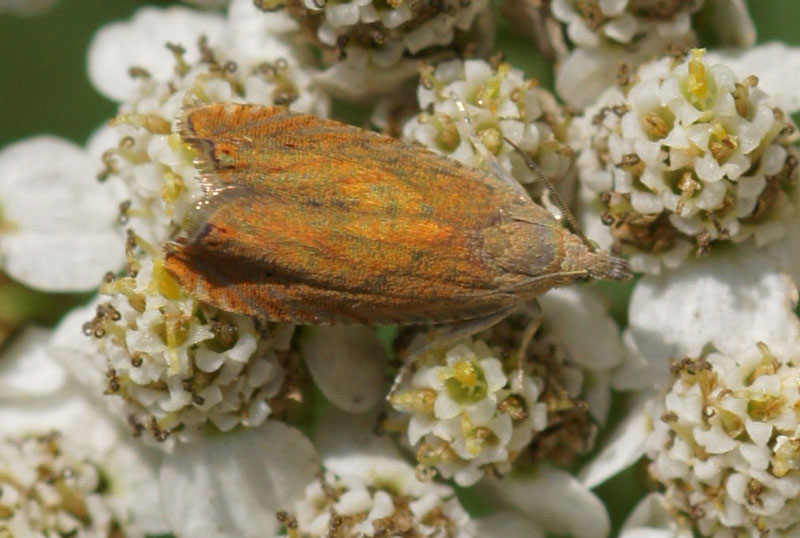
Features: a sharp V-shaped yellow spot and lots of hooks along the edge.
Host plants for larvae: Yarrow (Achillea millefolium) and tansy (Tanacetum vulgare). Here's the moth on Yarrow. May - August.
Wingspan: 12-15 mm. Europe, North America. Photo 28-7-2011. |
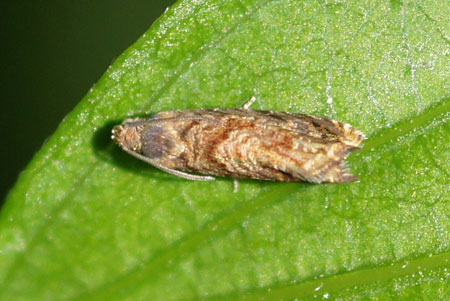 Hawthorn berry moth
(Grapholita janthinana) Tribe Grapholitini. Subfamily Olethreutinae. Family tortrix moths, leafrollers
(Tortricidae). Hawthorn berry moth
(Grapholita janthinana) Tribe Grapholitini. Subfamily Olethreutinae. Family tortrix moths, leafrollers
(Tortricidae).
The color ranges (black, brown and orange) It is characterized by the marks on the back.
The moth flies in the afternoon and early evening. Host plants: Hawthorn (Crataegus), Prunus, rowan (Sorbus) and other deciduous trees. July, August.
Wingspan: 9-11 mm. The larva overwinters in a cocoon. Photo 10-7-2011. |
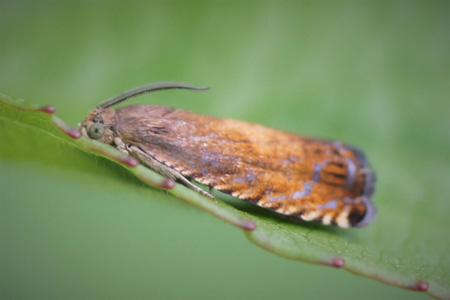 .. ..
 Pammene
aurita. Tribus Grapholitini. Tribe Grapholitini. Subfamily Olethreutinae. Family tortrix moths, leafrollers
(Tortricidae). Pammene
aurita. Tribus Grapholitini. Tribe Grapholitini. Subfamily Olethreutinae. Family tortrix moths, leafrollers
(Tortricidae).
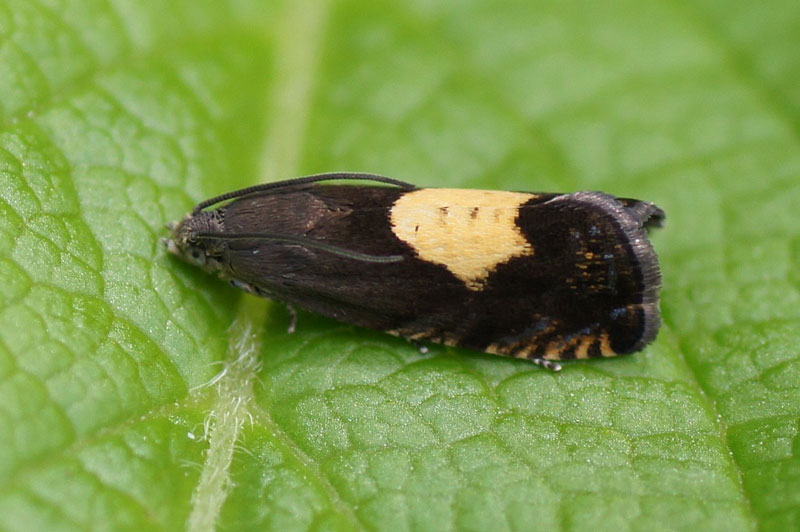
An orange moth, in the middle on the back a yellowish spot. On the side of the wings it has yellow and dark brown stripes.
The caterpillar feeds on the seeds of the maple (Acer pseudoplatanus).
Wingspan 14-15 mm. June-August. Photos 15-7-2017. |
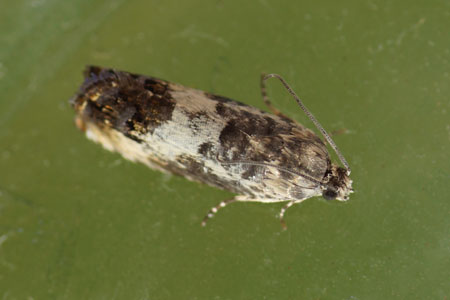 .. .. Chestnut leafroller (Pammene fasciana). Tribe Grapholitini. Subfamily
Olethreutinae. Family tortrix moths, leafrollers (Tortricidae).
Chestnut leafroller (Pammene fasciana). Tribe Grapholitini. Subfamily
Olethreutinae. Family tortrix moths, leafrollers (Tortricidae).
The forewings are white with grey.Wingspan 13-18 mm. June July. One
generation. The caterpillar overwinters in a cocoon.
Hosts are oak (Quercus) and sweet chestnut (Castanea sativa). Photos 25-6-2019. |
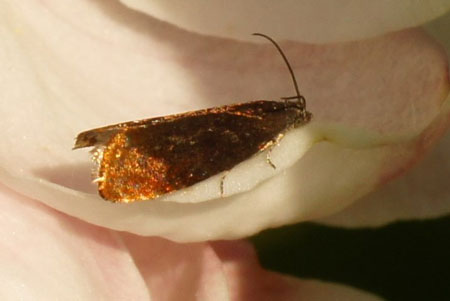 Fruitlet mining tortrix (Pammene rhediella). Tribe Grapholitini. Subfamily Olethreutinae. Family tortrix moths, leafrollers
(Tortricidae). Fruitlet mining tortrix (Pammene rhediella). Tribe Grapholitini. Subfamily Olethreutinae. Family tortrix moths, leafrollers
(Tortricidae).
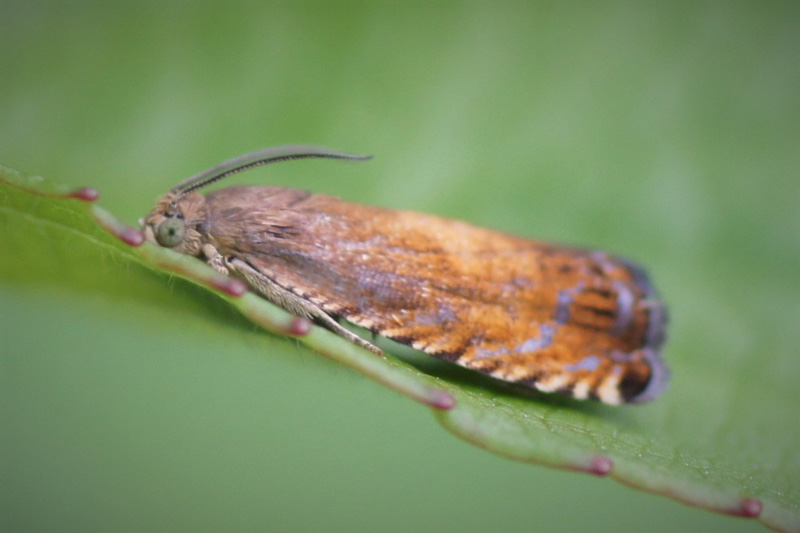
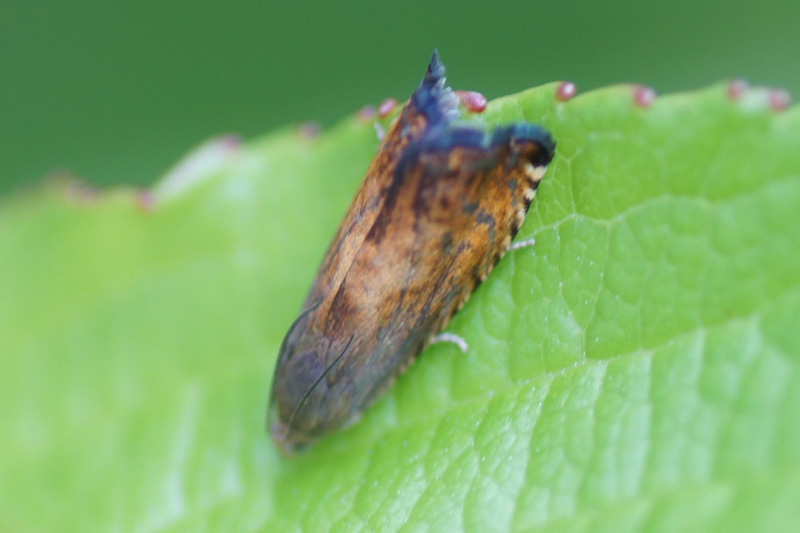
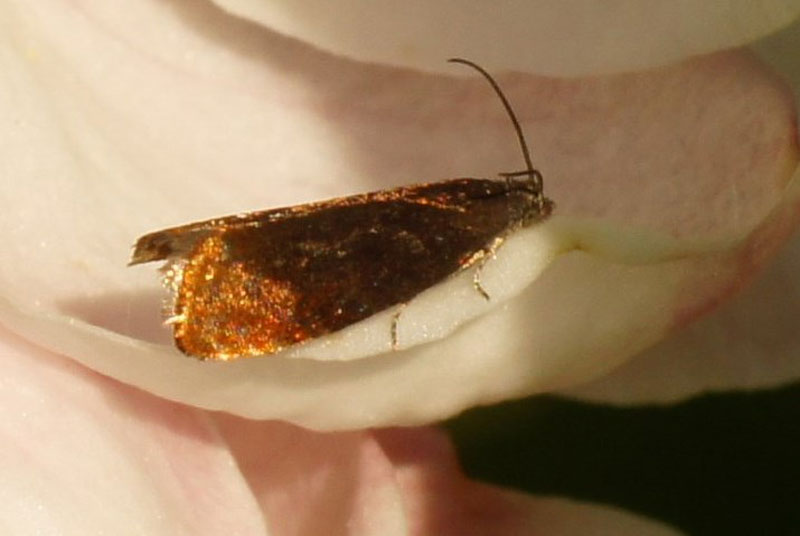
The largest part of the moth is dark purplish brown. The end of the wing is bright reddish brown. In this picture the flower of an apple tree.
Wingspan 9-12 mm. April-June. The caterpillars overwinter in a cocoon.
The larvae live in the fruits of hawthorn (Crataegus), but also in other fruit such as apple (Malus) or pear (Pyrus). Photo 20-4-2014. |
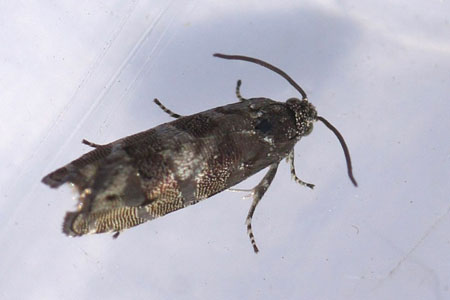 .. ..
 Pammene
splendidulana. Tribe Grapholitini. Subfamily Olethreutinae. Family tortrix moths, leafrollers (Tortricidae). Pammene
splendidulana. Tribe Grapholitini. Subfamily Olethreutinae. Family tortrix moths, leafrollers (Tortricidae).
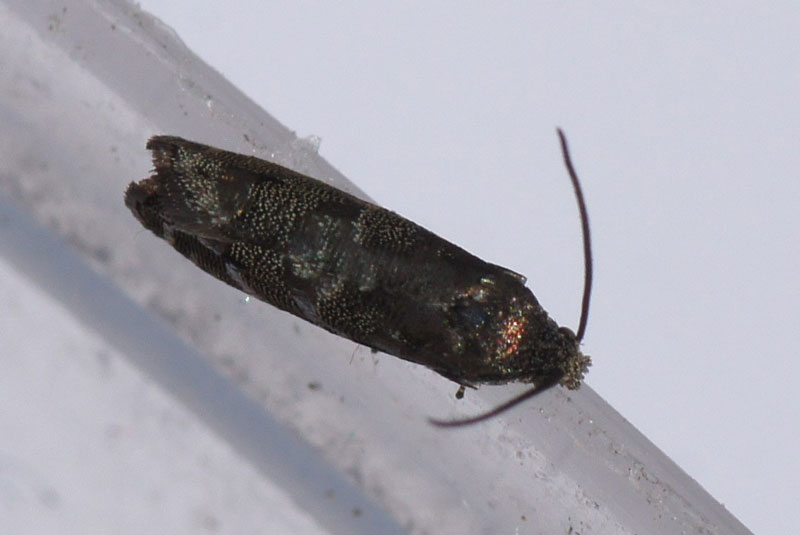
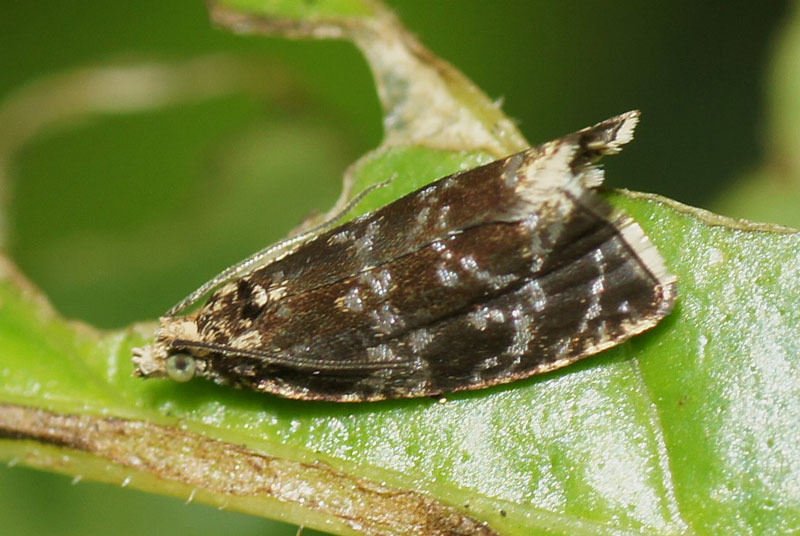
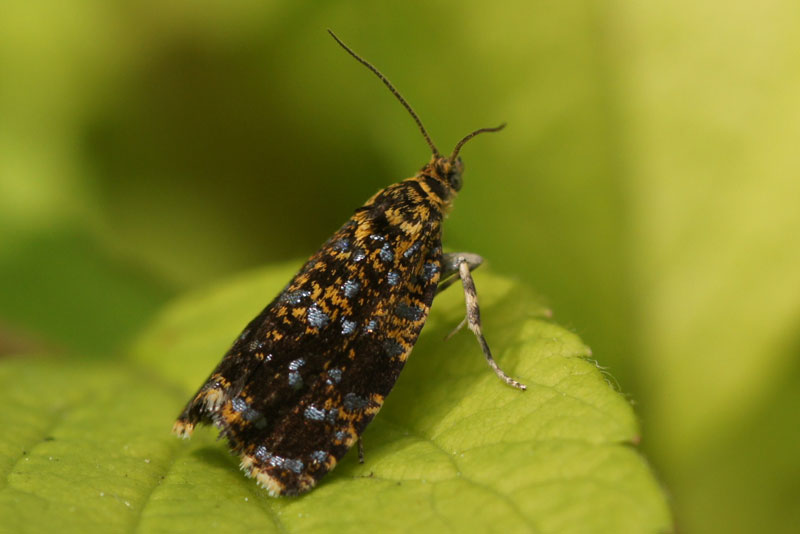
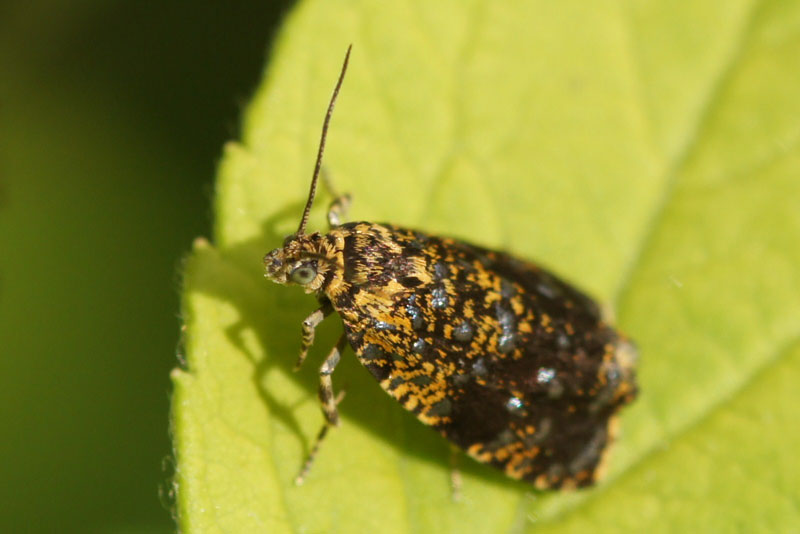
This dark brown leaf roller is easily recognizable by their shiny silvery small spots. A very beautiful leaf roller, unfortunately miny leafroller was very dark.
The larva feeds on oak (Quercus), where it spinstwo leaves together.
Wingspan 10-12 mm. April-June. The caterpillars overwinter in a cocoon. Photos 1-5-2015. |
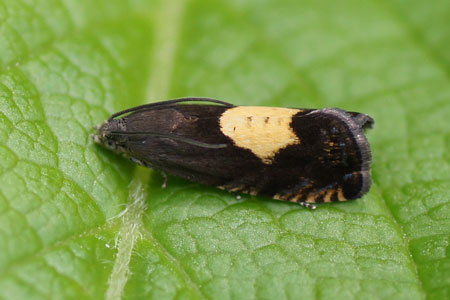 .. ..
 Pammene regiana. Tribe Grapholitini. Subfamily Olethreutinae. Family tortrix moths, leafrollers (Tortricidae). Pammene regiana. Tribe Grapholitini. Subfamily Olethreutinae. Family tortrix moths, leafrollers (Tortricidae).
It looks like the pammene trauniana but pammene trauniana is darker and the small stripes are shorter, thicker and more right on.
The larva feeds on several maple species such as norway maple (A. platanoides), sycamore maple (A. pseudoplatanus) en field maple (A. campestre).
Wingspan 11-13 mm. April-July. .The Pop overwinters in a cocoon. Palearctic. Photos 21-6-2015.
 19-7-2015 Much paler.
 |
Tribe Olethreutini.
 .. ..
 . .
 Darker. Dark Strawberry Tortrix (Celypha lacunana). Tribe
Olethreutini. Subfamily Olethreutinae. Family tortrix moths, leafrollers
(Tortricidae).
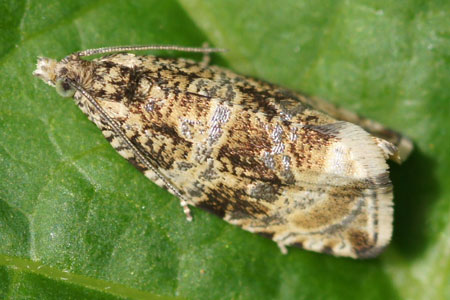
Darker. Dark Strawberry Tortrix (Celypha lacunana). Tribe
Olethreutini. Subfamily Olethreutinae. Family tortrix moths, leafrollers
(Tortricidae).
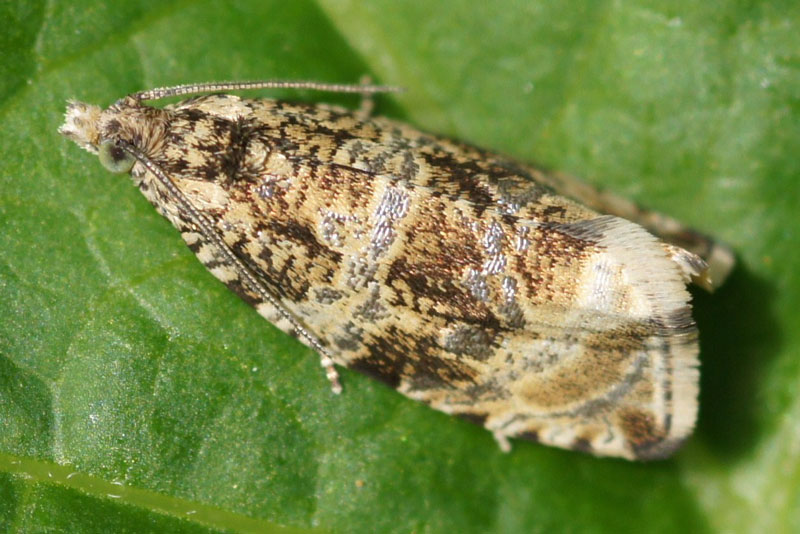
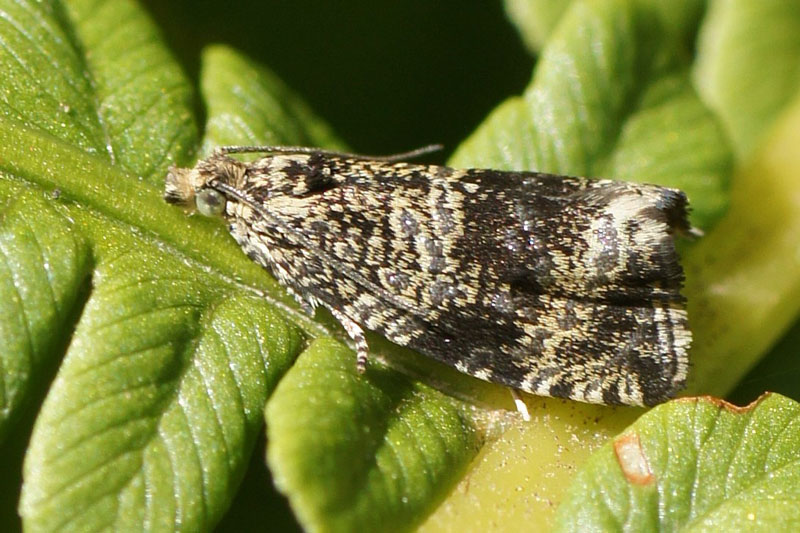
It is a beautiful small moth. Background colour: cream to olive gray. Transverse dark wavy lines with silver scales.
The not fully grown caterpillars hibernates in a cocoon. After the winter they fall down and pupates in a cocoon among the leaflitter.
It will eat from a great variety of plants, shrubs and trees.
April to September. Palearctic. In Europe it is a very common species. French: Tordeuse du fraisier. Photos 13-6-2014, 15-6-2014. |
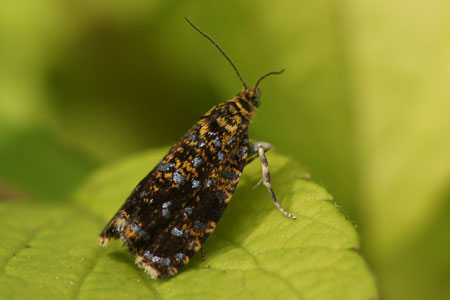 .. ..
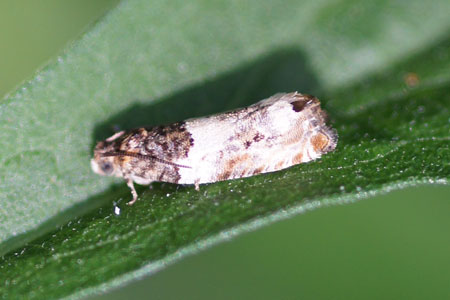
 Celypha
siderana. Tribe Olethreutini. Subfamily Olethreutinae. Family tortrix moths, leafrollers
(Tortricidae). Celypha
siderana. Tribe Olethreutini. Subfamily Olethreutinae. Family tortrix moths, leafrollers
(Tortricidae).
It is rather rare in the Netherlands. Wingspan 14-16 mm. May-July. Hostplants are spirea and goatsbeard
(aruncus). |
 .. ..
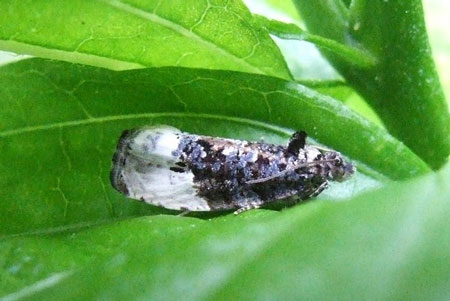
 Gypsonoma
dealbana. Tribe Olethreutini. Subfamily Olethreutinae. Family tortrix moths, leafrollers
(Tortricidae). Gypsonoma
dealbana. Tribe Olethreutini. Subfamily Olethreutinae. Family tortrix moths, leafrollers
(Tortricidae).
On the front of the head it has a white patch, That distinguished the Gypsonoma dealbana from the other Gypsonoma soecies.
Wingspan 11-14 mm. The larvae feed on the leaves, buds and young shoots of many deciduous trees. July-August. Photo 3-7-2011. |
 .. ..
 Marbled Orchard Tortrix, Green Budworm Moth, Marbled Orchard Tortrix, Green Budworm Moth
(Hedya nubiferana). Tribe Olethreutini. Subfamily Olethreutinae. Family tortrix moths, leafrollers
(Tortricidae). Marbled Orchard Tortrix, Green Budworm Moth, Marbled Orchard Tortrix, Green Budworm Moth
(Hedya nubiferana). Tribe Olethreutini. Subfamily Olethreutinae. Family tortrix moths, leafrollers
(Tortricidae).
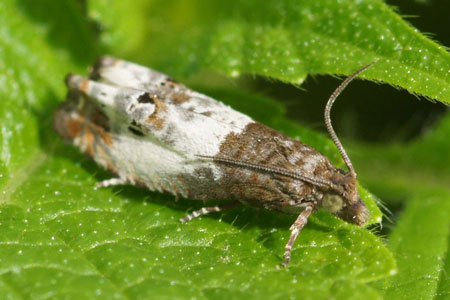
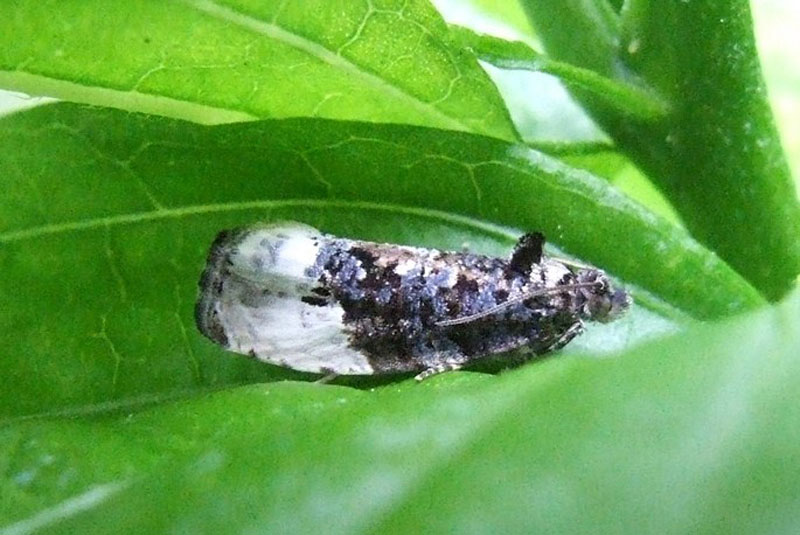
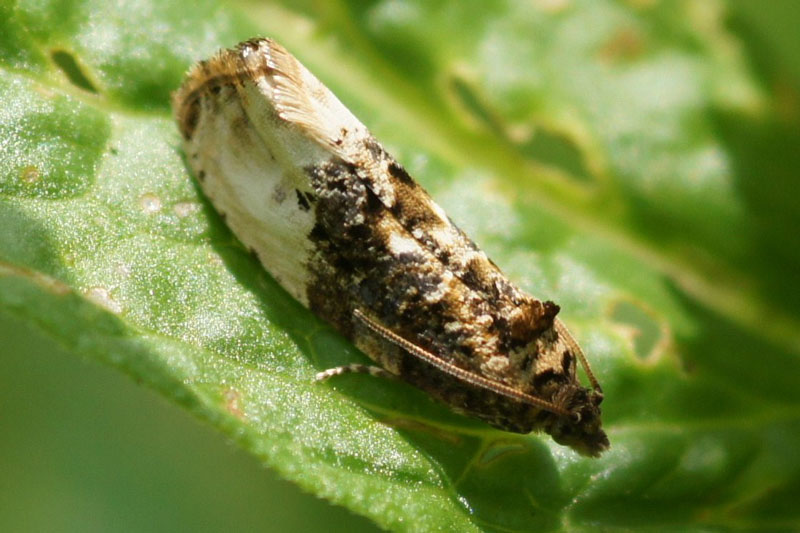
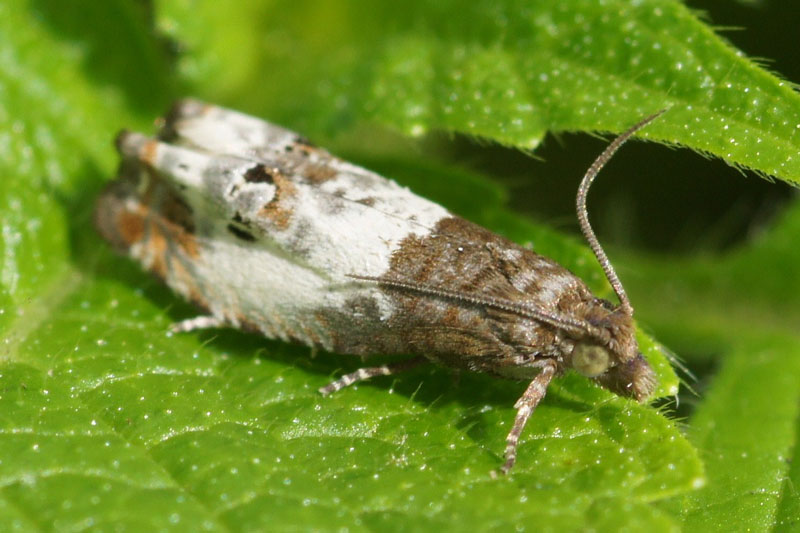
One of some similar species Hedya.
Hedya ochroleucana has a large round black spot in the middle, almost always more than half free. The white has a cream color.
Hedya pruniana has a small black spot in the wing section (apex), and slightly larger wings and the border black / white isn't curved.
Hedya nubiferana, two black dots in the middle of the wing. (The colour of the moths in both pictures is different, but the two black dots are clear.)
Wingspan: 15-21 mm. May-August. It flies from dusk into the night
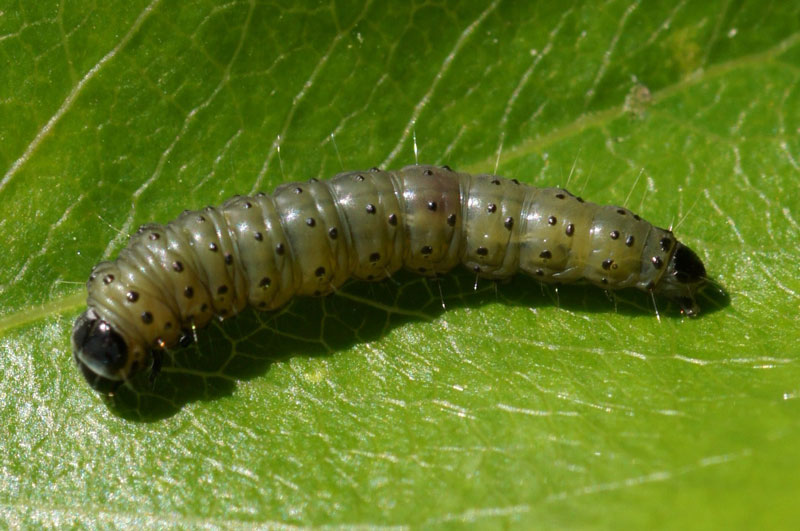
Caterpillars: June - autumn. The caterpillars overwinter.
The caterpillar can be found in rowan and hawthorn, but also in apple-pear and plum trees. It damages the fruit and is therefore seen as harmful.
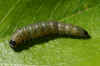 caterpillar 5-5-2010.
 |
 .. ..
 Notocelia
rosaecolana. Tribe Olethreutini. Subfamily Olethreutinae. Family tortrix moths, leafrollers
(Tortricidae). Notocelia
rosaecolana. Tribe Olethreutini. Subfamily Olethreutinae. Family tortrix moths, leafrollers
(Tortricidae).
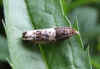
Similar to the Notocelia trimaculana and Notocelia roborana.
Wingspan 16-20 mm. May-August. It is found in the Palearctic ecozone ( Europe, Asia, northern Africa). The larvae feed on various roses. |
Subfamily
Tortricinae.
Tribe Archipini.
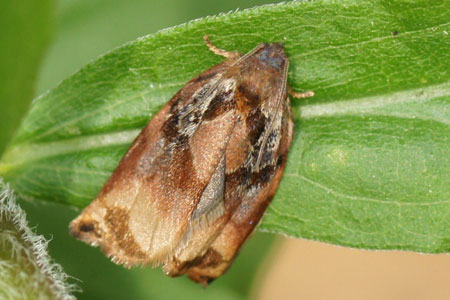 .. ..
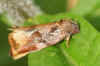 Large Fruit-tree Tortrix (Archips podana). Tribe
Archipini. Subfamily Tortricinae. Family tortrix moths, leafrollers (Tortricidae).
Large Fruit-tree Tortrix (Archips podana). Tribe
Archipini. Subfamily Tortricinae. Family tortrix moths, leafrollers (Tortricidae).
An ocher-colored to reddish brown moth. Males are darker than females.
Host plants: Fruit trees such as apple, pear, plum. They can do damage, because the caterpillars eat the young fruits. But other trees, shrubs and beech, rose.
June to September. One generation in the northern Netherlands. Sometimes two generations in the south. The caterpillars
overwinter. Wingspan females: 20-28 mm. Males: 19-23 mm. Europe, Asia Minor. Now also in North America. Photos 29-6-2012. French: Tordeuse des fruits, Tordeuse de
l'osier.
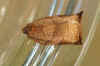 Female. Photo 22-7-2013.
 |
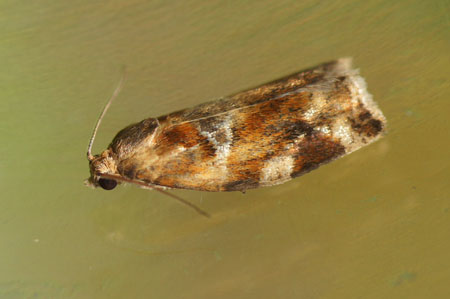 Variegated Golden Tortrix, Brown Oak Tortrix (Archips xylosteana). Tribe Archipini. Subfamily Tortricinae. Family tortrix moths, leafrollers
(Tortricidae). Variegated Golden Tortrix, Brown Oak Tortrix (Archips xylosteana). Tribe Archipini. Subfamily Tortricinae. Family tortrix moths, leafrollers
(Tortricidae).
The basic colour of the fore wings varies from yellow-brown or ocher to reddish brown, mottled with pale brown markings.
Wingspan 15-23 mm. June-August. The caterpillars overwinter.
Host: Various deciduous trees, shrubs and herbaceous plants. For example, oak, elm, maple, fruit trees (apple, pear). Europe, Asia. Photo 18-7-2013. |
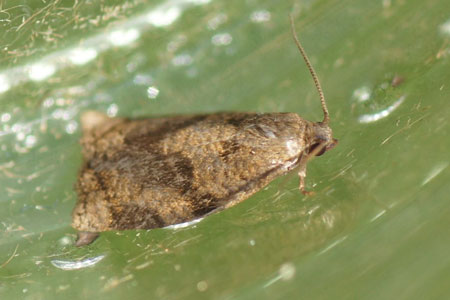 Rose Tortrix (Archips rosana). Tribe Archipini. Subfamily Tortricinae. Family tortrix moths, leafrollers
(Tortricidae). Rose Tortrix (Archips rosana). Tribe Archipini. Subfamily Tortricinae. Family tortrix moths, leafrollers
(Tortricidae).
The basic colour of the fore wings varies from brownto reddish brown, mottled with pale brown markings.
Wingspan. 15-24 mm. May-Augustus. The caterpillars overwinter.
Host: Privet, cultivated rose, leaves, fruits of pear (Pyrus) and apple (Malus). Palearctic and nearctic. Photo 18-7-2013. |
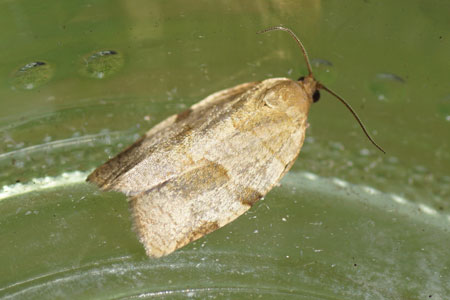 Mountain-ash tortricid (Choristoneura
hebenstreitella). Tribe Archipini. Subfamily Tortricinae. Family tortrix moths, leafrollers
(Tortricidae).
Mountain-ash tortricid (Choristoneura
hebenstreitella). Tribe Archipini. Subfamily Tortricinae. Family tortrix moths, leafrollers
(Tortricidae).
The forewings are sandy with a darker grey-brown pattern. Wingspan 19-30 mm. Females are generally larger than the males. May-July.
Host: Different types of deciduous trees (such as oak and birch) and low plants. Europe, Near East. Photo 24-6-2019. |
 .. ..
 . .
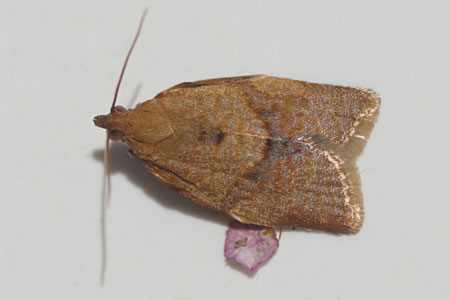
 Clepsis consimilana. Tribe Archipini. Subfamily
Tortricinae. Family tortrix moths, leafrollers (Tortricidae).
Clepsis consimilana. Tribe Archipini. Subfamily
Tortricinae. Family tortrix moths, leafrollers (Tortricidae).
The front wings are reddish brown, orange brown with on the hind edge two dark spots.
Wingspan 13-19 mm. June - September. Host: privet, various trees, shrubs. Such as privet, lilac, ivy, honeysuckle, apple. The caterpillars have a preference for dead leaves.
Europe, Asia Minor, North Africa, United States. Photos 22-7-2013, 20-6-2018. |
 .. ..
 . .  Red-barred Tortix (Ditula angustiorana). Tribe Archipini. Subfamily Tortricinae. Family tortrix moths, leafrollers (Tortricidae). Red-barred Tortix (Ditula angustiorana). Tribe Archipini. Subfamily Tortricinae. Family tortrix moths, leafrollers (Tortricidae).
A beautiful moth with a "crest".
Host plants: shrubs as well many different kinds of trees. May-August. One generation. The male is also active in sunshine.
Wingspan: 12-18 mm. Europe, North America. Photos 9-7-2011, 15-7-2011. |
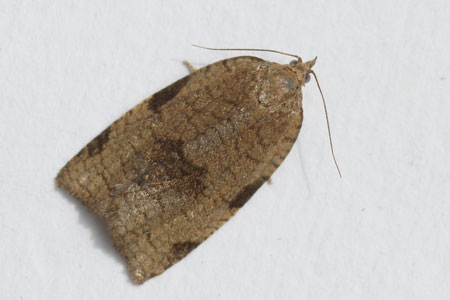 .. ..
 Lozotaenia
forsterana. Tribe Archipini. Subfamily Tortricinae. Family tortrix moths, leafrollers
(Tortricidae). Lozotaenia
forsterana. Tribe Archipini. Subfamily Tortricinae. Family tortrix moths, leafrollers
(Tortricidae).
A large leaf roller. He looks like a small owlet moth.. Light grey or light brown wings with two dark spots on the front and a dark spot on the back. Host plants: A preference for ivy. But also other shrubs and trees.
Wingspan: 20-29 mm. June-August. Europe, parts of Asia. Photos 29-6-2012. |
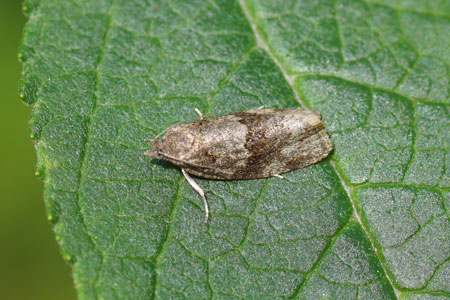 Dark-barred Tortrix (Syndemis musculana). Tribe
Archipini. Subfamily Tortricinae. Family tortrix moths, leafrollers (Tortricidae).
Dark-barred Tortrix (Syndemis musculana). Tribe
Archipini. Subfamily Tortricinae. Family tortrix moths, leafrollers (Tortricidae).
The colour of the forewings varies from whitish grey to brownish grey, with darker markings.
Host plants: All kinds of trees, shrubs, herbs and grasses such as blackberry, birch, oak.
Wingspan 15-22 mm. One generation. It overwinters as a fully grown caterpillar. April-July.
Europe, Asia, North-America. Photo 22-5-2022. |
Tribe Cnephasiini.
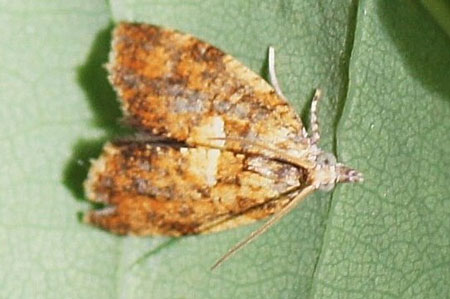 Pseudargyrotoza
conwagana. Tribe Cnephasiini. Subfamily Tortricinae. Family tortrix moths, leafrollers
(Tortricidae). Pseudargyrotoza
conwagana. Tribe Cnephasiini. Subfamily Tortricinae. Family tortrix moths, leafrollers
(Tortricidae).
A somewhat worn out small leaf roller, but it's my only photo. It has yellowish orange brown forewings with silvery shimmering spots and with a usually conspicuous pale yellow dorsal blotch.
Host plants: Ash and privet. Wingspan 11-15 mm. One generation. It overwinters as a pupa. May - August. Europe. Photo 10-6-2014. |
Tribe Cochylini.
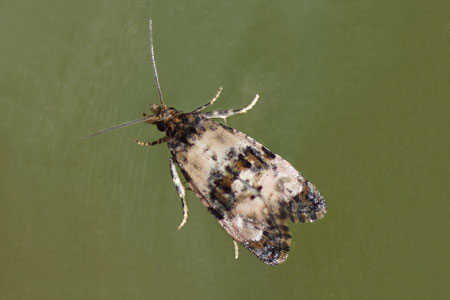 .. ..
 Black-headed conch
(Cochylis atricapitana). Tribe Cochylini. Family tortrix moths, leafrollers
(Tortricidae).
Black-headed conch
(Cochylis atricapitana). Tribe Cochylini. Family tortrix moths, leafrollers
(Tortricidae).
Light grey-brown with dark brown head, thorax and wing tips and a dark brown cross band in the center of the wings.
Host plants: ragwort (Jacobaea vugaris). Also Hypericum and Hieracium. Larvae in flowers in July and
later in the main stem.
Wingspan 12-16 mm. One generation. It hibernates in a cocoon. May-August. Two generations. Europe. Photo 6-8-2020.
|
Tribe Tortricini.
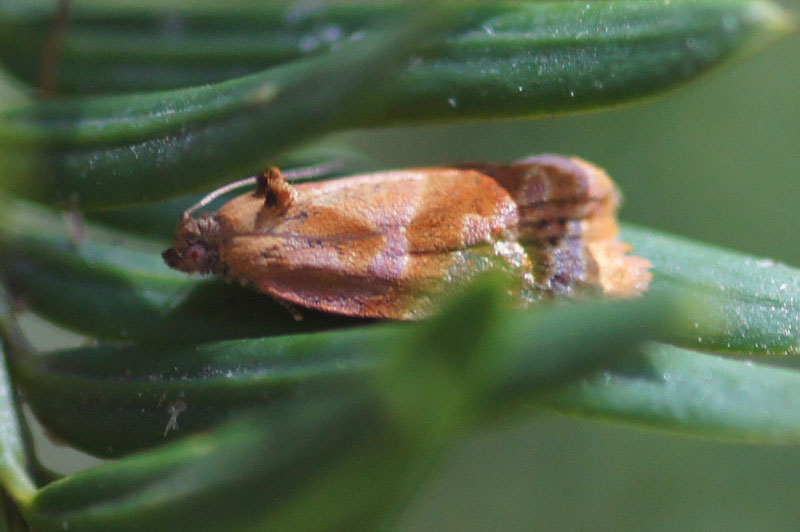
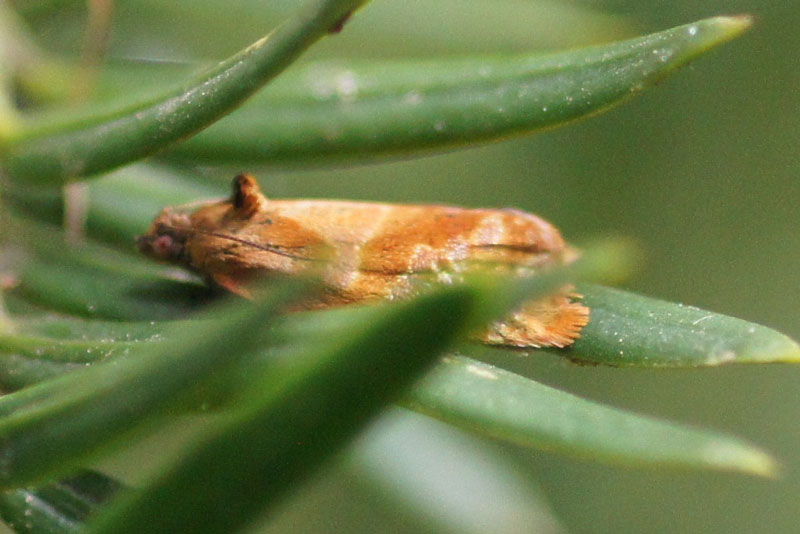
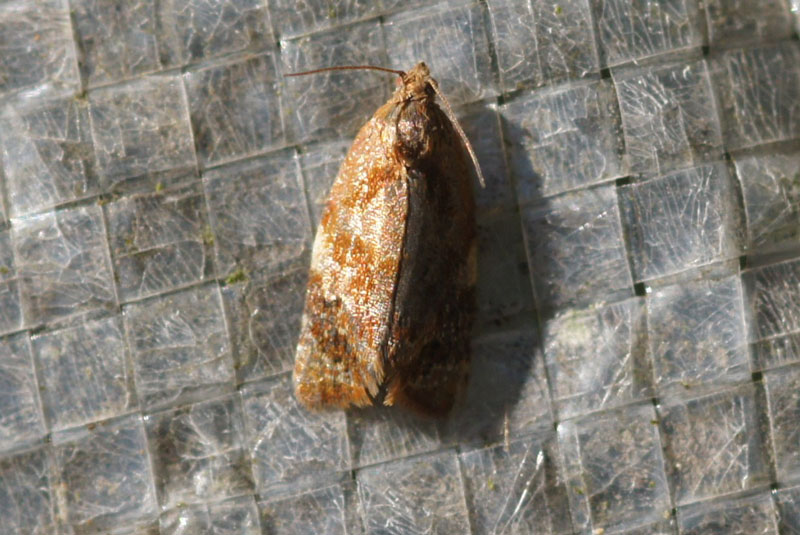
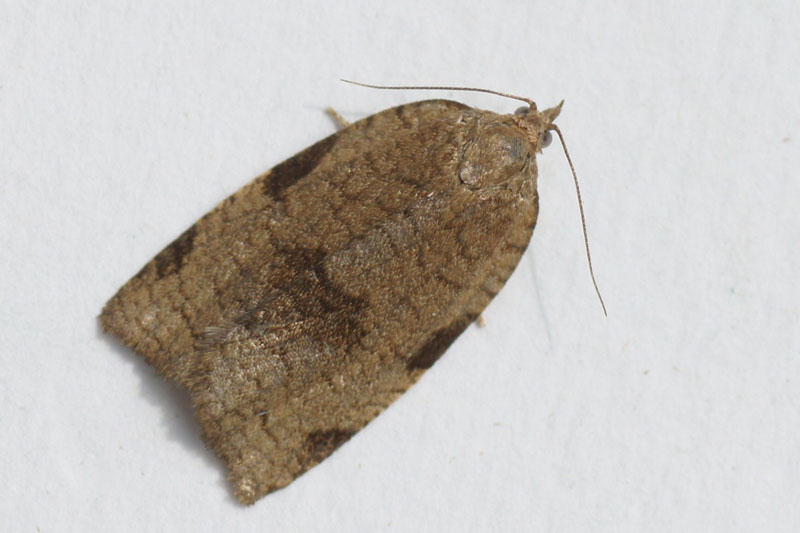
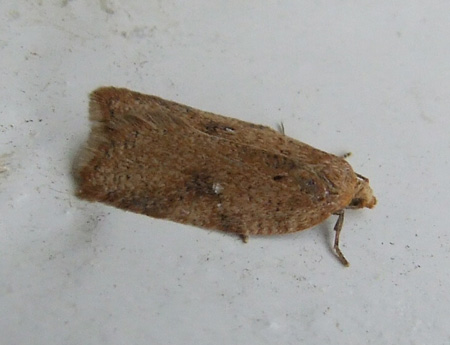 ..Acleris notana /
Acleris ferrugana. Tribe Tortricini. Subfamily Tortricinae. Family tortrix moths, leafrollers (Tortricidae). ..Acleris notana /
Acleris ferrugana. Tribe Tortricini. Subfamily Tortricinae. Family tortrix moths, leafrollers (Tortricidae).
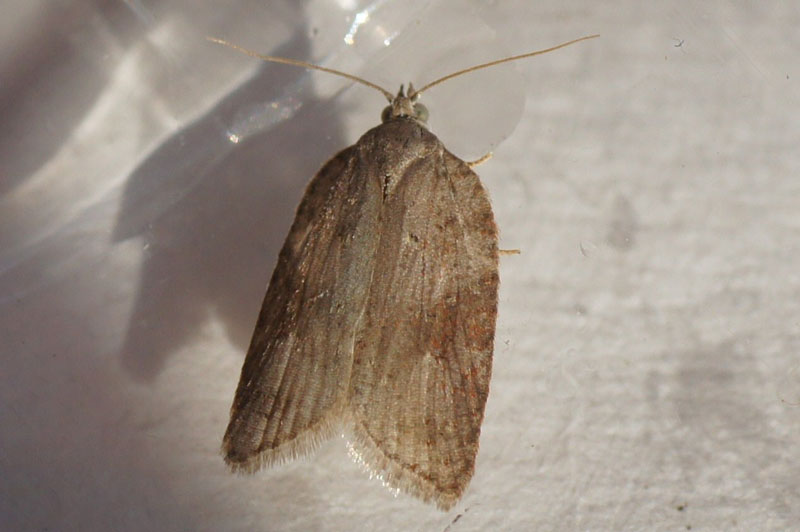
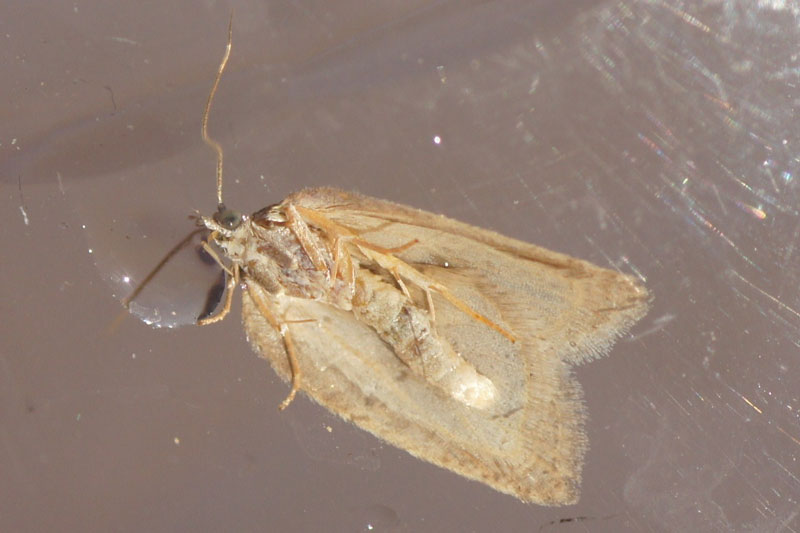
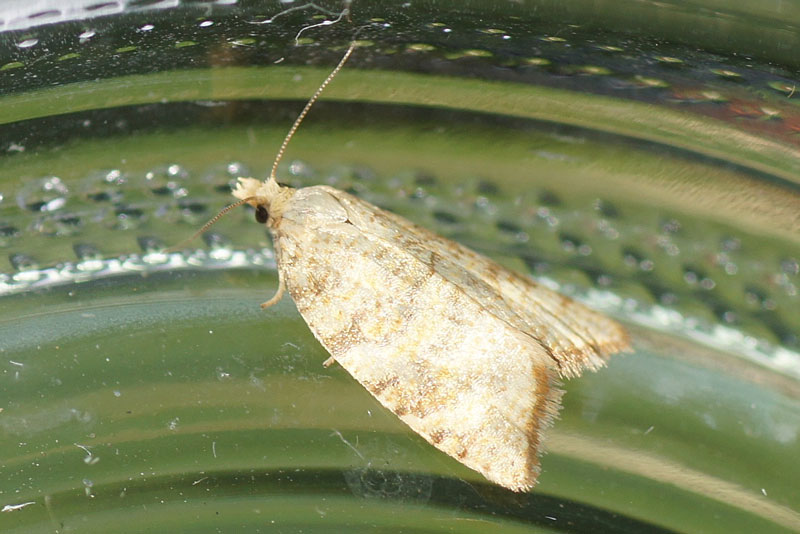
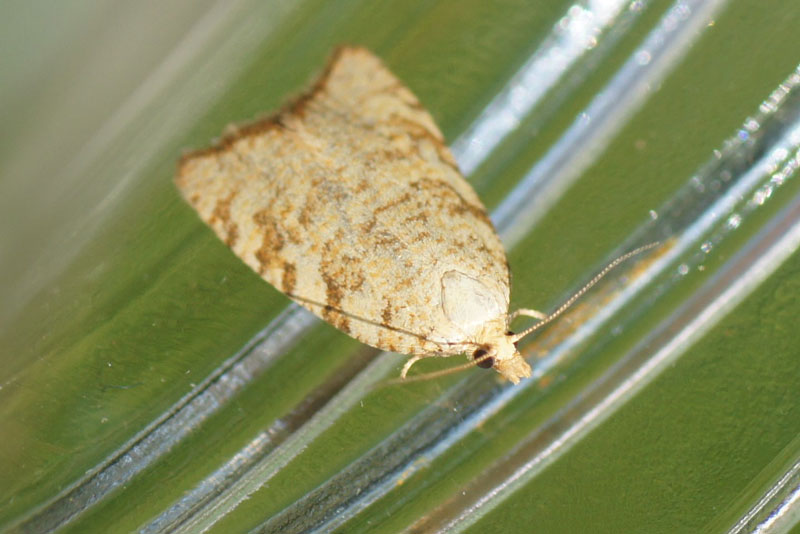
Two very similar species. And also very variable. The Acleris on the photo is perhaps Acleris notana, as Acleris ferrugana never gets that dark.
They can be brown, but they can also have a dotted pattern. The dark half circle near the edge of the upperwing can be lacking. The legs are ringed.
Wingspan: 14-18 mm. Two generations a year. First: April-June. The second generation overwinters.
This moth I found in February. A the day before there was frost. German: Admiral French: Vulcain.
|
 .. ..
 . .
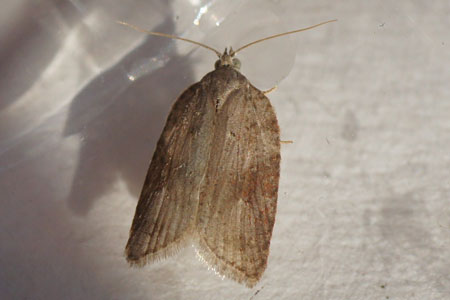
 Acleris
sparsana. Tribe Tortricini. Subfamily Tortricinae. Family tortrix moths, leafrollers
(Tortricidae). Acleris
sparsana. Tribe Tortricini. Subfamily Tortricinae. Family tortrix moths, leafrollers
(Tortricidae).
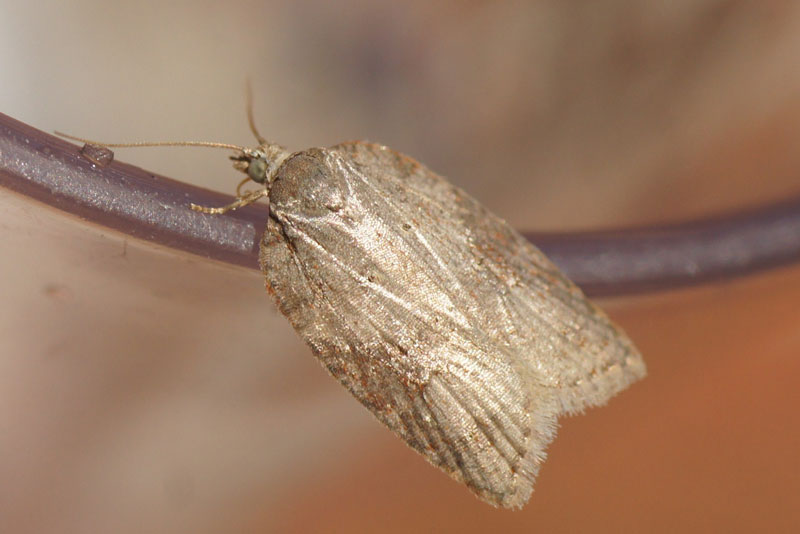
A variable grey moth. Sometimes with a triangular mark on the upper wings.
Wingspan 18-22 mm. June-April. The adult overwinters. Caterpillar: Several trees including maple, beech, oak, birch. Photos 31-10-2012. |
 .. ..
 . .
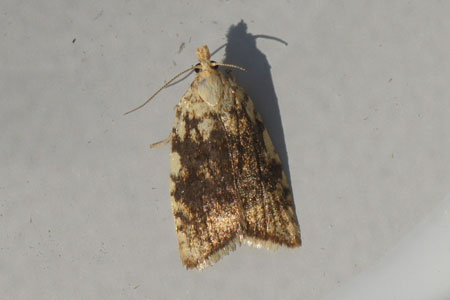
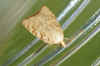 Aleimma loeflingiana. Tribe Tortricini. Subfamily Tortricinae. Family tortrix moths, leafrollers
(Tortricidae).
Aleimma loeflingiana. Tribe Tortricini. Subfamily Tortricinae. Family tortrix moths, leafrollers
(Tortricidae).
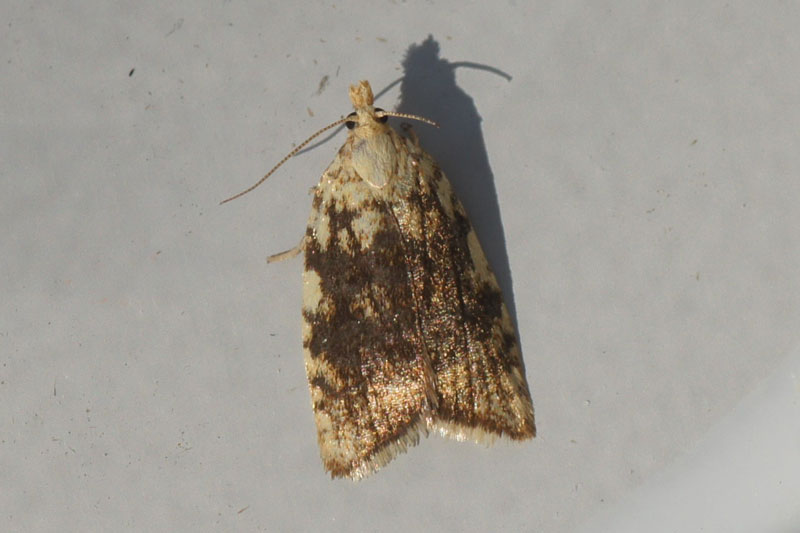
The wings are white brown with dark brown spots, but there is also a much lighter form like the leaf roller on the small pictures.
Wingspan 14-19 mm. June-Augustus. The eggs overwinter.
Host: oak, hornbeam, maple. Europa, Near East. Photos 15-7-2013. |
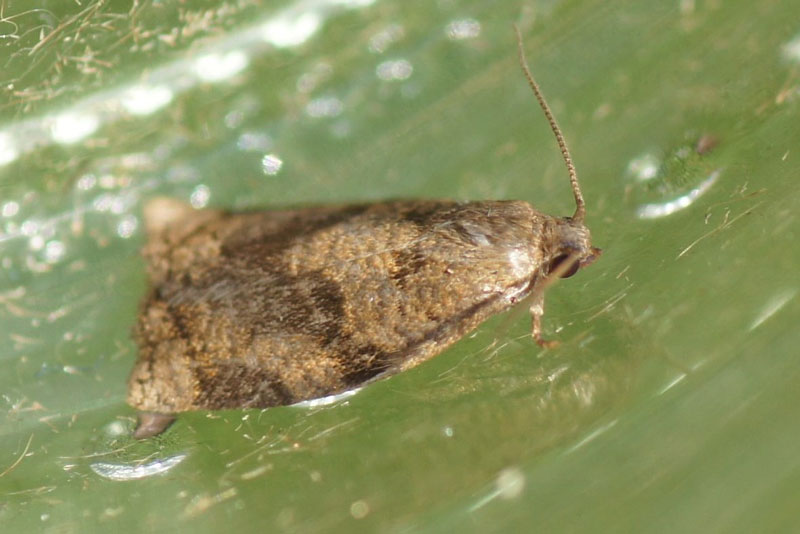
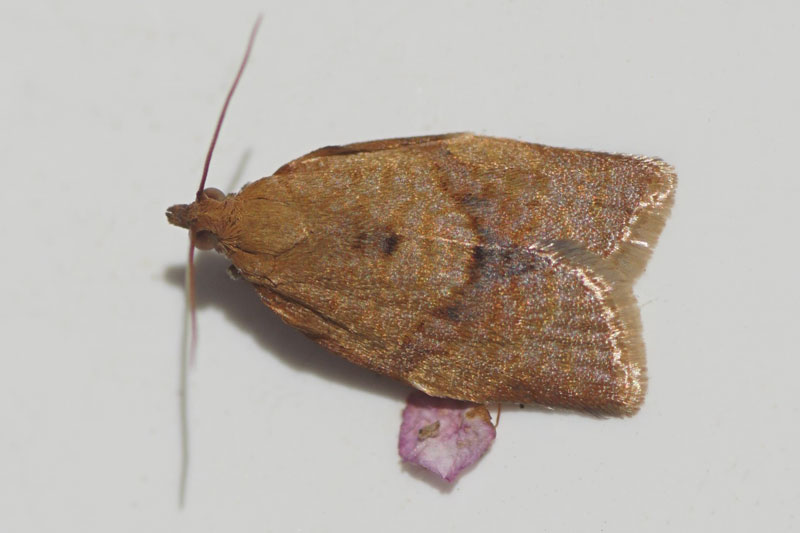
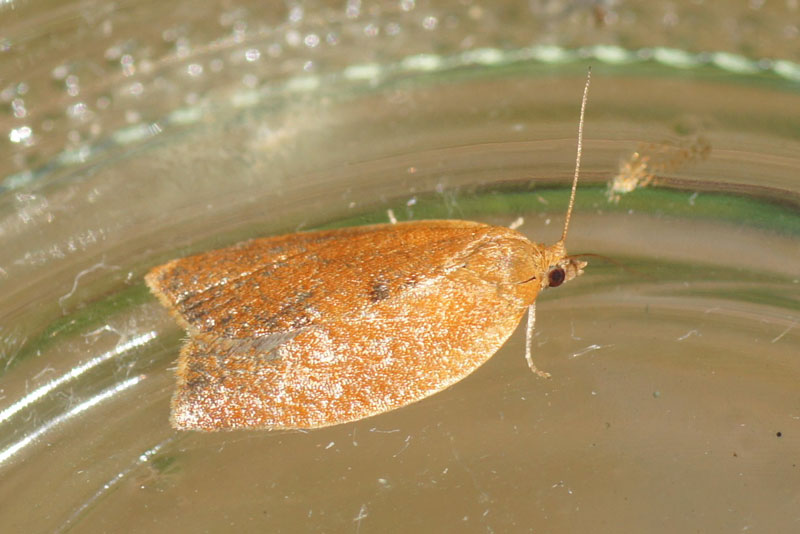
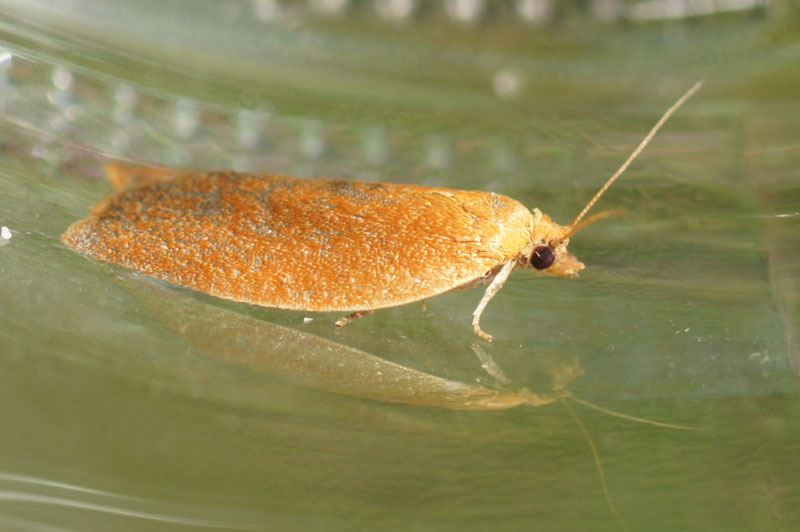
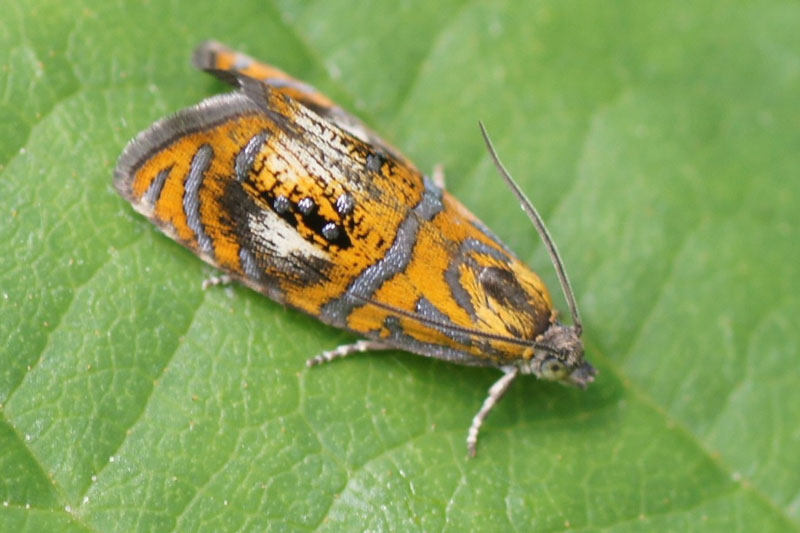
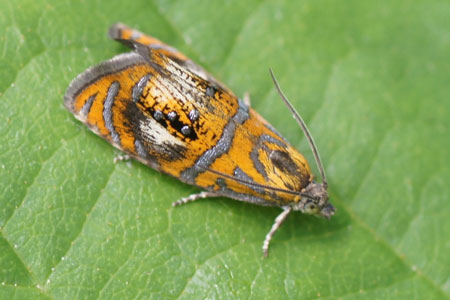 Arched Marble (Olethreutes arcuella). Tribe Tortricini. Subfamily Tortricinae. Family tortrix moths, leafrollers
(Tortricidae). In the dunes about 4 km from our home. Arched Marble (Olethreutes arcuella). Tribe Tortricini. Subfamily Tortricinae. Family tortrix moths, leafrollers
(Tortricidae). In the dunes about 4 km from our home.
A striking orange moth with metallic blue gray stripes and white-yellow spots.
Wingspan 14-18 mm. May-September. A day-flying moth and often sunning on leaves.
The caterpillar feeds on fallen leaves and leaves low on plants and overwinters. In the spring it pupates.
Woodlands. Palearctic. German: Prachtwickler. French: Tordeuse de l’œillet. |
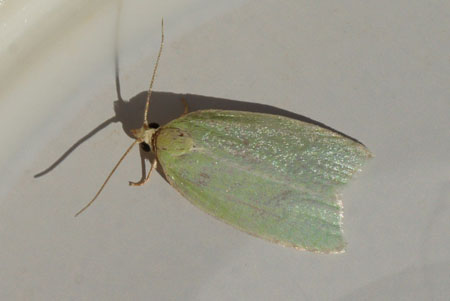 European oak leafroller, green oak moth ( Tortrix viridana). Tribe Tortricini. Subfamily Tortricinae. Family tortrix moths, leafrollers
(Tortricidae). The forewings are pale green to grass green. European oak leafroller, green oak moth ( Tortrix viridana). Tribe Tortricini. Subfamily Tortricinae. Family tortrix moths, leafrollers
(Tortricidae). The forewings are pale green to grass green.
Wingspan 16-24 mm. June August. The eggs overwinter.
Host: Particularly oak. Palearctic. Photo 6-7-2015. German: Eichenwickler. French: Tordeuse verte du chên. |
Nederlands /
Dutch
 
Subpage France: Insects
France
Subpage butterflies and
moths:
Butterflies
Owlet
moths, Noctuidae Geometer
moths Pyralidae,
Crambidae Concealer
moths, Oecophoridae
|










 www.microlepidoptera.nl